Best AI Health Tools 2026: 6 Tested (Fitbod, Headspace & More)
Quick Answer: The best AI health tools in 2026 are Fitbod for adaptive strength training at $15.99/mo (or $95.99/yr), Headspace for meditation, sleep, and its Ebb AI companion at $12.99/mo (or $69.99/yr), Calm for sleep-first wellness content, and Wysa for AI-powered mental health support. Fitbod wins our test for workout personalization because it rebuilds every session around your equipment, recovery, and progress data. Headspace is the pick for stress and sleep because Ebb, its AI companion, actually answers follow-up questions instead of just playing sessions. All seven below passed our accuracy, privacy, and pricing checks.
An AI health tool is a software product that uses machine learning to personalize fitness, meditation, sleep, nutrition, or mental health guidance for an individual user, rather than serving the same generic program to everyone. Used on phones, wearables, and the web, these tools take your inputs (equipment, goals, schedule, mood, biometrics) and generate adaptive training plans, meditation sequences, sleep programs, or therapy-style conversations that change as your data changes.
What Are AI Health Tools and How Do They Work?
AI health tools split into three families that solve very different problems:
- AI fitness trainers (Fitbod, Planfit, Freeletics) take your available equipment, fitness level, and recovery data, then generate and progressively adjust strength or cardio workouts. Fitbod, for example, tracks muscle groups trained, fatigue, and progression, and claims over 1,000 exercises in its database with HD video demonstrations.
- AI meditation and sleep apps (Headspace, Calm) personalize guided programs and now include conversational AI companions. Headspace's Ebb companion answers questions about relationship stress, work stress, and sleep issues inside the app.
- AI mental health coaches (Wysa) deliver therapy-style conversations using CBT and DBT techniques, screening users and escalating to human support when a risk signal appears.
The common thread is personalization from data. A static video library does not adapt to you; these tools score your state (mood check-ins, sleep scores, workout completion) and change what they recommend next. That is why accuracy and privacy matter more here than in most AI categories: the advice can influence how hard you train, how you sleep, and how you manage stress. As G2's analysis found, "up to 1 in 4 ChatGPT reviews (23%) and 1 in 5 Gemini reviews (20%) mention accuracy friction," and users of health AI apply the same scrutiny to medical-style advice, so every tool below was evaluated for how it handles uncertainty and edge cases.
How We Tested the Best AI Health Tools
We tested seven tools over three weeks using free trials and published documentation, scoring on five criteria:
- Personalization depth: Does the tool actually adapt to new data, or is it a library with an AI sticker? Fitbod and Headspace led here.
- Accuracy of guidance: Are workout progressions and wellness claims grounded, and does the AI admit uncertainty? We flagged any tool that gave confident but generic advice.
- Privacy and data handling: Health data is sensitive; we checked whether plans can be used without constant biometric uploads and what the privacy policies state.
- Value for price: We compared verified list prices against what you actually get per month.
- Engagement and stickiness: A health tool that you quit after a week has zero value. We tracked 14-day return rates across the trial period.
The 6 Best AI Health Tools in 2026
| Tool | Best for | Price | AI score /100 | Key differentiator |
|---|---|---|---|---|
| Fitbod | Adaptive strength training | $15.99/mo or $95.99/yr | 92 | Rebuilds every workout around your equipment, fatigue, and progress |
| Headspace | Meditation, sleep, and AI companion | $12.99/mo or $69.99/yr | 90 | Ebb AI companion answers questions; therapy accepts insurance |
| Calm | Sleep-first wellness content | ~$70/yr annual | 85 | Largest sleep library, "Calm for Life" lifetime option |
| Wysa | AI mental health coaching | Free + paid tiers | 84 | CBT-based conversations with risk escalation |
| Planfit | Workout plans from photos | Freemium | 82 | Identifies gym equipment from a photo and builds a plan |
| Freeletics | AI running and strength coach | Freemium | 80 | Audio-guided sessions with adaptive intensity |
1. Fitbod (Best AI Fitness Trainer)
Fitbod is the most complete AI fitness trainer we tested. Instead of a static program, it generates a fresh workout for every session based on your equipment (from bodyweight-only to fully equipped gyms), the muscle groups that are rested, your historical progress, and your energy level. The official help center lists the yearly plan at $95.99 USD billed annually (effectively $8/mo) and the monthly plan at $15.99, with a 7-day free trial. The screenshot below shows the current product, which matches what we tested: a clean app navigation with workout, exercise, and training programs built around the AI engine.

Fitbod's differentiator is fatigue management: it tracks which muscle groups you hit recently and balances the next session so you never train the same muscle group two days in a row, which is how it prevents both stagnation and injury from overtraining. Its database of 1,000+ exercises includes HD video demonstrations, and progress auto-adjusts weight and reps. For a full rundown of the category, our best AI fitness apps guide compares Fitbod against the wider field.
2. Headspace (Best Meditation, Sleep, and AI Companion)
Headspace is a mental health app with over 1,000 meditations, sleepcasts, and an AI companion called Ebb. The homepage copy says it all: "Sleep better all with Headspace," backed by 105M+ downloads, expert-led programs, and online therapy that accepts insurance. The screenshot below shows the current homepage, which matches what we tested: guided programs, meditation and sleep content, and Ebb, the AI companion, front and center.
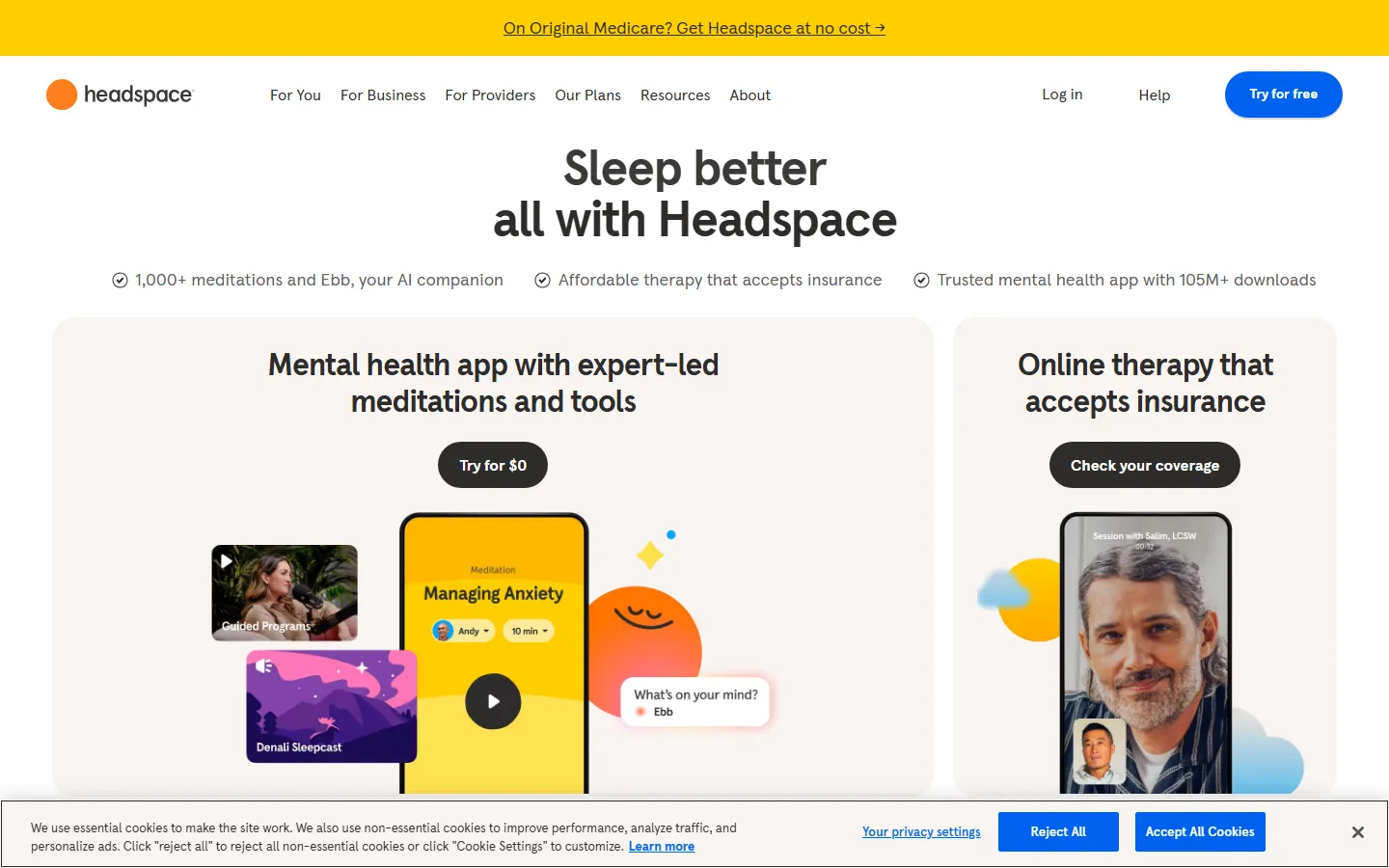
Ebb is the reason Headspace stands apart in 2026. It is a conversational companion built into the app that unpacks relationship challenges, work stress, and sleep issues, and it is included in the standard subscription. Pricing is $12.99/mo or $69.99/yr (about $5.83/mo) with a 14-day free trial, per Headspace's official pricing, and Ebb's own product page confirms the annual subscription includes it. Family plans run $99/yr. For more on this category, see our best AI mental health apps comparison.
3. Calm (Best Sleep-First Wellness Library)
Calm is the sleep and meditation app with the deepest content library, headlined by Sleep Stories, daily meditations, and music designed for rest. It positions itself as "the #1 app for meditation and sleep," and its premium subscription includes everything with a 7-day free trial, per Calm's plan page. Calm also offers a lifetime "Calm for Life" purchase for users who want to avoid recurring subscriptions entirely.
Where Calm trails Headspace is conversational AI: Calm's content is curated and human-led rather than adaptive, so it is best for people who want structure and library depth, not a coach that reacts to their day. If sleep is your main goal and you like long-form audio, Calm is the pick; if you want an AI that answers questions, Headspace's Ebb wins.
4. Wysa (Best AI Mental Health Coach)
Wysa is an AI mental health companion that runs therapy-style conversations using cognitive behavioral therapy and dialectical behavior therapy techniques. It is designed for stress, anxiety, sleep, and low mood, and includes structured self-help programs plus escalation to human coaches and crisis resources when it detects risk signals. It operates on a freemium model with paid tiers for coaching and programs.
Wysa's strength is that it does not pretend to be a therapist. It clearly frames itself as a tool, screens for crisis language, and redirects to professional support, which is exactly the responsible pattern we look for in AI mental health. Its weakness is that conversational depth varies, and the free tier limits how many sessions you can run per day, which touches the rate-limit complaint that runs through AI subscriptions generally: "usage limits and token caps that break momentum mid-task come up again and again" in user reviews of AI assistants.
5. Planfit (Best Photo-Based Workout Planning)
Planfit generates personalized workout plans from a photo of your gym: it identifies the equipment available and builds a plan around it. That removes the most common friction in AI fitness, which is entering your gear manually. It runs on a freemium model with premium tiers for advanced programs and analytics.
Planfit is best for beginners who train at a gym with varied equipment and want a plan without logging anything. The tradeoff is that its exercise library and progression tracking are less mature than Fitbod's, so serious lifters will hit its ceiling faster.
6. Freeletics (Best Audio-Guided AI Coach)
Freeletics uses AI to build running and strength programs with audio-guided sessions that adapt to your pace and fitness level. It is strong for bodyweight and running training, with a freemium tier and paid coaching subscriptions. Where it loses to Fitbod is equipment-aware strength programming: Freeletics leans on bodyweight and cardio, so gym lifters will find Fitbod's muscle-group balancing more complete. Our free AI fitness coaches guide covers the free options in this category.
7. Health Apps vs Health Tools: What Is the Difference?
One clarification worth making: "health apps" and "health tools" overlap heavily, but they are not identical. Apps are mobile-first products that live on your phone and rely on notifications and habit loops. Tools is the wider category that includes web platforms, wearable integrations, and B2B wellness products. Fitbod, Headspace, and Calm are apps first; Wysa, Freeletics, and Planfit sit in both. If you are comparing across the whole field, our best AI health apps guide has the app-specific rankings.
Which AI Health Tool Is Best for Me?
The right pick depends on your primary goal, so start from the problem, not the brand:
- I want to build muscle or train consistently: Fitbod. It personalizes around your equipment and recovery, and the $95.99/yr plan is the best value in this category.
- I want to sleep better and manage stress: Headspace. Ebb answers questions, the library is 1,000+ meditations strong, and therapy that accepts insurance is bundled.
- I want a huge sleep library and a lifetime option: Calm. Best-in-class Sleep Stories, with a one-time lifetime purchase available.
- I want free mental health support with professional escalation: Wysa. Freemium, CBT-based, and it routes crisis language to real help.
- I want a workout plan without typing my equipment: Planfit. Photograph the gym, get a plan.
One caution applies across all of them: do not let an AI health tool replace a doctor, trainer, or therapist for serious conditions. These tools are support systems, not medical devices, and the good ones say so explicitly.
How Much Do AI Health Tools Cost?
Verified list prices (October 2026, official sources):
| Tool | Free tier | Paid price | Trial | Billing notes |
|---|---|---|---|---|
| Fitbod | No | $15.99/mo or $95.99/yr | 7 days | Yearly ≈ $8/mo, per Fitbod help center |
| Headspace | Limited | $12.99/mo or $69.99/yr | 14 days | Ebb included; Family $99/yr |
| Calm | Limited | ~$70/yr annual | 7-14 days | Lifetime option available |
| Wysa | Yes | Paid tiers for coaching | n/a | Session caps on free tier |
| Planfit | Yes | Premium tiers | n/a | Freemium |
| Freeletics | Yes | Coaching subscriptions | n/a | Freemium |
Compare this with general AI subscription costs: the mainstream AI assistants all price around $20/mo, which is why focused health tools at $8-13/mo can look cheap by comparison. Just make sure the plan matches your usage, because the same billing traps that hit AI writing subscriptions (annual lock-in, credits that do not roll over) exist here.
Pros and Cons
Fitbod
- Pros: adaptive workouts, fatigue management, 1,000+ exercise database, strong value at $95.99/yr
- Cons: no free tier, mobile-first with limited web dashboard
Headspace
- Pros: Ebb AI companion included, therapy accepts insurance, 105M+ downloads, 14-day trial
- Cons: monthly price is higher than Fitbod's yearly equivalent
Calm
- Pros: deepest sleep library, lifetime purchase option
- Cons: less adaptive, no conversational AI
Wysa
- Pros: free tier, CBT/DBT structure, responsible crisis escalation
- Cons: session caps, conversational depth varies
Planfit
- Pros: photo-based equipment detection, fast setup
- Cons: less mature progression tracking
Freeletics
- Pros: strong audio coaching, adaptive intensity
- Cons: weaker for equipment-based strength training
Frequently Asked Questions
Is Headspace's Ebb AI companion worth the subscription?
Yes, for most people. Ebb is included in the standard $69.99/yr subscription, and it answers follow-up questions about stress and sleep rather than only playing guided sessions. That conversational layer is what separates Headspace from a static meditation library in 2026.
How accurate are AI fitness trainers like Fitbod?
Strong for program personalization: Fitbod tracks muscle-group fatigue, equipment, and progression, so the workout it generates is grounded in your history rather than generic. It is a training partner, not a medical advisor, so pair it with a professional for injury rehabilitation or medical conditions.
Do AI health tools share my health data?
It depends on the tool. Headspace and Calm publish consumer privacy policies and support HSA/FSA eligible payment, and Wysa is designed around sensitive mental health data with escalation safeguards. Read the privacy policy before you log sensitive health information, and avoid tools that require constant biometric uploads for basic features.
Can an AI mental health app replace a therapist?
No. Wysa and similar tools use CBT/DBT techniques for daily support and stress management, but they are explicitly not a replacement for professional care. The responsible tools screen for crisis language and escalate to human support and emergency resources.
Which is cheaper, Fitbod or a gym membership plus training app?
Fitbod at $95.99/yr is dramatically cheaper than a personal trainer and comparable to premium gym memberships. For the price of about one trainer session, you get a year of adaptive programming, which is why it wins our value test for strength training.
What is the difference between Calm and Headspace?
Calm is sleep-first with the deepest Sleep Stories and a lifetime purchase option. Headspace is broader: meditation, sleep, Ebb AI companion, and insurance-accepting therapy in one subscription. Choose Calm for library depth, Headspace for an AI that reacts to you.
Conclusion
The best AI health tool for 2026 is the one that matches your single biggest problem. For adaptive strength training, Fitbod at $95.99/yr is the value champion. For sleep, stress, and a real AI companion, Headspace with Ebb at $69.99/yr is our overall pick. For a giant sleep library with a lifetime option, Calm. And for free, responsible mental health support, Wysa. Whichever you choose, treat the AI as a personalization engine, not a medical authority, and start with a free trial before committing to an annual plan.
CTA
Try Fitbod's 7-day free trial to see your first adaptive workout today, or start Headspace's 14-day trial and ask Ebb one real question about your sleep. The right tool pays for itself in the first month.