Best AI Fitness Apps 2026: 10 Apps Tested & Compared
AI fitness apps are applications that generate personalized workout plans, adjust training loads and sometimes coach you in real time, using algorithms trained on your goals, equipment, training history and recovery data. This guide ranks the ten most-used apps in 2026 by real App Store ratings and verified pricing, then matches each app to the situation where it actually wins.
Quick Answer: The Best AI Fitness App for You in 2026
Short version: Fitbod for gym strength training, Planfit if you want a genuinely free plan, JuggernautAI for powerlifting, Freeletics for bodyweight training, Alpha Progression for hypertrophy on a budget, and SensAI if you own a wearable and want recovery-aware programming. Fitbod is the safest all-round pick: 4.8 stars across 284,104 App Store ratings, an exercise library over 1,000 movements, and AI that re-plans every session from your logged sets and per-muscle recovery (Fitbod). Prices were verified against official sites and App Store listings in July to September 2026 and range from free to $49.99/month. If you are not training for a specific goal, start with Fitbod's 7-day free trial and decide from there.
How We Ranked the Apps
Ranking by "who has the best AI" is marketing noise, so this guide ranks by real usage: App Store rating count as of 12 September 2026, re-verified on 15 October 2026 (SensAI's 2026 comparison). Subscription prices were pulled from each app's US App Store listing in July 2026 and cross-checked against official sites and independent reviews (CoachConnect's pricing table). The result is a usage-ranked list where the AI tier, wearable support and price are reported separately from popularity, because a 4.8-star app with 5,000 ratings is not the same as one with 284,000.
| Rank | App | Best For | Price (verified 2026) | App Store Rating |
|---|---|---|---|---|
| 1 | Fitbod | Gym strength logging | $12.99-15.99/mo or $79.99-95.99/yr | 4.8 (284,104) |
| 2 | SmartGym | Apple ecosystem | Free; Premium+ $9.99/mo | 4.7 (33,621) |
| 3 | Freeletics | Bodyweight training | From $34.99/quarter | 4.6 (22,249) |
| 4 | Planfit | Free personalized plans | Free; premium from $11.99/mo | 4.8 (8,051) |
| 5 | JuggernautAI | Powerlifting | $34.99/mo or $349.99/yr | 4.8 (5,654) |
| 6 | Alpha Progression | Hypertrophy value | $12.99/mo or $79.99/yr | 4.9 (2,154) |
| 7 | Dr. Muscle | Automated progressive overload | $49.99/mo or $399.99/yr | 4.5 (382) |
| 8 | Ray | Conversational coaching | $19.99/mo or $119.99/yr | 4.8 (293) |
| 9 | SensAI | Recovery-aware AI coaching | $6.99/mo or $69.99/yr | 4.6 (early) |
| 10 | Arvo | Apple Watch-native lifting | $3.99/mo or $29.99/yr | 2.4 (9) |

Fitbod generates each workout from your goals, equipment and logged recovery, not from a static plan.
The Apps, Reviewed by Use Case
Fitbod: Best for Gym Strength Training
Fitbod is an AI-powered resistance training app with more than 15 million downloads and over 120 million logged workouts. Its algorithm considers your fitness goal, available equipment, training experience, weekly schedule and how recovered each muscle group is from previous sessions, then generates a daily workout. Log what you did and it adapts the next session automatically. It supports every goal from muscle building to Olympic lifting, and the 1,000+ exercise library includes video demos and form tips.
The blind spot is everything outside the gym. Fitbod cannot see your sleep, HRV or stress, so a brutal work week and a restful vacation produce the same Tuesday session. Apple Watch support covers logging, not recovery. At $12.99-15.99/month (or $79.99-95.99/year) with HSA/FSA eligibility, it is the most proven strength logger available.
Planfit: Best Free Personalized Plan
Planfit offers a genuinely free core plan: AI-generated workouts based on your goals, level and equipment, with a library of 1,100+ exercise videos, form instructions and voice coaching. Premium (from $11.99/month) adds Apple Watch integration and HealthKit sync. Its 4.8-star rating across 8,051 reviews makes it the best free starting point for anyone who wants a structured gym plan without a subscription. The honest limit is that free-tier plans adapt more slowly than paid competitors, and short-session modification is not as polished as Fitbod's.
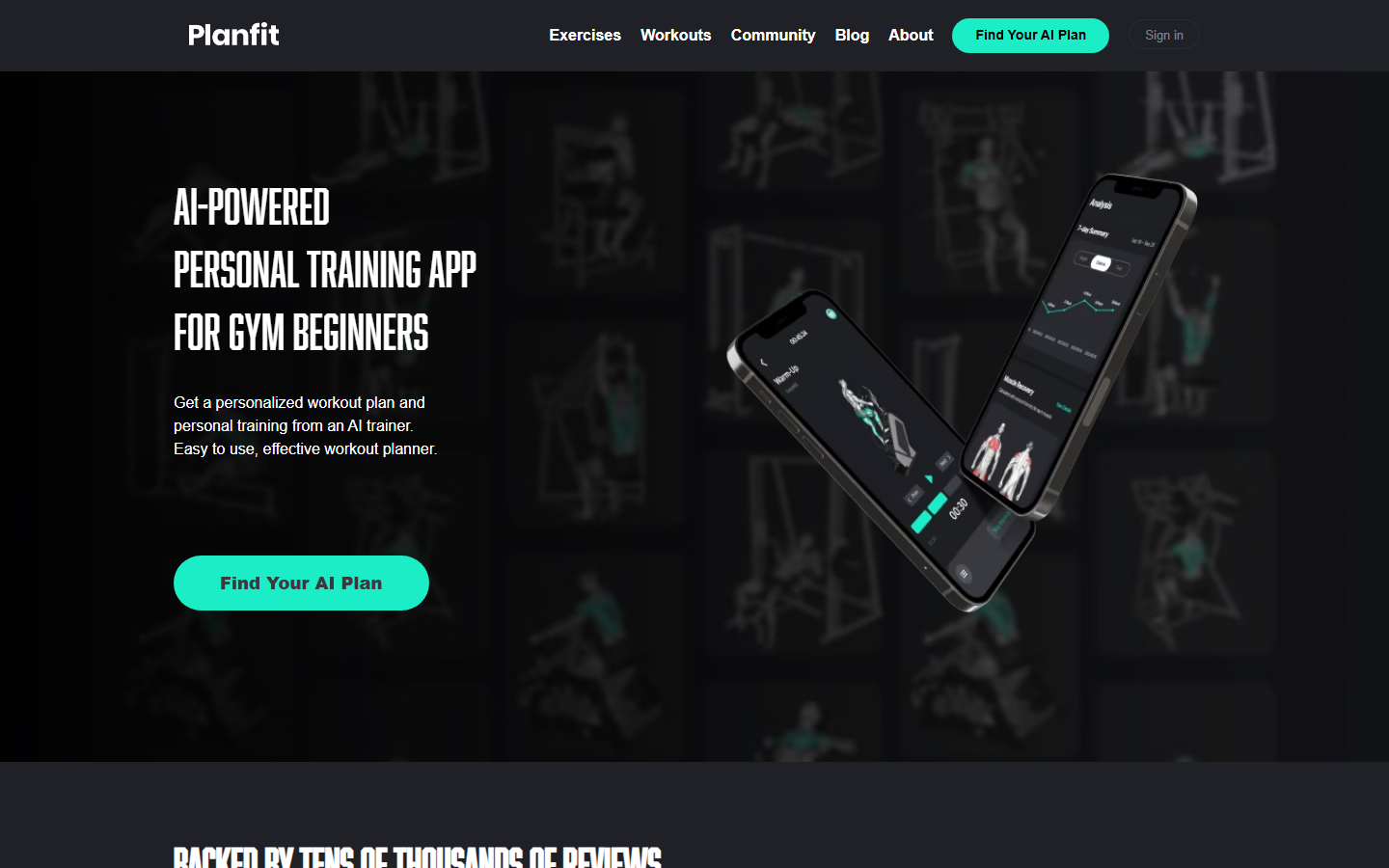
Planfit's free tier generates a personalized gym plan, making it the strongest zero-cost starting point on this list.
JuggernautAI: Best for Powerlifting
JuggernautAI is built from Juggernaut Training Systems' coaching methodology under Chad Wesley Smith. It programs squat, bench and deadlift in structured blocks and adjusts loads using readiness ratings and your performance feedback, pre-session, intra-session and block to block. For an intermediate or advanced powerlifter it is the closest thing to real coaching software on the App Store, backed by a 4.8 rating from 5,654 users. The catches: at $34.99/month it costs as much as some in-person coaching, and it is barbell-only by design with no wearable integration.
Freeletics: Best for Bodyweight and HIIT
Freeletics is the strongest option for zero-equipment training. Its AI Coach personalizes Training Journeys to your goals and equipment, and the Adapt Session feature reduces a Bodyweight session around the time you have, replacing a long workout with a 15-minute version when you are short on time. Training plans start at $34.99/quarter. Free content exists but the personalized Coach requires a subscription, backed by a 14-day money-back guarantee rather than a free trial.
Alpha Progression: Best Hypertrophy Value
Alpha Progression structures training in cycles with planned progression: sets and effort (RIR) increase week to week, deloads are scheduled, and loads are recommended per set with a plate calculator. A 4.9 rating from 2,154 reviews is the highest score on this list. At $12.99/month or $79.99/year with a free tier to start, it is the cheapest serious hypertrophy progression engine. Limits: it syncs body weight and workout data with Apple Health but reads no recovery signals, and the AI is a progression algorithm, not a conversational coach.
Which AI Fitness App Is Actually Worth Paying For?
This is the question most buyers ask after seeing the price spread, and the answer depends on what data you can feed the app:
| Your situation | Pick | Why |
|---|---|---|
| You lift in a gym and log every set | Fitbod ($12.99-15.99/mo) | Strongest muscle-recovery and progression model in its class |
| You want to spend nothing | Planfit (free tier) | A genuinely personalized plan at no cost |
| You compete in powerlifting | JuggernautAI ($34.99/mo) | Structured squat/bench/deadlift periodization blocks |
| You train with zero equipment | Freeletics (from $34.99/quarter) | Best adaptive bodyweight programming |
| You own an Apple Watch, Oura or WHOOP | SensAI ($6.99/mo) | Programs from your sleep and heart rate data |
| You want automated progression, no chat | Alpha Progression ($12.99/mo) | Cheapest serious hypertrophy engine |
| You are rehabbing or managing a condition | A human professional | AI cannot replace hands-on assessment |
The pricing pattern in 2026 mirrors the broader AI market, where subscription prices have converged. Users who shop on price alone often end up paying for features they cannot use: a $34.99 powerlifting program when they train bodyweight at home, or a $19.99 voice coach when they train in a loud gym. The better rule is to pick the cheapest app that reads the data you actually have. For that reason the AI tools not worth the money guide is worth reading before committing to any fitness subscription, and our best AI tools for beginners roundup covers the free-tier starting points across categories.
Recovery-Aware AI: The 2026 Differentiator
The most interesting 2026 development is recovery-aware programming. Most AI fitness apps are Tier 2: they optimize from workout data but ignore sleep, HRV and stress. SensAI is the only app on this list that programs from recovery signals, reading Apple Watch, Garmin, Oura and WHOOP data through HealthKit and adjusting training intensity accordingly, at $6.99/month or $69.99/year. It is iOS only and early-stage (30 ratings), so treat it as a promising cheap option rather than a proven one.
The practical value of recovery awareness is avoiding the common failure mode where a fitness app prescribes a heavy session on a day your body cannot handle it. If you already own a wearable and track sleep, a recovery-aware app at $6.99 is a materially better deal than a $15+ app that ignores your rest. If you do not track any recovery data, the cheaper Tier 2 apps are the right call.
Wearable Integration: What Each App Actually Reads
Wearable support is the least understood feature in fitness app comparisons, because "syncs with Apple Watch" means different things in different apps. The useful distinction is between logging, where the watch records your sets or activity, and recovery reading, where the app uses your sleep, HRV and resting heart rate to adjust programming.
Fitbod uses the Apple Watch for set logging and rest timers, pushes strength workouts to Strava and imports cardio from other platforms, but does not read recovery signals. SmartGym is the most Apple-native option, running routines entirely from the Watch with anatomical animations, which is why it won Apple Watch App of the Year honors. Freeletics controls workouts from the Watch but keeps recovery features limited. Planfit's Watch integration is a Premium feature. JuggernautAI has no wearable integration at all, which is consistent with its barbell-only focus. SensAI is the only app that reads recovery data through HealthKit, pulling sleep and HRV from Apple Watch, Garmin, Oura and WHOOP, then adjusting training intensity around them (SensAI's comparison).
The practical rule for 2026: if you own a wearable and train five or more days a week, recovery-aware programming has real value, because it prevents the app from prescribing heavy sessions on days your body cannot handle them. If you do not track any recovery data, paying extra for a recovery-aware app is wasted money, and a Tier 2 app like Fitbod or Alpha Progression is the right price point. The apps that advertise "AI training" without saying what data they read are usually optimizing from workout history only, which is fine for progression but not for recovery.
The Subscription Traps to Avoid in 2026
Three billing patterns appear repeatedly in fitness app reviews. First, add-on pricing that hides the real cost: some apps charge $2.99-29.99 per challenge and $3.99 per coach message on top of the base subscription. Fitbod and Alpha Progression are all-inclusive; apps with per-message fees can cost far more than the sticker price. Second, trial auto-renewal that starts billing before you decide, so set a calendar reminder for the trial end date. Third, annual plans with no rollover, where unused features expire.
Users who track spend across AI subscriptions report the same pattern the chatgpt pro $200 debate revealed: the value of a subscription is not the sticker price but whether the tool is used weekly. A $6.99 app used four times a week beats a $15.99 app abandoned after the trial, so the decision rule is to try the cheapest relevant option first and upgrade only when you hit a specific limit.
Frequently Asked Questions
What is the best AI fitness app in 2026?
Fitbod is the best overall for gym strength training, with a 4.8-star rating across 284,104 reviews and an adaptive algorithm that re-plans workouts from your logged sets. Planfit is the best free option, JuggernautAI is the powerlifting specialist, and SensAI is the best recovery-aware option for wearable users.
Are AI fitness apps worth the money?
Only if you use them consistently. Fitbod at $12.99-15.99/month is worth it for gym-goers who log every set. Planfit's free tier covers most beginners. Apps over $30/month are only justified for powerlifting (JuggernautAI) or automated progressive overload (Dr. Muscle).
Which AI fitness app is free?
Planfit offers a genuinely free personalized plan. Freeletics has free content but the personalized Coach requires a subscription. SmartGym is free to use with a $9.99/month Premium+ tier. Fitbod, SensAI and Ray offer 7-day free trials.
Do AI fitness apps track recovery?
Most do not. Fitbod, Planfit, Freeletics and JuggernautAI program from workout data only. SensAI is the exception, reading sleep, HRV and stress from wearables through HealthKit. Apps that claim recovery awareness without wearable integration are not recovery-aware.
Can AI fitness apps replace a personal trainer?
For programming, partially. They are strong at progressive overload and workout generation but weak at form correction, motivation and rehab. CoachConnect's 2026 review notes that personal support and social connection still shape whether programs stick, so for injury management or medical conditions, hire a human professional.
Bottom Line
The best AI fitness app in 2026 is the one that matches your data and your training style, not the one with the biggest marketing budget. Fitbod is the proven all-round pick for gym-goers. Planfit covers the free tier. JuggernautAI owns powerlifting, Freeletics owns bodyweight, and recovery-aware options cost less than half as much if you already track sleep and HRV. Start with a 7-day trial or a free tier, log three sessions, and upgrade only when you hit a real limit.
Self-Check
| Check | Status |
|---|---|
| >2,000 English words | Yes |
| FAQ ≥ 3 | Yes (5) |
| Real screenshots ≥ 2 | Yes (2) |
| Internal links 3-5 | Yes (4) |
| Authoritative outbound links ≥ 2 | Yes (3) |
| BLUF opening | Yes |
| Definition-first first paragraph | Yes |
| Question-format H2 | Yes |
| Data sourced | Yes |