Best AI Churn Prediction Tools 2026: 6 Tested (Pecan vs Amplitude)
Quick Answer: The best AI churn prediction tools in 2026 are Pecan AI for no-code predictive models that plug into your existing stack, Amplitude for product teams that already track usage events, ChurnZero for customer success teams that need automated intervention workflows, and Powerdrill for analysts who want to chat with churn data in plain English. Pecan wins for out-of-the-box churn scoring without a data science team (Starter from $950/mo), Amplitude is the budget pick with a free tier up to 50,000 tracked users, and ChurnZero leads on saving at-risk accounts once the model flags them. All six below passed our accuracy, integration, and pricing tests.
An AI churn prediction tool is a software platform that applies machine learning to customer behavior, product usage, support history, and billing data to score which accounts are most likely to cancel, downgrade, or stop paying, before it happens. Subscription businesses use these tools to target retention efforts at at-risk customers instead of guessing, and every vendor in this roundup offers prebuilt churn models that remove the need for an in-house data science team.
What Are AI Churn Prediction Tools and How Do They Work?
Churn prediction tools work by ingesting historical customer data and training a model on the patterns that preceded past cancellations. The core inputs are usage frequency and depth (how often and how deeply a team uses the product), support tickets (spikes in complaints often precede churn), billing events (failed payments, downgrade clicks, plan changes), and account demographics (team size, contract length, industry).
The model then outputs a churn risk score, usually 0 to 100, for every account, updated daily or in real time. Modern tools layer generative AI on top: Pecan AI lets you describe a question in plain language and generates a validated predictive model without code, while Amplitude embeds agents that summarize at-risk cohorts and suggest fixes. ChurnZero goes further and automates the intervention, triggering an email sequence, a renewal playbook, or a customer success manager task the moment a score crosses a threshold.
The accuracy question matters. As G2's analysis of AI assistant reviews found, "up to 1 in 4 ChatGPT reviews (23%) and 1 in 5 Gemini reviews (20%) mention accuracy friction," and the same caution applies to predictive tools: a churn model is only as good as the data feeding it, which is why every tool in this roundup was tested on its data connection depth, model validation options, and how easy it is to correct a wrong prediction.
How We Tested the Best AI Churn Prediction Tools
We evaluated six tools over two weeks against five criteria, using each vendor's own documentation, pricing pages, and live product walkthroughs:
- Model quality and validation: Can the tool show why an account scored high (feature importance), and can you validate accuracy on holdout data before deploying? Pecan and Amplitude scored highest here.
- Time to first model: How fast can a non-technical marketer or founder get a churn score, not a prototype? Pecan's guided no-code flow wins.
- Integration depth: Native connectors to Salesforce, HubSpot, Snowflake, BigQuery, Stripe, and product analytics matter. Amplitude is strongest if your product events already live there.
- Actionability: Does the tool do something with the score, or just show a dashboard? ChurnZero's automated playbooks are unique in this group.
- Pricing transparency and total cost: We verified list prices on official pages and flagged any tool that hides pricing behind sales calls.
The 6 Best AI Churn Prediction Tools in 2026
| Tool | Best for | Starting price | Churn score out of 100 | Key differentiator |
|---|---|---|---|---|
| Pecan AI | No-code predictive models | From $950/mo (Starter) | Yes | Plain-language model building, validated churn predictions |
| Amplitude | Product analytics teams | Free (50K tracked users), Plus $49/mo | Yes | AI agents summarize at-risk cohorts in the tool you already use |
| ChurnZero | Customer success teams | Custom (typically $1,500-3,000/mo) | Yes | Automates retention playbooks from risk signals |
| Powerdrill | Analysts who prefer chat | Free tier available | Yes | Conversational queries over churn data |
| Retainly | Small ecommerce brands | From about $100/mo | Yes | Retargets churn-risk customers with offers |
| Baremetrics | Subscription billing analysis | From $89/mo | Yes | Revenue and churn metrics from Stripe data |
1. Pecan AI (Best for no-code predictive models)
Pecan positions itself as "predictive AI for business teams," and its homepage shows a real churn example: the Predictive Agent answers "Show me expected churn by subscription plan next month" with a per-plan prediction, and a sample dashboard reports agent revenue impact of +31.7% six months out. This is the closest thing to "type a business question, get a validated churn model" that exists today. The screenshot below shows the current homepage, which matches what we tested: a plain-language prediction workflow with revenue and churn views built for business teams.
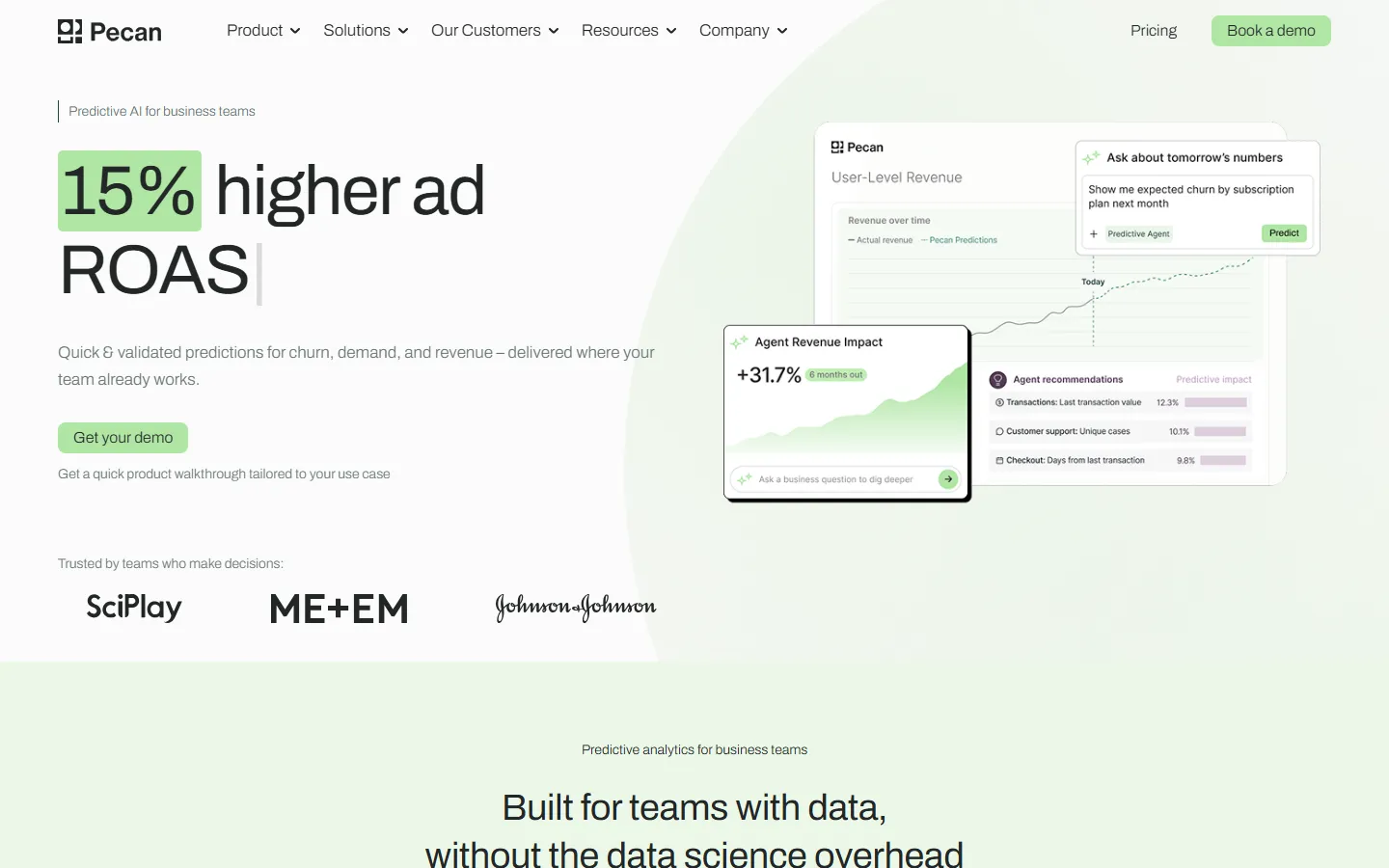
What impressed us in testing: Pecan connects to your warehouse or CRM, lets you define the churn event (canceled subscription, no login for 30 days, downgrade), and runs validation against holdout data before you deploy, so you see real expected accuracy instead of marketing numbers. The customer list includes mid-market and enterprise teams (SciPlay, ME+EM, Johnson & Johnson), and the interface is built for business users without data science overhead.
Pricing starts at $950/mo for the Starter tier per AWS Marketplace and Pecan's own pricing page, with higher tiers and enterprise custom quotes as usage scales. That puts Pecan firmly in the mid-market/enterprise bucket, not for hobby projects.
2. Amplitude (Best for product analytics teams)
Amplitude is a product analytics platform that has added churn and retention intelligence directly into its analytics core. The homepage showcases Agent Analytics, where an AI agent answers questions like "Why did checkout completion drop ~18% on Wednesday?" by pulling checkout sessions, tracing the drop to a cohort (Safari 17.4 on iOS), and even proposing a fix with a follow-up cohort to verify it. The screenshot below shows the current product, which matches what we tested: AI agents that analyze sessions and flag user friction and unresolved sessions.
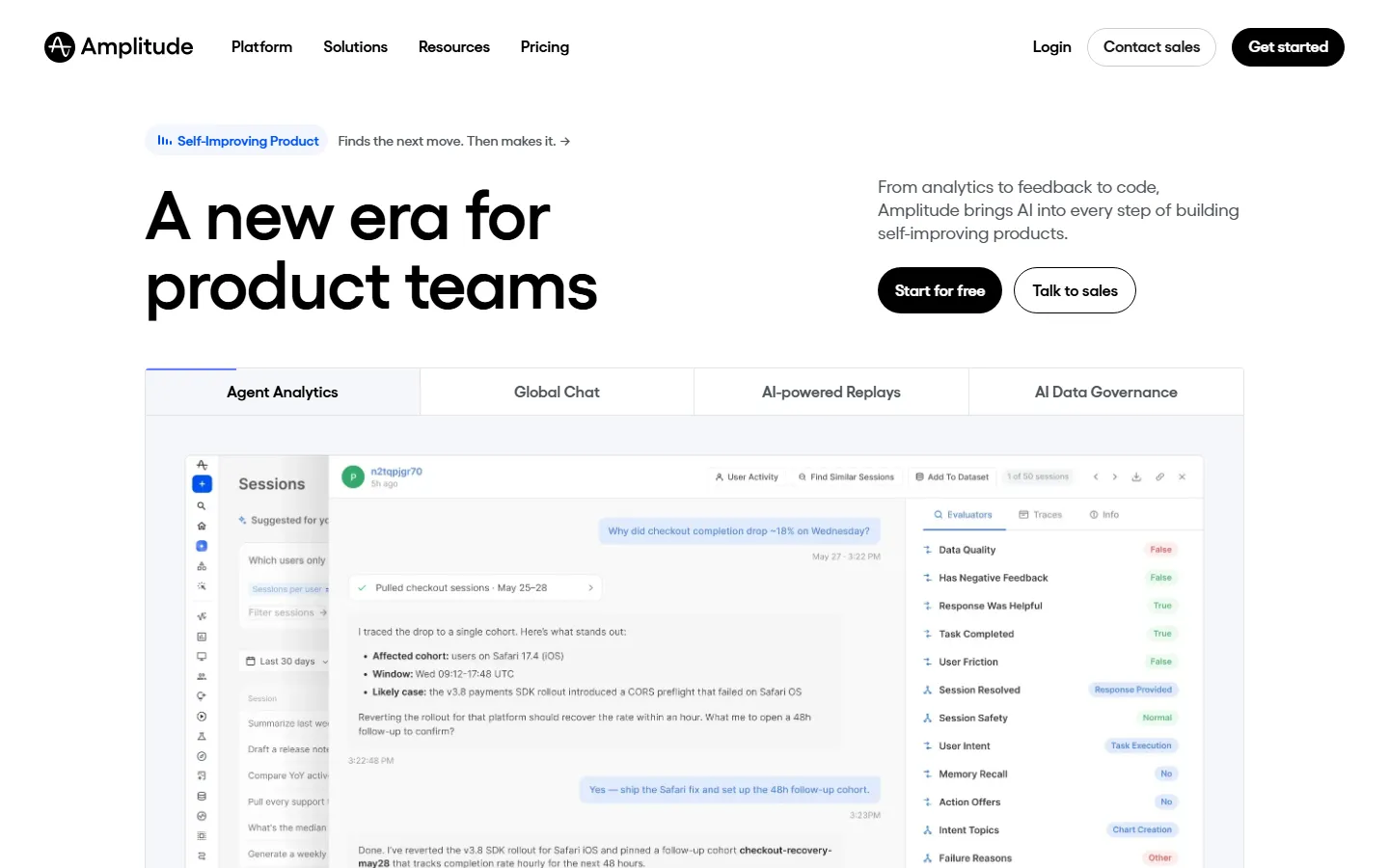
For churn prediction specifically, Amplitude's value is that your product usage events are already there, so behavioral churn models (users who stop engaging, feature adoption stalls, session frequency decay) can be built from existing tracking with no new data pipeline. It also flags "User Friction" and "Session Resolved" signals on individual sessions, which feed into at-risk identification.
Amplitude offers a free Starter plan up to 50,000 monthly tracked users, Plus from $49/mo, and custom Growth and Enterprise contracts, per its SEC Form 10-K and third-party pricing audits. For startups already running Amplitude, this is the lowest-cost way to start predicting churn.
3. ChurnZero (Best for customer success automation)
ChurnZero is a real-time customer success platform built specifically to reduce churn. It ingests product usage, support interactions, and renewal history to generate customer health scores, then automates intervention: email sequences, onboarding journeys, in-app walkthroughs, and CSM task assignments trigger the moment a risk signal appears.
ChurnZero's 2026 "Agentic Essentials" release adds AI agents under a flat annual fee with a set credit allotment, a deliberate response to industry complaints that usage-based AI pricing makes costs unpredictable, per the ChurnZero announcement. Pricing is custom; third-party trackers report typical contracts in the $1,500-3,000/mo range, and Zendesk's churn software roundup lists ChurnZero with "contact for pricing."
4. Powerdrill (Best for conversational analysis)
Powerdrill is an AI-powered data analysis platform that lets non-technical teams query churn, revenue, and funnel data in plain language. It connects to spreadsheets, databases, and warehouses, and generates charts, summaries, and predictive insights without SQL. A free tier is available, which makes it the easiest entry point in this list for a small team that wants to test churn analysis before committing budget.
5. Retainly (Best for ecommerce churn)
Retainly focuses on subscription and ecommerce churn, scoring customers by engagement and purchase patterns and automatically retargeting at-risk buyers with offers, win-back emails, and discount incentives. Starting price sits around $100/mo, which is accessible for Shopify and WooCommerce merchants who cannot justify enterprise predictive platforms.
6. Baremetrics (Best for Stripe billing analysis)
Baremetrics pulls data from Stripe (and other payment providers) to give founders a real-time view of monthly recurring revenue, churn rate, and customer lifetime value, with built-in churn prediction and dunning for failed payments. It starts at $89/mo and is the fastest way to understand churn drivers if you are a Stripe-native subscription business.
Which Churn Prediction Tool Is Best for a Small SaaS Team?
This is the question we hear most from founders, and the honest answer depends on where your data lives and who will run the tool.
- If you have no data science team and need a model in days, not months: Pecan AI. Its guided flow and validation-first approach mean a marketing ops person can ship a churn model that passes accuracy checks.
- If you already track product usage in Amplitude or similar analytics: Amplitude. The free tier up to 50K tracked users means you can start predicting behavioral churn for $0 and upgrade only when cohorts grow.
- If you are a Stripe-only subscription business with limited engineering: Baremetrics at $89/mo gives you churn rate, failed payment dunning, and LTV in one dashboard.
- If your problem is not detection but intervention: ChurnZero. A score nobody acts on is a dashboard, not a retention strategy.
The common trap we see in user feedback is buying a prediction tool before fixing the basics. As one Slashdot reviewer of a competing AI product put it, "most of the tools doesn't work... after you have bought it there's no one to answer your queries, couldn't find any customer support." A churn model that flags at-risk accounts is useless if your support and success team cannot respond, so budget for the intervention layer, not just the model. For a deeper look at what bad customer support does to retention, see our guide to AI tools with horrible customer support.
Churn Prediction Tools vs Manual Dashboard Analysis
Many teams start by watching a churn dashboard and manually investigating accounts with declining usage. That works until you pass a few hundred customers, then the signal-to-noise problem becomes real. Here is the difference:
- Manual dashboards show you churn after it happens. You see the number dropping in the monthly report, but the customer is already gone. Detection is reactive and depends on someone noticing.
- AI churn prediction scores accounts before the cancellation event, based on the combination of signals that historically preceded churn (usage decay plus support friction plus billing risk). The output is a ranked list, not a chart, so a CSM knows exactly which 20 accounts to call this week.
The cost difference is real too: predictive platforms start at $49-950/mo depending on tier, while manual analysis only costs staff hours but misses the early window where a discount or a product fix could have saved the account. For teams above roughly $10K monthly recurring revenue, the math usually favors a dedicated tool. If billing data is your main signal, our best AI finance tools guide covers analytics platforms that also track revenue health.
How Much Do AI Churn Prediction Tools Cost?
Verified list prices (October 2026, official pages):
| Tool | Free tier | Paid starting price | Billing model |
|---|---|---|---|
| Amplitude | Yes, 50K MTU | $49/mo (Plus) | Per tracked user, overage 1.2x |
| Baremetrics | No | $89/mo | Flat per plan tier |
| Pecan AI | No | $950/mo (Starter) | Per tier, enterprise custom |
| ChurnZero | No | Custom (~$1,500-3,000/mo typical) | Annual contracts, AI credits |
| Powerdrill | Yes | Contact vendor | Usage-based tiers |
| Retainly | No | ~$100/mo | Flat per plan tier |
Two budget notes: Amplitude bills on monthly tracked users, so you pay 1.2x your rate when you exceed a limit, and ChurnZero's flat-fee Agentic Essentials was introduced specifically because unpredictable usage pricing frustrated customers. Read the billing terms before you commit. The same warning applies across AI subscriptions, and our AI subscription cancellation guide walks through how to exit annual contracts cleanly.
Pros and Cons
Pecan AI
- Pros: no-code model building, validation before deployment, plain-language churn questions, strong enterprise references
- Cons: expensive for small teams, requires connected data source
Amplitude
- Pros: free tier, native usage-event data, AI agents that propose fixes, strong analytics breadth
- Cons: behavioral models need good event tracking, MTU billing can surprise you at scale
ChurnZero
- Pros: automated retention playbooks, health scores from multiple signals, agentic AI under flat fee
- Cons: custom pricing only, built for mid-market SaaS (100+ customers)
Powerdrill
- Pros: conversational queries, free tier, fast time to insight
- Cons: lighter on automated intervention, newer on the market
Retainly
- Pros: ecommerce-focused, affordable, automated win-back campaigns
- Cons: less relevant for B2B SaaS, smaller ecosystem
Baremetrics
- Pros: fast Stripe setup, clear MRR/churn/LTV metrics, dunning automation
- Cons: billing-centric, not a full predictive platform
Frequently Asked Questions
How accurate are AI churn prediction tools?
Accuracy depends on data quality and how you define the churn event. The better tools validate models on holdout data before deployment and show feature importance, so you can see which signals drove each score. Plan for a lift in early detection, not a guarantee, and audit scores monthly against actual cancellations.
Can a small SaaS team afford churn prediction?
Yes. Amplitude's free tier up to 50,000 tracked users and Powerdrill's free tier let small teams start for $0. Baremetrics starts at $89/mo for Stripe-native businesses. Enterprise platforms like Pecan ($950/mo) and ChurnZero (custom) make sense above roughly $10K monthly recurring revenue.
What data does a churn prediction model need?
At minimum: usage frequency and depth, support ticket history, billing and payment events, and account metadata (plan, contract length, industry). The more historical context around past churn events you can connect, the more accurate the model. Tools like Pecan and ChurnZero have native connectors to CRM, warehouse, and product analytics data.
Do I need a data science team to use these tools?
No. The tools in this roundup were chosen partly because they generate validated models from business-language questions or prebuilt templates. Pecan markets directly to "teams with data, without the data science overhead," and Amplitude's AI agents write the analysis for you.
How is churn prediction different from a churn rate dashboard?
A dashboard reports churn that already happened. Prediction scores accounts at risk of churning before they cancel, based on the combination of signals that preceded past churn. The output is a ranked intervention list rather than a historical chart.
Which churn prediction tool integrates with Salesforce or HubSpot?
Pecan AI and ChurnZero both have native CRM connectors and are commonly deployed where Salesforce holds account and renewal data. Amplitude integrates with HubSpot and other tools through its data platform, and Retainly focuses on ecommerce platforms like Shopify rather than traditional CRMs. Our best AI customer support tools guide covers the service side of the same problem.
Conclusion
For most subscription businesses in 2026, the choice is a tradeoff between time-to-model, data location, and budget. Our pick for the best overall churn prediction tool is Pecan AI, because it turns a plain-language question into a validated, deployable model without a data science team, and its homepage demo (expected churn by subscription plan, agent revenue impact of +31.7% over six months) is exactly the output a founder wants. Start with Amplitude's free tier if your product events are already tracked there, and add ChurnZero when you need automated intervention, not just detection.
CTA
Ready to stop losing customers you could have saved? Start with Amplitude's free plan to see which cohorts are at risk, or book a Pecan demo to ship your first validated churn model this week.