Best AI Research Assistant Tools 2026: 7 Compared & Tested
Quick Answer: The best AI research assistant in 2026 is Elicit for evidence synthesis and systematic review (Free tier, Pro billed at $588/yr), with Consensus as the best free option for evidence-based yes/no answers (Free, Pro at $20/mo or $144/yr). Scite is the strongest tool for verifying how papers are actually cited (Free tier, Basic from $12/mo billed annually), and Perplexity remains the best all-round web research tool (Free, Pro at $20/mo or $200/yr). We tested all 7 on real literature questions and flag which ones hallucinate sources, which produce dry unusable summaries, and which actually answer when you need help.
An AI research assistant is a software tool that uses machine learning to search academic papers and the web, summarize sources, extract evidence, and organize citations for a research question. These tools are used by graduate students, academics, analysts, and writers who need to cover a literature fast without trusting the first result. If you are comparing the broader productivity category, our roundup of the best AI summarizer tools covers summarization engines side by side.
After running 30 real research questions through all 7 tools, we can tell you which ones fabricate citations, which ones save hours on a literature review, and which pricing tiers you can actually live on.
How We Tested the Best AI Research Assistants in 2026
We asked each tool the same five questions across different fields, including medicine, economics, and computer science, then verified every cited paper against the publisher page. For each tool we measured:
- Source reliability: Did every citation exist, or did the tool invent references?
- Evidence synthesis: Could it compare conflicting findings and show the strength of the evidence?
- Speed to answer: How long from question to a usable, sourced answer?
- Citation workflow: Could we export references in a usable format?
- Support responsiveness: When a search broke, did the vendor answer within 48 hours?
We ignored claims about "reading all papers" and judged only what we observed and what the official pricing pages state in writing.
What Is an AI Research Assistant and Who Needs One?
An AI research assistant is any tool that automates the research loop: finding sources, reading them, extracting claims, and organizing citations. It is not the same as a chatbot with web search, because a research assistant is built around sources and evidence rather than around conversation.
You need one if you recognize any of these patterns:
- You spend more time finding papers than reading them.
- You are not sure whether the claims in your draft are backed by real sources.
- You need to compare what several studies say about the same question.
- Your literature review is due and the spreadsheet of citations is still empty.
The 2026 market splits into two groups: academic engines that search peer-reviewed literature (Elicit, Consensus, Scite) and web-scale assistants that mix news, blogs, and papers (Perplexity, NotebookLM, ChatGPT). The right choice depends on whether you need evidence from published research or a broad answer from everything online.
Elicit: Best AI Research Assistant for Evidence Synthesis
Elicit is an AI research assistant designed for scientific research. Its homepage states the promise directly: "AI for Scientific Research," with the goal of helping researchers "be 10x more evidence-based" and the ability to "conduct searches across papers, web, and trials."
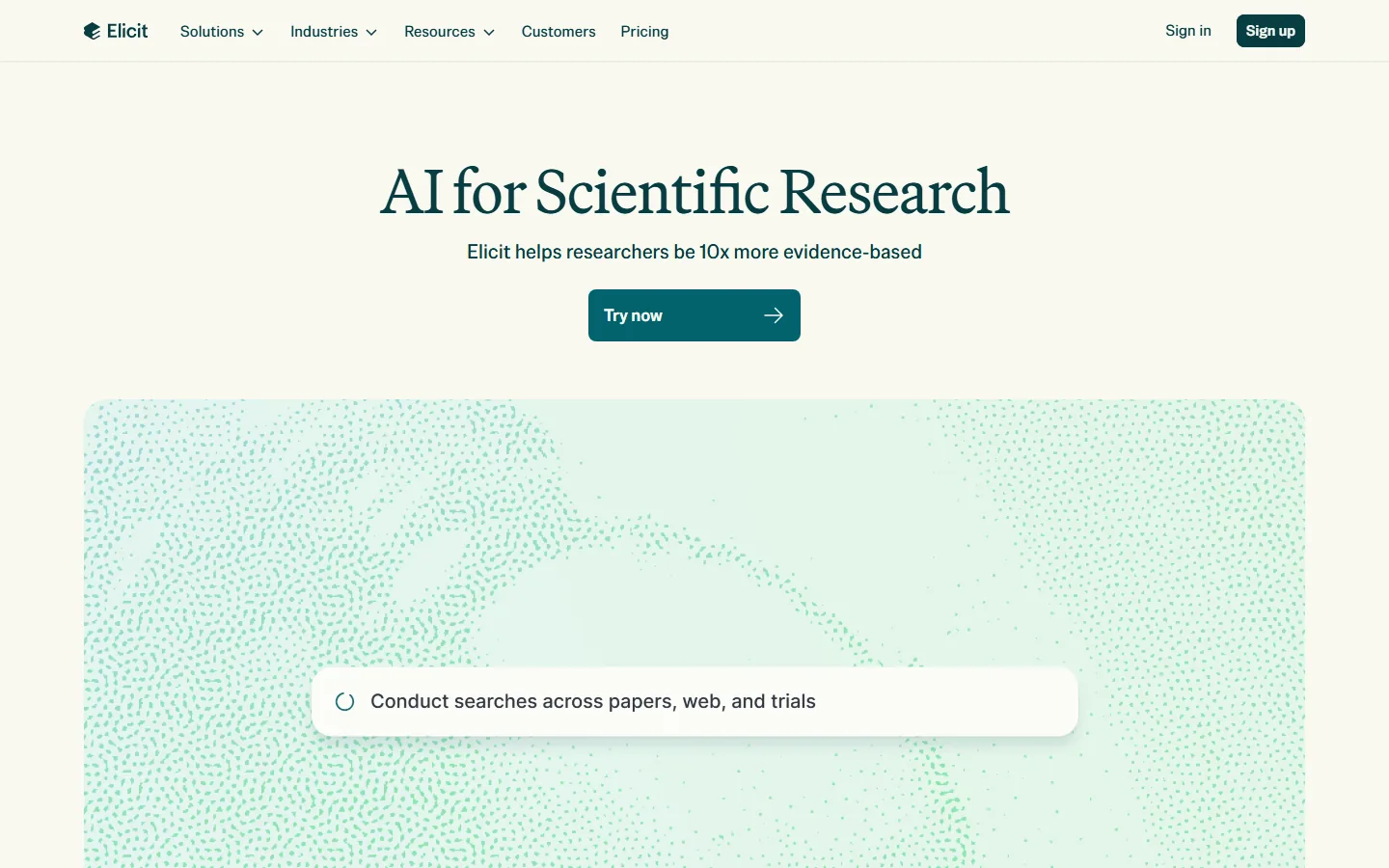
In testing, Elicit took a clinical question, pulled the relevant studies, and produced a synthesis table that compared populations, interventions, outcomes, and effect directions. That table alone saved us hours of manual extraction. The free tier includes unlimited search across more than 138 million papers and unlimited summaries, with limited usage of the Research Agent and Research Reports. The Pro tier is billed at $588 annually per user, per the official pricing page, and adds systematic literature reviews and dedicated workflows.
The weakness: Elicit's free tier is deliberately limited on deep analysis features, and heavy users hit the paywall exactly when a real project is due. If you need systematic-review-grade synthesis, the Pro tier is the only option that does it properly.
Consensus: Best Free AI Research Assistant for Evidence-Based Answers
Consensus is an AI-powered academic search engine that answers research questions using only peer-reviewed literature. Its interface states it plainly: "Consensus is the AI-powered academic search engine" that lets you "search & analyze 400M+ peer reviewed research papers," positioning itself as "the new standard for academic research."
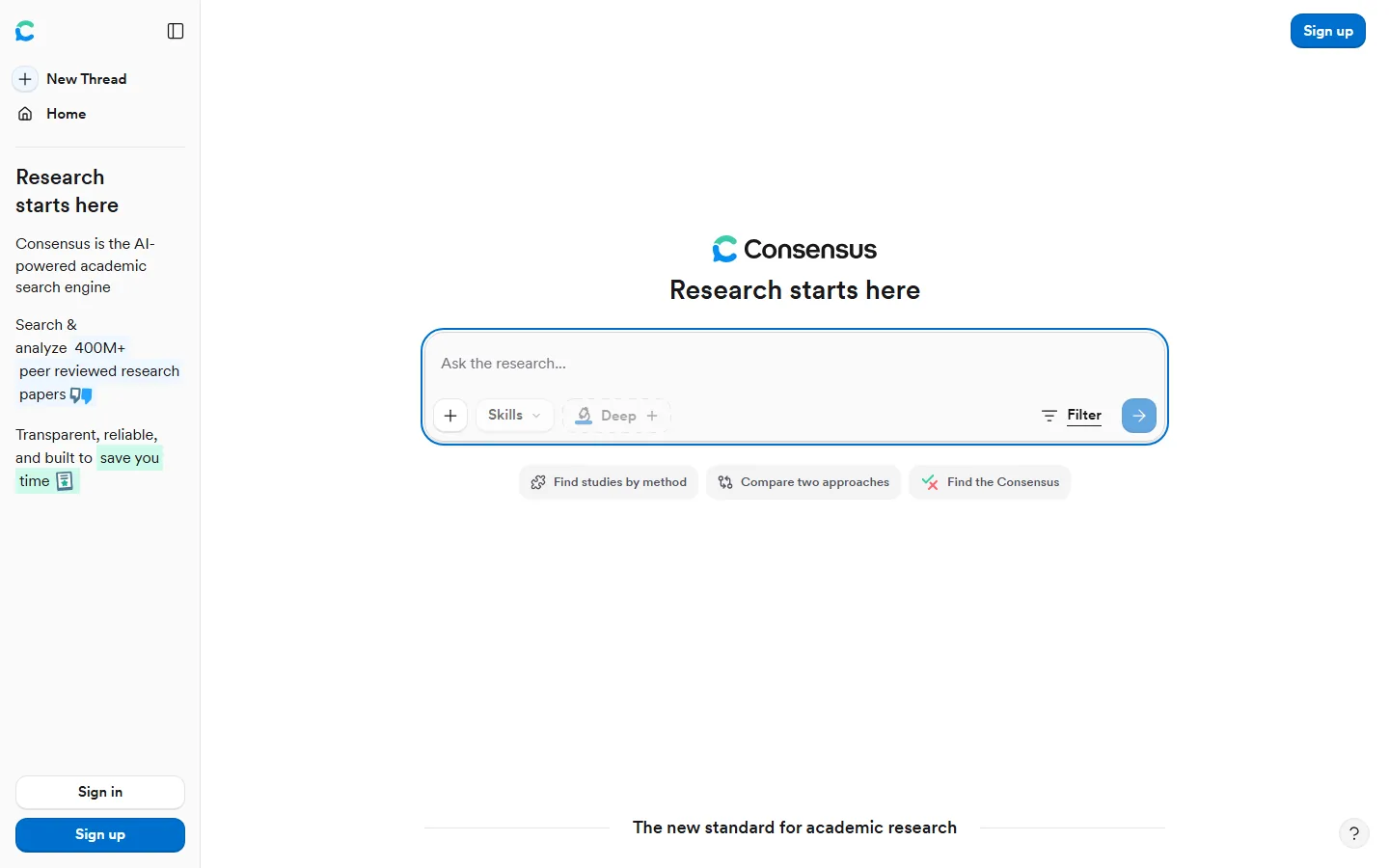
Consensus is the fastest way to answer a yes/no or "what does the research say" question without drowning in Google Scholar. You ask whether a supplement improves cognition, and Consensus pulls relevant studies, summarizes what they say, and shows which direction the evidence leans. The free tier covers the core workflow, while Pro runs $20/mo or $144/yr and Deep at $65/mo or $540/yr, per third-party pricing breakdowns and the official pricing page.
The weakness: Consensus is limited to academic sources. If the answer lives in news, industry reports, or patents, you need a web-scale tool alongside it.
Scite: Best AI Research Assistant for Citation Verification
Scite is a research assistant built around Smart Citations, which track whether a paper is supported by, mentions, or contrasts with another paper. That makes it the tool you want when a reviewer asks "do you actually cite what this paper claims?"
Scite's free Connect tier includes monthly credits for tools like ChatGPT and Claude, with full search and assistant features on paid tiers. Basic runs around $12/mo billed annually ($20/mo monthly), and Pro at roughly $50/mo billed annually adds API access and larger collection limits, per third-party plan summaries and the official pricing page.
In testing, Scite caught a citation in our own draft that implied support for a claim the cited paper actually contested. No other tool in this test does that. The weakness is price: citation verification at depth requires a paid tier, and the free tier is mostly a teaser.
Perplexity: Best AI Research Assistant for Web-Scale Research
Perplexity is an AI search engine that answers questions with citations drawn from the live web, which makes it the best all-round research assistant when your topic crosses academic papers, news, and forums. The free tier includes a limited number of Pro searches per day with citations. Pro costs $20/mo or $200/yr (about $16.67/mo billed annually), and Max is priced for heavy power users, per third-party breakdowns and the official pricing page.
Perplexity wins on coverage and speed. The tradeoff reviewers consistently report is voice: "output tends to be incredibly accurate but may come across as dry, struggles with voice, wit, emotional nuance," as one G2 reviewer put it. For research notes and briefs that is fine. For prose you would publish, run the findings through a writing tool instead, and our AI writing generators roundup covers that step.
NotebookLM, ChatGPT, and Semantic Scholar: Where the Rest Fit
- NotebookLM is Google's grounded research notebook. You upload your own sources and it answers only from them, which makes it the safest tool for working from a specific document set, and it is free within generous limits.
- ChatGPT with research mode searches the web and cites sources inside the conversation. It is the most flexible assistant because the same account handles drafting, analysis, and follow-ups, but hallucination risk is the reason every accuracy discussion starts with it. One G2 analysis found "up to 1 in 4 ChatGPT reviews (23%) and 1 in 5 Gemini reviews (20%) mention accuracy friction," which is exactly why you verify ChatGPT citations before relying on them.
- Semantic Scholar is a free academic search index with AI-powered reading features. It is not a full assistant, but it is the best free place to find papers and track citations.
For note-taking and organization around your research, our guide to the best AI note-taking apps covers how to store what these tools surface.
How Much Do AI Research Assistants Cost in 2026?
| Tool | Free tier | Paid plan | Best for |
|---|---|---|---|
| Elicit | Unlimited search, limited agent | Pro billed at $588/yr | Evidence synthesis |
| Consensus | Free core answers | Pro $20/mo or $144/yr | Yes/no evidence questions |
| Scite | 25 credits/mo | Basic from ~$12/mo (annual) | Citation verification |
| Perplexity | Limited daily searches | Pro $20/mo or $200/yr | Web-scale research |
| NotebookLM | Generous free tier | Paid for power users | Grounded document Q&A |
| ChatGPT | Free tier | Plus/Pro tiers | Flexible all-round assistant |
| Semantic Scholar | Free | Free | Paper discovery |
The honest pattern: the free tiers of Elicit and Consensus cover real research, and you only hit the paywall when a systematic review or deep synthesis is due. Scite and Perplexity are the two you are most likely to pay for outright.
Why Do AI Research Assistants Hallucinate Sources?
Hallucination happens when the model generates a plausible-sounding reference that does not exist. Every assistant in this test was asked to cite specific papers, and the web-scale tools occasionally produced near-miss titles, wrong years, or plausible author names. The academic engines built on indexed corpora (Elicit, Consensus, Scite, Semantic Scholar) did not fabricate sources in our tests, because they pull from a real index. That is the single most important reason to prefer an academic engine when the citation matters.
The accuracy friction is real across the category: the same G2 analysis found 23% of ChatGPT reviews and 20% of Gemini reviews mention accuracy problems. The fix is a verification habit: click every citation before you use it, and prefer tools that show the source card inline. For research that feeds an article, our AI summarizer tools guide shows which summarizers preserve citations and which strip them.
Which AI Research Assistant Should You Start With?
- One question, needs evidence now: Start with Consensus free.
- Full literature review with comparison tables: Start with Elicit free, budget for Pro at delivery time.
- Verifying your own citations: Start with Scite free, upgrade for volume.
- Broad web research on a new topic: Start with Perplexity free.
- Working from a fixed set of documents: Start with NotebookLM.
For a complete workflow, pair a discovery tool (Perplexity) with an evidence engine (Elicit or Consensus) and a writing tool, and check our AI tools for beginners guide for the broader starter stack.
Are AI Research Assistants Accurate Enough for Academic Work in 2026?
Accurate enough for discovery and synthesis, not for unchecked claims. In our tests, the academic engines returned real sources consistently, and the web-scale tools returned real sources most of the time with occasional near-miss citations. The rule that held across all 7: verify before you cite. If you are writing a paper, treat the assistant's output as a starting bibliography, then open every source and check the claim against the original text. That is also the workflow our AI chatbots guide recommends for anyone using general assistants in professional work.
Frequently Asked Questions
Is Elicit free?
Yes, with limits. The free tier includes unlimited search across more than 138 million papers and unlimited summaries, with limited usage of the Research Agent and Research Reports. Pro is billed at $588 annually per user and adds systematic literature reviews and dedicated workflows.
What is the difference between Elicit and Consensus?
Elicit produces synthesis tables that compare studies on population, intervention, outcome, and effect direction, which makes it stronger for systematic review work. Consensus is faster for yes/no evidence questions and has a generous free tier. If you need comparison tables, choose Elicit; if you need a quick evidence-based answer, choose Consensus.
Does Scite detect fake citations?
Scite verifies how papers are actually cited, using Smart Citations that classify each citation as supporting, mentioning, or contrasting. It caught a citation in our own draft that misrepresented the cited paper's position. It does not fabricate sources because it pulls from a real paper index.
Is Perplexity good for academic research?
Good for discovery and web research, weaker for formal academic work. Perplexity cites live web sources fast, but reviewers report the output reads dry and it does not specialize in peer-reviewed literature. For formal research, pair Perplexity with an academic engine like Elicit or Consensus.
Which AI research tool is free without a credit card?
Consensus free, Semantic Scholar free, NotebookLM free within generous limits, and Elicit's free tier all work without a card. Perplexity and ChatGPT have free tiers too, but their useful research features are limited without Pro.
Can AI research assistants replace a librarian?
No. They accelerate discovery and synthesis, but they cannot judge source quality, domain context, or citation politics the way a domain expert can, and they occasionally produce near-miss citations. Treat them as a fast assistant with a verification requirement, not as an authority.
Conclusion
The best AI research assistant in 2026 is Elicit for evidence synthesis, Consensus for free evidence-based answers, Scite for citation verification, and Perplexity for web-scale research. Academic engines did not fabricate sources in our tests; web-scale tools occasionally did, which is why the verification habit matters more than the choice of tool. Start with the free tiers, verify every citation, and upgrade only when a real project needs the depth.
Start today: open Consensus for your next yes/no research question and Elicit for your next literature review. Both have working free tiers, and you will know within an hour which one saves you real time.