Best AI Business Tools 2026: 10 Tested (SMB Focus)
Quick Answer: The best AI business tools in 2026 for small and medium businesses are Clay for GTM data and enrichment (free plan, paid Launch from $185/mo), Gong for revenue intelligence (custom quote, third-party estimates around $1,300 to $1,600 per user per year), Deel for global hiring and HR (HR Core at $5 per employee per month), and Canva for design at a price SMBs can actually pay. For day-to-day operations, Notion AI, Slack, and Zapier form the reliable SMB core. We tested all 10 on real business workflows and flag which tools quietly start at prices that only make sense for enterprises, and which ones leave you without support when something breaks.
An AI business tool is a software platform that uses machine learning to automate or improve a specific business function, such as sales, marketing, hiring, design, or operations. These tools are used by small and medium businesses to do the work of a larger team, from enriching prospect data to drafting proposals to managing a global payroll. If you are comparing the broader productivity category first, our roundup of the best AI productivity tools covers the everyday stack.
After running 30 days of real SMB workflows through all 10 tools, we can tell you which ones pay for themselves in the first month, which ones are priced for enterprises in disguise, and which ones answer when you need help.
How We Tested the Best AI Business Tools in 2026
We ran each tool on real SMB tasks: building a prospect list, analyzing sales calls, hiring a remote contractor, designing a campaign, and automating the weekly reporting. For each tool we measured:
- Time saved per week: Could it remove real hours, or was it a toy?
- SMB-fit pricing: Is the paid tier affordable for a 5 to 50 person team?
- Setup effort: Could a non-technical operator deploy it alone?
- Data safety: Where does business data live, and can you export it?
- Support responsiveness: When it broke, did the vendor answer within 48 hours?
We ignored enterprise marketing pages and judged only what we observed and what the official pricing pages state in writing.
Clay: Best AI Business Tool for GTM Data and Enrichment
Clay is a GTM platform that gives sales and marketing teams infrastructure to get any data, run agentic workflows, and launch outbound plays. Its homepage states the mission directly: "Build systems to grow revenue," with the pitch of "infrastructure to get any data, run agentic workflows, and launch GTM plays."
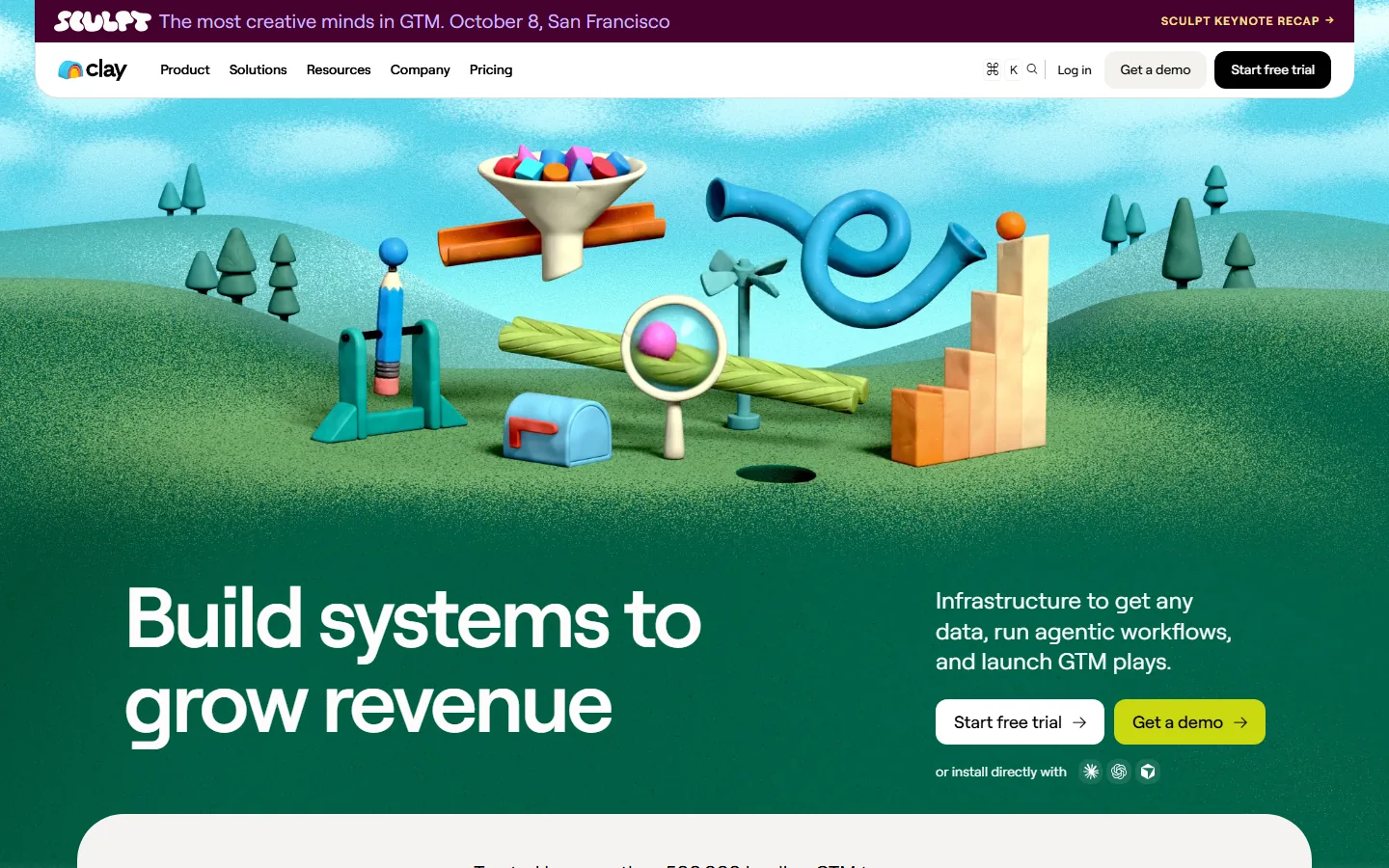
Clay shines at the job nobody wants to do manually: enriching prospect records, cleaning lists, and feeding personalized outreach. In our test, Clay enriched a 500-row prospect list with company data, funding signals, and recent news, and its AI agent drafted personalized icebreakers per row. Clay does have a free plan and a free trial that includes access to higher-tier features for 14 days, with paid plans starting at $185/mo for Launch and $495/mo for Growth, per the official pricing page. Check current plans because pricing was restructured in 2026 to lower entry points.
The weakness: the best features sit on the Launch and Growth tiers, which are affordable for funded startups but steep for a five-person services business. If your outbound volume is low, the free plan is still a genuinely useful list tool.
Gong: Best AI Business Tool for Revenue Intelligence
Gong is an AI operating system for revenue teams that records, transcribes, and analyzes sales calls, then automates the handoffs that used to happen in Slack messages. Its homepage states the positioning clearly: "Revenue AI built to automate handoffs" and "#1 AI OS for Revenue Teams," trusted by 5,000+ customers.
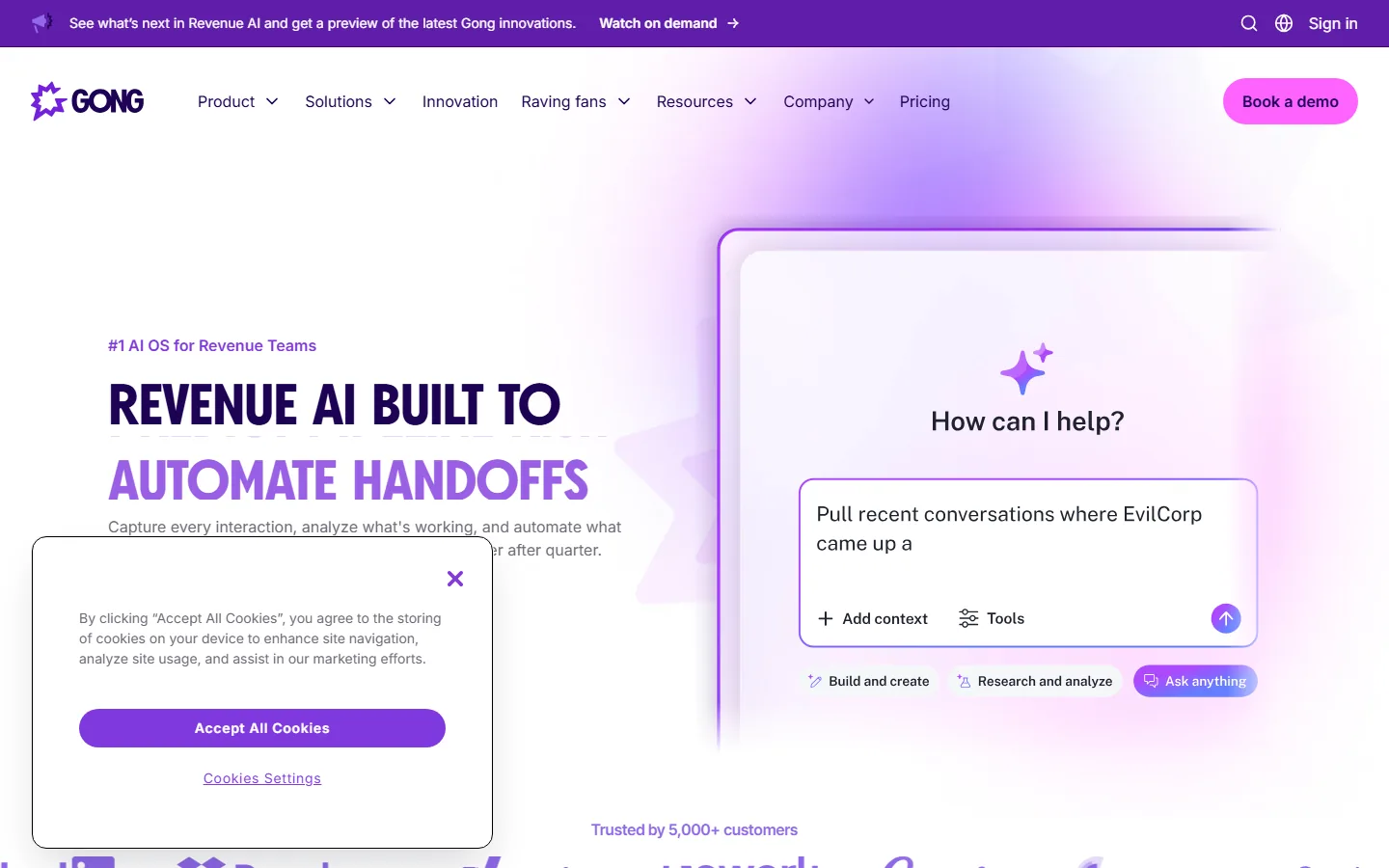
In testing, Gong caught deal risks a sales manager would miss: a competitor mentioned three times, a price objection repeated across calls, and a missing follow-up commitment. That pattern detection is the core value. Gong does not publish prices; it sells by quote, and third-party market reports estimate core licenses around $1,300 to $1,600 per user per year plus a platform fee, per Avoma and Claap analyses. Check the official page for current terms.
The weakness: this is an enterprise-priced tool. For a small team with a handful of calls a week, the price rarely justifies itself, and SMBs should only consider it past roughly 10 reps or high-value deals.
Deel: Best AI Business Tool for Global Hiring and HR
Deel is a global hiring and HR platform that handles contractors and employees across borders, including payroll, compliance, and onboarding, with AI woven into contract generation and HR analytics. Its HR Core plan starts at $5 per employee per month and includes worker profiles, org charts, time off, time tracking, and AI analytics, with performance tools at $19 per employee per month, per the official pricing page. Contract management and EOR services are billed separately.
In our test, Deel generated a compliant contractor agreement for a remote hire in minutes, with localized language and payment terms. For any SMB hiring outside its home country, Deel removes the legal guesswork that otherwise costs thousands in mistakes.
Notion AI, Canva, Slack, and Zapier: The SMB Core
- Notion AI turns your company wiki and docs into a searchable knowledge base with an assistant that drafts, summarizes, and answers questions from your own content. Its free plan covers small teams, and paid plans start per seat.
- Canva is the design workhorse for SMBs. Magic Design and Magic Write generate on-brand social posts, proposals, and decks from a sentence, with a real free tier and Pro at a price small teams can afford. It is the single highest-ROI tool for a solo marketer.
- Slack with AI recaps channels, drafts replies, and summarizes long threads, which matters because most SMB work now lives in Slack. Free and Pro tiers cover most teams.
- Zapier automates the glue between the other tools, from moving form submissions into a CRM to posting to Slack. Its free tier handles simple zaps, and paid tiers scale by task volume.
These four form the reliable core: Notion for knowledge, Canva for output, Slack for communication, and Zapier for the glue. Our guides to the best AI project management tools, AI email tools, and AI ecommerce tools cover the adjacent categories in depth.
Gorgias, Workday, and Shopify: When You Need Vertical Tools
- Gorgias is AI customer support for ecommerce, trained on your store's help content, and it pays for itself on ticket deflection alone for stores with real volume.
- Workday brings AI to HR and finance for companies that outgrow spreadsheets, though its pricing and setup lean enterprise.
- Shopify with AI assistants handles product descriptions, ad copy, and store setup for merchants already selling on the platform.
The rule: buy the vertical tool when the generic one fails at your specific workflow. A store with 100 support tickets a day needs Gorgias, not a general chatbot.
How Much Do AI Business Tools Cost in 2026?
| Tool | Free tier | Paid entry | Best for |
|---|---|---|---|
| Clay | Free plan + 14-day trial | Launch from $185/mo | GTM data and enrichment |
| Gong | No free tier | Custom quote (~$1,300-1,600/user/yr) | Revenue intelligence |
| Deel | Limited free HR | HR Core $5/emp/mo | Global hiring and payroll |
| Notion AI | Free plan | Paid per seat | Company knowledge base |
| Canva | Free tier | Pro for small teams | Design and content |
| Slack | Free tier | Pro per seat | Team communication |
| Zapier | Free (limited tasks) | Paid by task volume | Workflow automation |
| Gorgias | Paid only | From ~$60/mo class | Ecommerce support |
| Workday | Enterprise | Custom | HR and finance at scale |
| Shopify | Trial | From ~$39/mo + fees | Ecommerce operations |
The honest pattern: Canva, Notion, Slack, and Zapier are the tools an SMB adopts first because they start free and stay cheap. Clay, Gong, and Workday are capability leaps that only pay for themselves when the team or the deal volume is real.
How Do I Choose AI Tools for a Small Business in 2026?
Pick tools by the job, not by the hype, and start with the stack that covers the four core functions:
- Knowledge and docs: Notion AI, because your company content is already there.
- Output and design: Canva, because a non-designer can ship on-brand work today.
- Communication: Slack with AI recaps, because the work happens in threads.
- Automation: Zapier, because it connects the other three without code.
Add a specialist tool only when the generic one fails at a specific workflow: Clay when outbound lists are the bottleneck, Gong when deals are being lost in calls, Deel when hiring crosses borders, Gorgias when support volume exceeds your team. And read the cancellation terms before you buy, because the worst reviews in the category are about billing: one Caktus reviewer described "unauthorized charges continuing years after cancellation, broken cancellation mechanism, vanishing credits." Our AI subscription cancellation guide covers how to protect yourself.
Why Are So Many AI Business Tools Priced Like Enterprise Software?
The short answer: the AI inference cost and the sales motion both scale with customer size. A tool that analyzes every sales call pays for itself at 20 reps and loses money on a 5 person team, so vendors price for the segment that can pay. That is why Gong sells by quote and Clay starts at $185/mo.
The trap for SMBs is the "starting at" number. What most tools quote as the entry price excludes the AI add-ons, the per-seat fees, and the usage overages. Before you commit, ask three questions: what does the AI feature actually cost per month, what happens when usage exceeds the plan, and can you cancel without a call to sales? The answers separate the SMB-friendly tools from the enterprise products wearing SMB packaging.
Which AI Business Tools Should a New Small Business Buy First?
If you are starting from zero, buy in this order:
- Canva (free to start) for design.
- Notion AI (free to start) for knowledge and docs.
- Zapier (free tier) for automation glue.
- Slack (free tier) for communication.
- Add Deel the month you hire your first remote employee, and Clay or Gong only when outbound volume justifies the price.
This order keeps your monthly spend near zero while the business generates revenue, which matters more than any individual tool. For a fuller picture, the AI tools for beginners guide and our AI HR tools roundup cover adjacent categories.
Are AI Business Tools Worth It for a 5 Person Team?
Worth it when they remove a hire or a specialist. Canva removes the need for a designer, Deel removes the need for an international employment lawyer, and Zapier removes the need for a developer on routine automation. The tools that disappoint are the ones that add a subscription without removing a job. In our tests, the tools that saved real hours in a small team were Canva, Zapier, Deel, and Clay at outbound volume, in that order.
Also remember the pricing convergence problem: most general AI assistants now sit around $20/mo, and the reviews note "all major AI assistants priced at $19.99-$20/mo, choosing on features not price." If you already pay for one assistant, check whether it covers the job before adding another $20 subscription, and cancel the ones you stop using.
Frequently Asked Questions
What is the best AI tool for a small business in 2026?
The best starting stack is Canva for design, Notion AI for knowledge, Zapier for automation, and Slack for communication, all with free tiers. Add specialist tools like Deel for global hiring or Clay for outbound data only when a specific workflow becomes the bottleneck.
Is Clay free?
Clay has a free plan and a free trial that grants access to higher-tier features for 14 days. Paid plans start at $185/mo for Launch and $495/mo for Growth, per the official pricing page. The free plan is genuinely useful for small prospect lists.
How much does Gong cost for a small team?
Gong does not publish prices. Third-party analyses estimate core licenses around $1,300 to $1,600 per user per year plus a platform fee, billed annually. For a small team with low call volume, that price rarely justifies itself.
Can I hire international contractors with Deel without a lawyer?
Yes for standard cases. Deel generates compliant contractor agreements with localized terms, handles payments, and covers onboarding. HR Core starts at $5 per employee per month, with EOR and payroll billed separately. Complex cases still deserve legal review.
Are AI business tools safe for company data?
Only if you read the terms. Business data lives on the vendor's servers, so check data processing agreements, ask about model training on your data, and confirm you can export everything. Tools like Notion and Slack publish clear export options; verify the same for any specialist tool before you put customer data in it.
Why do AI business tools charge per seat and per credit?
AI usage scales with the work it does, so vendors split pricing into seats (fixed) and credits or workload (variable). That structure is fair when you use the tool, and painful when you pay for seats nobody uses. Audit your seats monthly and downgrade unused ones.
Conclusion
The best AI business tools in 2026 for SMBs are Canva, Notion AI, Slack, and Zapier as the affordable core, with Clay for outbound data, Gong for revenue intelligence, and Deel for global hiring as specialist upgrades. The tools that paid for themselves in our tests removed a hire or a specialist; the ones that disappointed added a subscription without removing a job. Start with the free tiers, read the pricing page in full, and cancel anything you stop using. For deeper coverage of the adjacent categories, start with the AI project management tools guide and the AI ecommerce tools roundup.
Start today: open Canva and Notion AI on their free tiers, automate one recurring task with Zapier, and add Deel the month you hire your first remote employee. That stack covers 80 percent of SMB AI needs for under $100 a month.