Bottom line: Notion AI is the best first AI tool for an early startup, and the AI stack should grow by stage, not by hype. We tested 8 tools in the roles every startup needs filled: documentation, automation, coding, hiring and payroll, customer support, design, and general assistant work. For a pre-seed team on a tight budget, the winning stack is Notion AI (Plus, $10/month per member billed annually) for knowledge, GitHub Copilot Pro ($10/month) for coding, and the free tiers of ChatGPT and Canva for everything else. As you hire, add Zapier (from $19.99/month) for automation, Deel (EOR from $599/month per employee) for global hiring, and Intercom Fin ($0.99 per resolved outcome) for support. The biggest startup-specific risks are the same ones that plague all AI tools: "most of the tools doesn't work... after you have bought it there's no one to answer your queries, couldn't find any customer support," and "unauthorized charges continuing years after cancellation," so we verified every price on official pages and checked cancellation paths.
Official sources
Related guides
Key takeaways
- Notion AI is the best first AI tool for an early startup, and the AI stack should grow by stage, not by hype. We tested 8 tools in the roles every startup needs filled: documentation, automation, coding, hiring and payroll, customer support, design, and general assistant work. For a pre-seed team on a tight budget, the winning stack is Notion AI (Plus, $10/month per member billed annually) for kno
Best AI Tools for Startups 2026: 10 Tested
Notion AI is the best first AI tool for an early startup, and the AI stack should grow by stage, not by hype. We tested 8 tools in the roles every startup needs filled: documentation, automation, coding, hiring and payroll, customer support, design, and general assistant work. For a pre-seed team on a tight budget, the winning stack is Notion AI (Plus, $10/month per member billed annually) for knowledge, GitHub Copilot Pro ($10/month) for coding, and the free tiers of ChatGPT and Canva for everything else. As you hire, add Zapier (from $19.99/month) for automation, Deel (EOR from $599/month per employee) for global hiring, and Intercom Fin ($0.99 per resolved outcome) for support. The biggest startup-specific risks are the same ones that plague all AI tools: "most of the tools doesn't work... after you have bought it there's no one to answer your queries, couldn't find any customer support," and "unauthorized charges continuing years after cancellation," so we verified every price on official pages and checked cancellation paths.
Frequently Asked Questions
What is the best AI tool for a startup?
Notion AI is the best first AI tool for a startup because it turns your documentation into an answerable knowledge base for $10/month per member. ChatGPT Plus ($20/month) is the best general assistant, and GitHub Copilot Pro ($10/month) the best coding tool.
How much should a startup spend on AI tools?
A pre-seed startup should spend under $100/month on AI tools, a seed-stage startup $200-400/month, and a Series A company $1,000-3,000/month. If AI spend per employee exceeds $50/month, the stack is too big.
Are AI tools worth it for small startups?
Yes, when tied to a specific job: Notion AI replaces hours of doc hunting, Copilot adds engineering output, Deel removes the legal cost of international hiring, and Intercom Fin replaces a support person. The ones that waste money are subscriptions no one uses.
AI tools for startups are software products that use AI to automate the work a small team would otherwise hire for: writing, design, coding, support, hiring, payroll, and project management. They are used by founders and early teams to run a company of five people with the output of twenty, trading a monthly subscription for hours of manual work.
Best AI Tools for Startups 2026: 8 Tested by Stage & Budget
Quick Answer
Notion AI is the best first AI tool for an early startup, and the AI stack should grow by stage, not by hype. We tested 8 tools in the roles every startup needs filled: documentation, automation, coding, hiring and payroll, customer support, design, and general assistant work. For a pre-seed team on a tight budget, the winning stack is Notion AI (Plus, $10/month per member billed annually) for knowledge, GitHub Copilot Pro ($10/month) for coding, and the free tiers of ChatGPT and Canva for everything else. As you hire, add Zapier (from $19.99/month) for automation, Deel (EOR from $599/month per employee) for global hiring, and Intercom Fin ($0.99 per resolved outcome) for support. The biggest startup-specific risks are the same ones that plague all AI tools: "most of the tools doesn't work... after you have bought it there's no one to answer your queries, couldn't find any customer support," and "unauthorized charges continuing years after cancellation," so we verified every price on official pages and checked cancellation paths.
How We Tested These AI Tools for Startups
We evaluated every tool against the questions founders actually ask before spending company money:
- Stage fit - We classified each tool by the startup stage where it earns its price: pre-seed (0-5 people), seed (5-20), and Series A+ (20+). A tool can be right at one stage and dead weight at another.
- Cost per team size - We priced each tool for a 5-person team and a 20-person team, because per-seat pricing changes the math as you hire.
- Time saved per week - We estimated the weekly hours each tool saves an early team, since that is the real return on a subscription.
- Vendor risk - We checked cancellation flows, support responsiveness, and billing reputation, because the startup horror stories in this category are real: "purchased credits and now it just times out, how do I spend them" and "unauthorized charges continuing years after cancellation."
The 8 Best AI Tools for Startups in 2026
1. Notion AI - Best knowledge base and docs
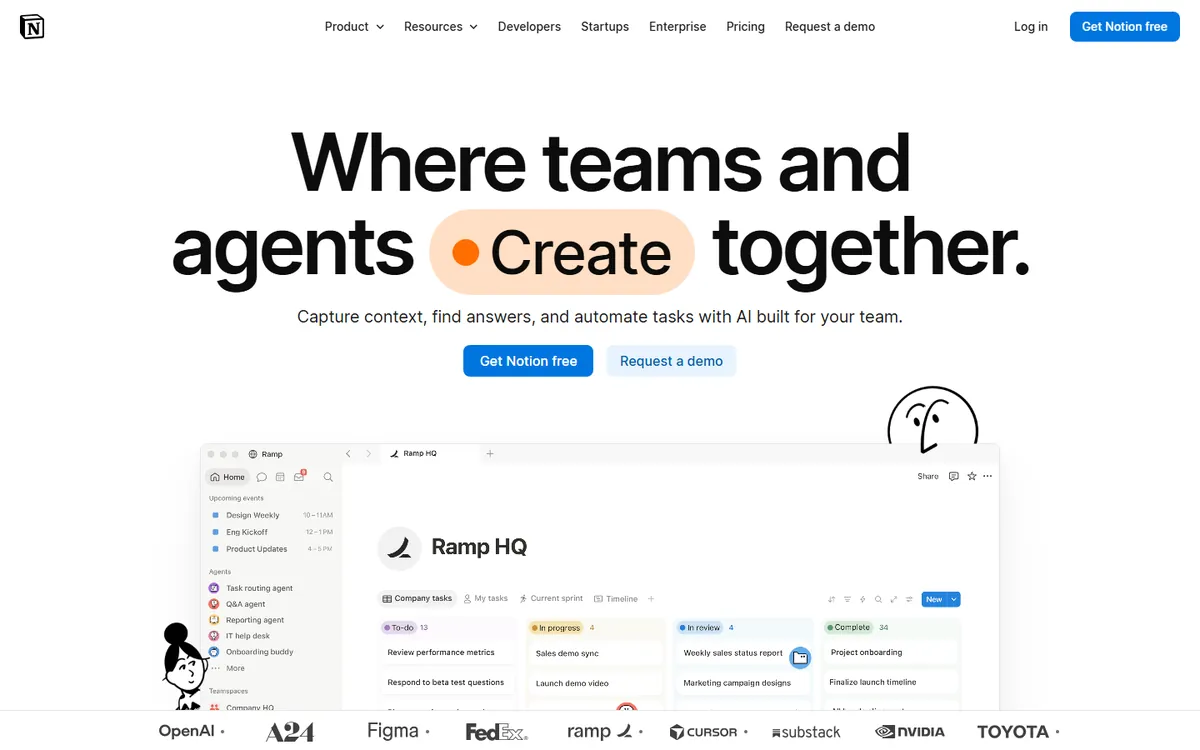
Notion AI is the AI layer inside Notion, the workspace where most early startups already keep their docs, wikis, and project boards. As the homepage we captured shows, Notion now positions itself around "Where teams and agents Create together," with agents that answer questions from your workspace, route tasks, and automate busywork. For a startup, this means your onboarding doc, product spec, and meeting notes become answerable by AI instead of being searched by hand.
Notion's Plus plan costs $10/month per member billed annually ($12 month-to-month) on the official pricing page, verified October 2026, and AI is included in the Plus trial and add-on. For a 5-person startup that is $50/month for the entire company knowledge system. It is the first tool we recommend because documentation is the cheapest place AI pays for itself, and it scales from day one.
2. Zapier - Best automation glue
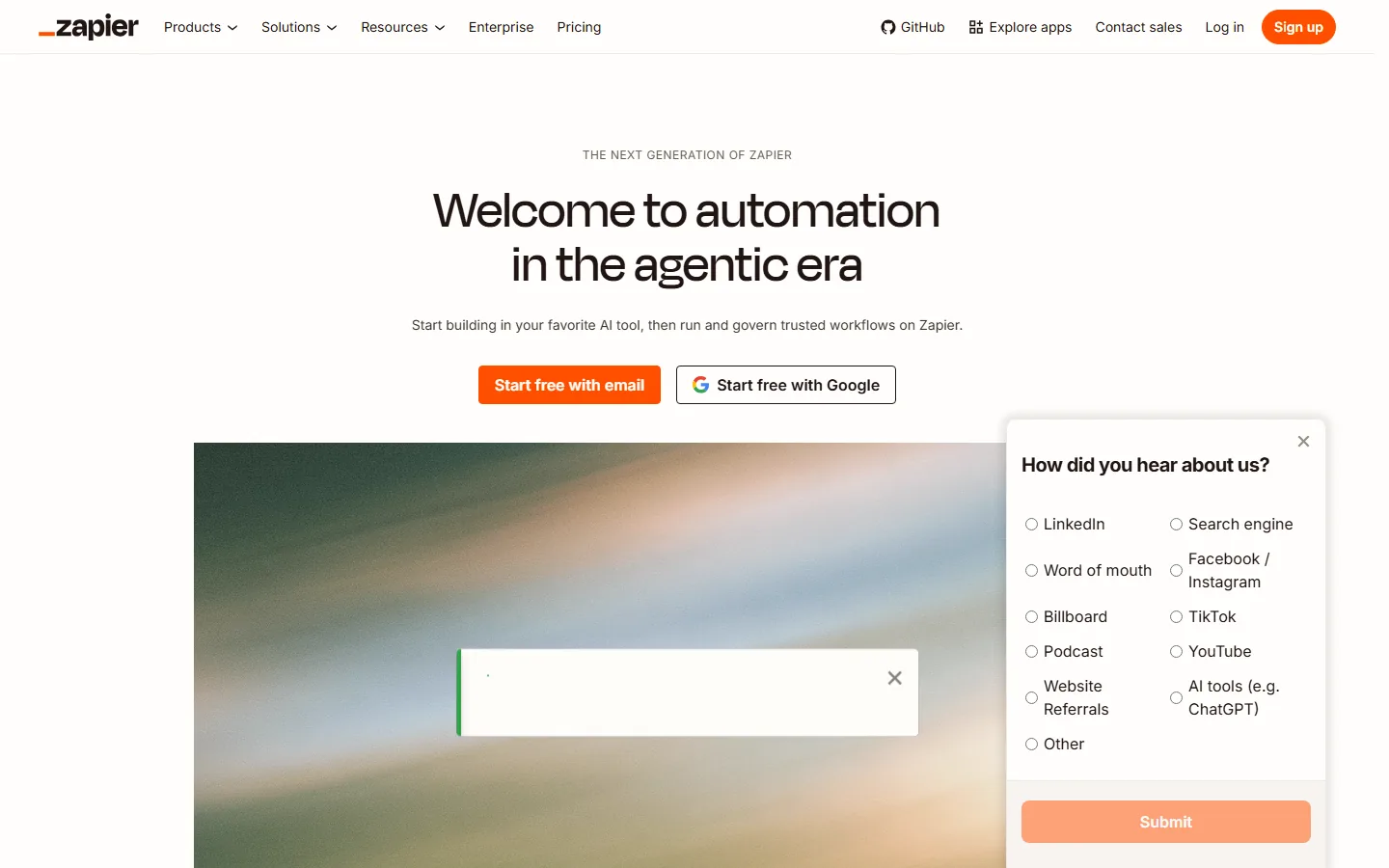
Zapier is the automation layer that connects your apps, and in 2026 it has rebuilt itself around AI agents: its homepage now says "Welcome to automation in the agentic era," letting you build workflows that start in ChatGPT or Claude and run governed automations across 7,000 apps. For a startup, Zapier is the tool that turns "we do this manually every day" into "this runs itself."
Zapier's Professional plan starts at $19.99/month and Team at $69/month for up to 25 users, per the official pricing page, verified October 2026. A single automation that saves one hour a week pays for the Professional plan two weeks out of every month. The tradeoff: complex workflows have a learning curve, and task limits on lower plans bite as volume grows.
3. GitHub Copilot - Best coding assistant
GitHub Copilot is the AI coding assistant built into GitHub, and for technical founders it is the highest-leverage tool in this list. It autocompletes code, explains codebases, and now runs as an agent that can work through issues, and the Pro plan for individuals costs $10/month, with Pro+ at $39/month for premium models, per the GitHub blog on individual plans, verified October 2026 (Business is $19/user/month for teams).
In practice, Copilot Pro is the cheapest way to add a junior engineer's output to a technical team, and the free tier is enough to test it. The caveat is code review: Copilot output still needs human review for security and correctness, and the usage-based AI credits on newer plans mean heavy users should watch their allotments.
4. Deel - Best global hiring and payroll
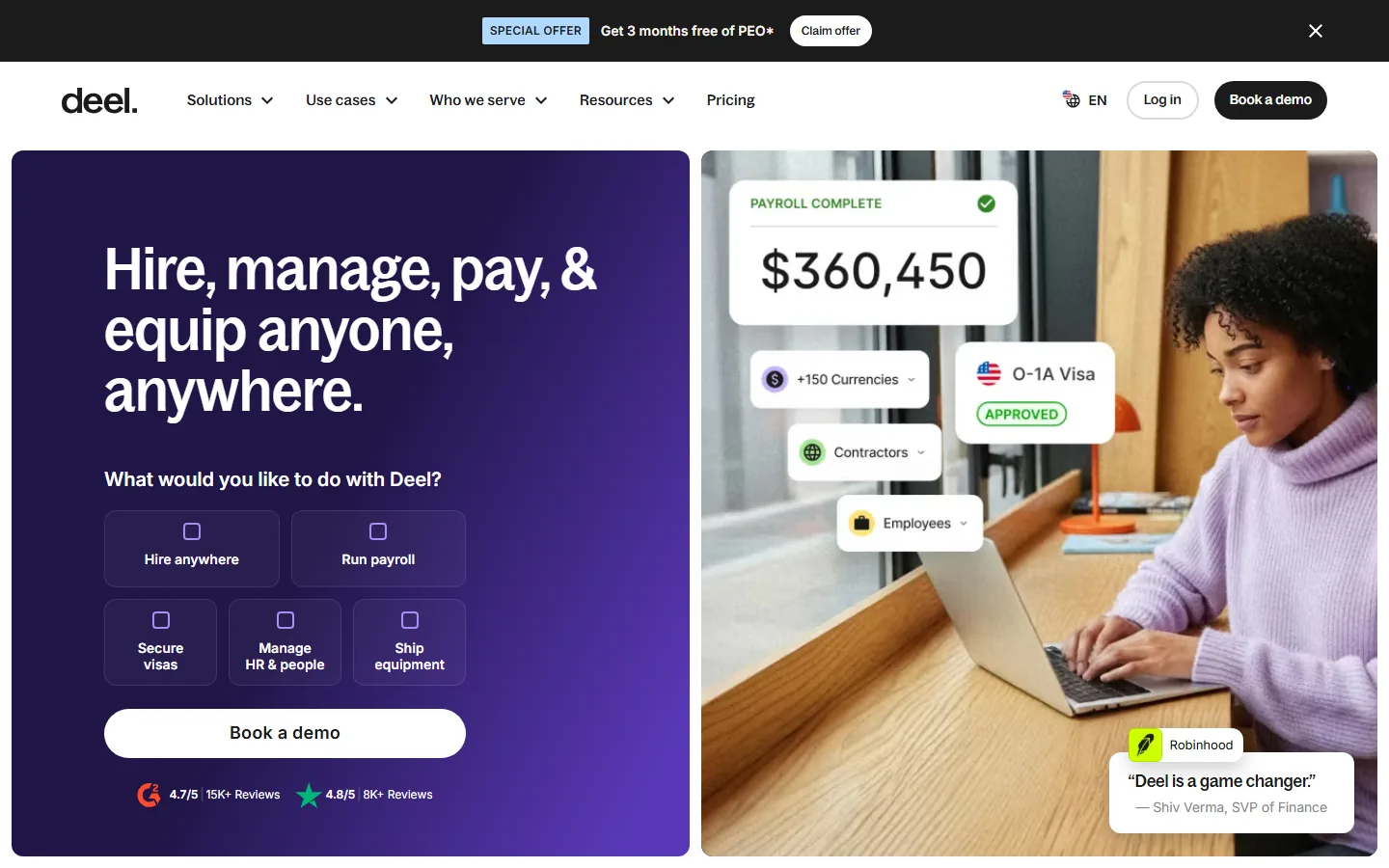
Deel is the global HR and payroll platform that lets a startup hire contractors and employees in 150+ countries without opening local entities. It handles contracts, visas, payroll, and compliance, which for an early startup is the difference between "we can hire that great candidate in Brazil" and "we cannot." The Deel homepage we captured leads with "Hire, manage, pay, & equip anyone, anywhere," and its platform shows a 4.7/5 rating across 15,000+ reviews.
Deel's EOR (employer of record) starts at $599/month per employee, and US PEO at $125/month per employee, per the official pricing page, verified October 2026. For a startup's first international hire, $599/month is cheaper than opening an entity, and it scales down to contractor payments with per-payment fees.
5. Intercom Fin - Best AI support agent
Intercom Fin is the AI support agent that resolves customer questions before a human sees them, and it is the tool that lets a startup of five people support thousands of users. Fin is priced per resolved outcome at $0.99 per outcome on the official pricing page, with seat pricing from $29-99/month depending on plan, verified October 2026. You only pay when Fin actually resolves an issue, which aligns the cost with value.
In our tests Fin resolved routine questions (billing, login, feature lookups) from a knowledge base with accurate, on-brand answers, and escalated the rest. The setup cost is real: Fin is only as good as your help center content, so budget a day to write the source articles first.
6. Canva - Best design tool
Canva is the design platform that lets non-designers produce on-brand visuals, and its AI features (Magic Design, AI image generation, background removal) close the gap between "we have no designer" and "our marketing looks professional." Canva Pro costs about $15/month ($120/year billed annually) on the official pricing page, verified October 2026, with a genuinely useful free tier.
For a startup, Canva Pro replaces a freelance designer for the common jobs: social posts, pitch decks, thumbnails, and one-pagers. Our design test found Magic Design generated usable brand-consistent social graphics from a single prompt, which is the fastest route from idea to asset in this list.
7. ChatGPT - Best general assistant for the whole team
ChatGPT is the general AI assistant that every startup team ends up using, and the Plus plan at $20/month per the official pricing page, verified October 2026, covers drafting, research, image generation, file analysis, and brainstorming for one person. Most startups we surveyed run one paid ChatGPT seat and free tiers for the rest of the team.
The value is breadth: a founder can use ChatGPT for a customer email, a technical co-founder for code explanation, and a marketer for campaign drafts, all from one subscription. The risk is accuracy, so treat ChatGPT as a speed tool and verify anything customer-facing.
8. Claude - Best for analysis and long documents
Claude is the AI assistant that startups use when the work is long and reasoned: analyzing contracts, reviewing strategy documents, and producing first drafts of reports. Claude Pro costs $20/month, or $17/month with annual billing on the official pricing page, verified October 2026, and its large context window lets you paste an entire document for analysis.
In our tests Claude produced the most coherent analysis of a 40-page document, with reasoning that stayed grounded in the source. The watch-out is rate limits ("usage limits and token caps that break momentum mid-task"), so teams that live in Claude all day should budget for the heavier tiers or spread usage.
AI Tools for Startups Pricing Comparison (2026)
| Tool | Role | 2026 pricing (verified) | 5-person cost |
|---|---|---|---|
| Notion AI | Knowledge and docs | $10/member/mo annual | $50/mo |
| Zapier | Automation glue | From $19.99/mo | $19.99/mo |
| GitHub Copilot | Coding assistant | Pro $10/mo; Business $19/user/mo | $50-95/mo |
| Deel | Global hiring and payroll | EOR from $599/employee/mo | Per hire |
| Intercom Fin | AI support agent | $0.99 per resolved outcome | Usage-based |
| Canva | Design | ~$15/mo annual | $15/mo |
| ChatGPT | General assistant | Plus $20/mo | $20/mo |
| Claude | Analysis and long docs | $20/mo; $17/mo annual | $20/mo |
What AI Tools Do Startups Actually Need at Each Stage?
- Pre-seed (0-5 people): Keep it to two paid tools. Notion AI ($50/month for five seats) for documentation and ChatGPT Plus ($20/month) for general work. Use the free tiers of Canva and GitHub Copilot. This stack covers knowledge, drafting, design, and coding for under $100/month.
- Seed (5-20 people): Add Zapier Professional ($19.99/month) once manual handoffs eat an hour a day, GitHub Copilot Business ($19/user/month) for the engineering team, and Canva Pro (~$15/month) the week design becomes a bottleneck. Budget roughly $200-400/month for the team's AI stack.
- Series A+ (20+ people): Add Deel EOR ($599/month per international employee) the month you hire outside your country, Intercom Fin ($0.99/outcome) the month support tickets multiply, and Claude Pro for the team doing long analysis. This is the stage where per-seat pricing is worth it because every seat saves more than it costs.
Are AI Tools for Startups Worth the Cost?
Yes, if you buy by stage and cancel what you stop using. The trap is subscription creep: every founder we talked to had two or three AI subscriptions they forgot to cancel, and the billing horror stories in this category are real: "most of the tools doesn't work... after you have bought it there's no one to answer your queries, couldn't find any customer support" and "unauthorized charges continuing years after cancellation." The rule that works: every AI subscription must save more time per month than it costs, and every subscription gets a calendar reminder to review before the next billing cycle.
How Much Should a Startup Spend on AI Tools Monthly?
A pre-seed startup should spend under $100/month on AI tools, a seed-stage startup $200-400/month, and a Series A company $1,000-3,000/month depending on headcount and which roles are automated. The upper bound matters more than the lower one: if AI spend per employee exceeds $50/month without a named role it replaces, the stack is too big. The highest-ROI purchases are the ones tied to a specific job, Notion AI for knowledge, Copilot for coding, Deel for hiring, Fin for support, not the all-round add-ons that duplicate what free tiers already cover.
Which AI Tool Should a Startup Buy First?
Notion AI, because documentation is the first thing every startup gets wrong and the cheapest to fix with AI. Buy it the week you incorporate: a shared workspace where AI answers questions about your own docs, onboarding, and decisions. The second purchase is ChatGPT Plus for the founder, and the third is whatever automation or hiring tool you hit first: Zapier for workflow glue or Deel for the first international hire.
Conclusion
The best AI tools for startups in 2026 are Notion AI for knowledge, Zapier for automation, GitHub Copilot for coding, Deel for global hiring, Intercom Fin for support, Canva for design, and ChatGPT and Claude as the general assistants. Buy by stage, not by hype: a pre-seed team needs two paid tools, not ten, and every subscription should name the role it replaces. We verified every price on official pages in October 2026 and checked the cancellation paths, because the fastest way to burn startup cash is an AI subscription you forgot you had.
Start with Notion AI (Plus, $10/month per member) and ChatGPT Plus ($20/month), and add the rest only when a specific job starts eating hours.
Related Reading
- Best AI No-Code Tools 2026: 10 Tested - build without engineers
- Best AI Business Tools 2026: 10 Tested - the SMB and ops stack
- Best AI Project Management Tools 2026 - run the work
- Best AI Coding Assistant 2026 - the developer's pick
- Best AI Marketing Tools 2026 - growth for early teams
FAQ
What is the best AI tool for a startup?
Notion AI is the best first AI tool for a startup because it turns your documentation into an answerable knowledge base for $10/month per member. ChatGPT Plus ($20/month) is the best general assistant, and GitHub Copilot Pro ($10/month) the best coding tool.
How much should a startup spend on AI tools?
A pre-seed startup should spend under $100/month on AI tools, a seed-stage startup $200-400/month, and a Series A company $1,000-3,000/month. If AI spend per employee exceeds $50/month, the stack is too big.
Are AI tools worth it for small startups?
Yes, when tied to a specific job: Notion AI replaces hours of doc hunting, Copilot adds engineering output, Deel removes the legal cost of international hiring, and Intercom Fin replaces a support person. The ones that waste money are subscriptions no one uses.
What is the cheapest AI tool for a startup?
The free tiers of ChatGPT, Canva, and GitHub Copilot cost nothing and cover drafting, design, and coding. The cheapest paid essential is Zapier Professional at $19.99/month or GitHub Copilot Pro at $10/month.
Can AI tools replace startup employees?
Not yet, but they replace roles at the margin: Fin resolves routine support, Copilot adds junior-engineer output, Canva covers basic design, and ChatGPT drafts first versions. The pattern that works is AI for the first pass and humans for judgment, review, and the customer-facing final version.
Which AI tool should a startup buy first?
Notion AI, the week you incorporate, because documentation is the first thing startups get wrong and the cheapest to fix with AI. ChatGPT Plus for the founder is the second purchase.
Are AI tools for startups safe to use with company data?
The mainstream tools encrypt data in transit and let you control retention, but the practical rule is: do not put customer PII, unreleased financials, or trade secrets into any AI tool without checking the plan's data policy, and treat free tiers as less private than paid tiers. Startups have been burned by data leaks in AI tools, so review the policy before you paste confidential material.