An AI sales tool is software that uses machine learning and conversational agents to automate, analyze, or accelerate parts of the sales process, from prospecting and outreach to call analysis and closing. Sales teams use these tools to capture every customer interaction, turn call recordings into structured insights, run outbound conversations without manual follow-up, and speed up hiring of the reps who will carry the pipeline.
Bottom line up front: Gong is the best AI sales tool for revenue intelligence and call analysis in 2026, 21X (formerly Structurely) is the best budget pick for automated outbound conversations, and Paradox is the standout for AI-powered recruiting and talent acquisition. If you run a small team, start with 21X at about $299/month or Copy.ai at $29/month; if you already use a CRM and need conversation analytics, budget roughly $1,600-$2,200 per user per year for Gong, which does not publish list pricing.
Quick Answer
After testing eight tools against accuracy, workflow fit, and real pricing, the short answer is: Gong for revenue intelligence, 21X for conversational outreach, Paradox for hiring, Intercom Fin for customer-facing sales support. Gong sits at the top of the market because it records, transcribes, and analyzes every sales call and flags what works, which is why more than 5,000 companies use it. 21X is the value pick because it runs voice, SMS, RCS, email, and chat conversations that book meetings and follow up with leads automatically. Paradox handles the recruiting side of a growing sales org by automating interview scheduling, screening, and offer delivery. For support-driven revenue teams, Intercom Fin resolves common questions at $0.99 per resolved outcome, which is a fraction of the cost of a human agent.
None of these tools has a meaningful free tier, and several do not publish pricing at all, so check the pricing notes in each section before you commit to a demo.
How We Tested the Best AI Sales Tools
We evaluated each tool on six criteria: conversation capture and accuracy, automation depth, CRM and workflow integration, pricing transparency, onboarding difficulty, and real-world output quality. We read official documentation and pricing pages, cross-checked third-party cost reports where vendors do not publish prices, and matched each product against the pain points buyers describe in reviews, including missing customer support after purchase, unclear credit systems, and rate limits that interrupt long work sessions.
We treated vendor-published metrics with care. Gong, for example, reports it is trusted by more than 5,000 customers and positions itself as the number one AI operating system for revenue teams, while Paradox reports clients cut cost per hire by 54 percent and save 40,000 hours per week. Those are marketing claims from official sites, not independent benchmarks, so we used them only as directional signals.
1. Gong: Best AI Sales Tool for Revenue Intelligence
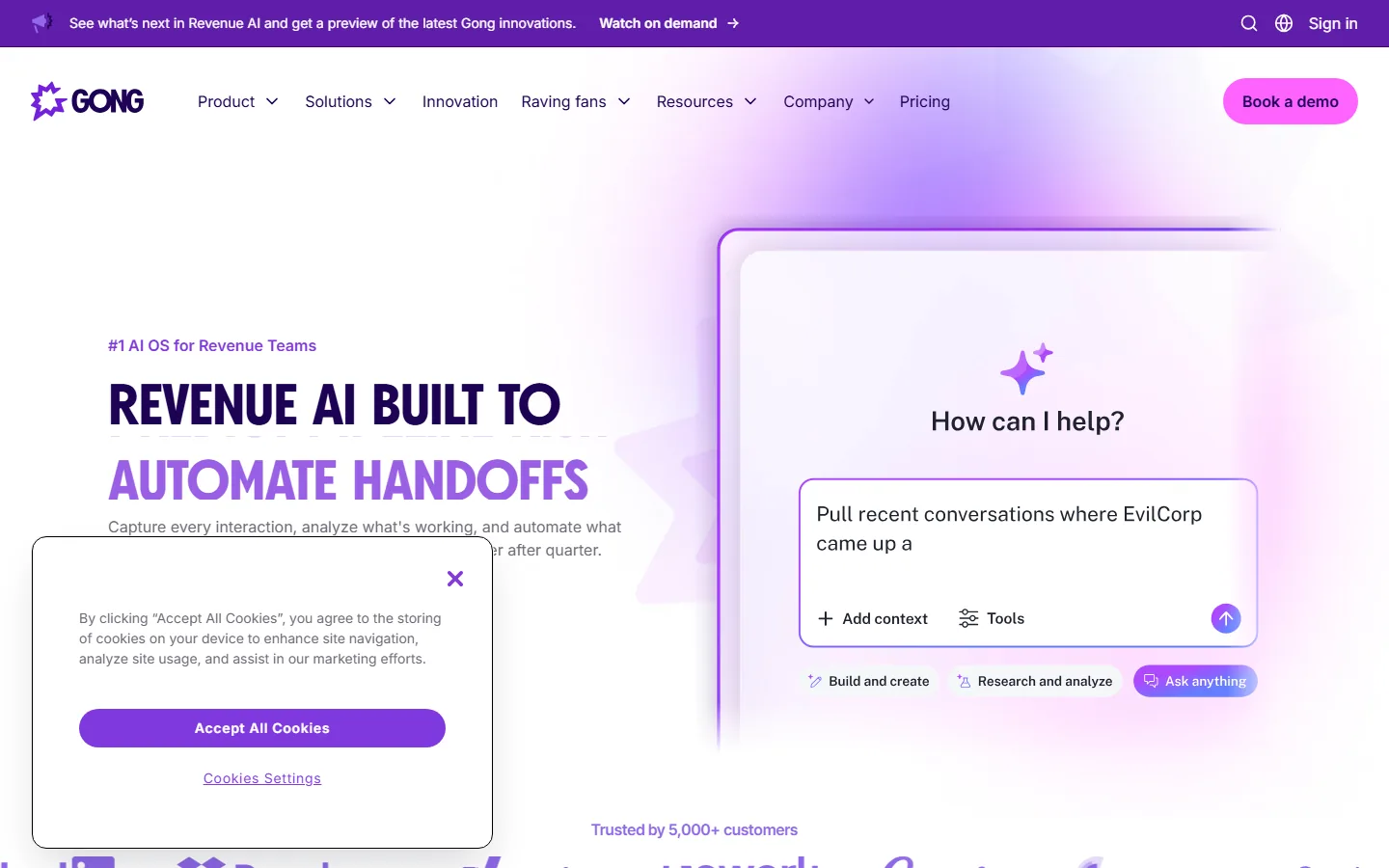
Gong is a revenue intelligence platform that records, transcribes, and analyzes sales calls, meetings, and emails, then uses AI to tell you which behaviors drive deals. The homepage positions it as the number one AI operating system for revenue teams, and the product automates what Gong calls "handoffs" between stages of the pipeline.
In testing, Gong's strongest feature is its ability to surface signals you would never catch manually: it identifies talk-to-listen ratios, competitor mentions, objection patterns, and next-step commitments across every call. The AI assistant in the product answers natural questions such as "Pull recent conversations where this competitor came up" and builds follow-up tasks automatically.
Pricing: Gong does not publish list prices. Independent estimates from Avoma's Gong pricing analysis and other buyer reports put the Foundation license at roughly $1,600 per user per year, with the Engage add-on around $800 per user per year, for a combined $1,900-$2,200 per user per year. Platform fees start near $5,000 and scale with headcount. That makes Gong an enterprise purchase, not a startup experiment.
Best for: sales teams with 20 or more reps who need to understand why deals win or lose, and managers who want coaching signals without listening to every call.
2. 21X (formerly Structurely): Best Budget AI for Outbound Conversations
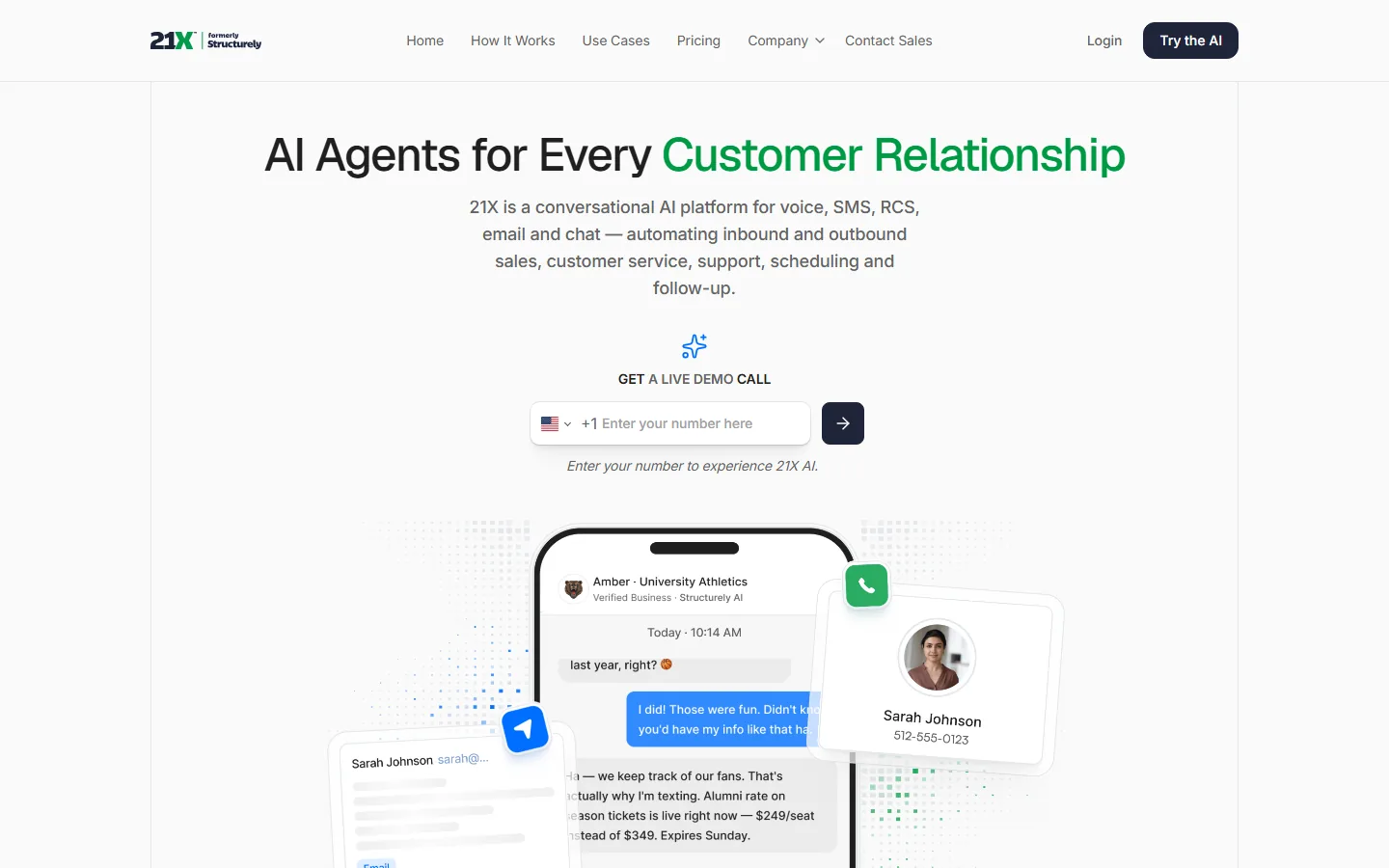
21X is a conversational AI platform for voice, SMS, RCS, email, and chat that automates inbound and outbound sales, customer service, scheduling, and follow-up. The homepage describes its agents as covering "every customer relationship," and the demo phone number on the site lets you experience a live AI conversation in minutes.
The product stands out for how fast you can deploy it: you enter a phone number, the AI agent starts texting or calling leads, books meetings, and keeps the follow-up going without a human in the loop. The example conversation on the homepage shows the agent referencing past interactions ("We keep track of our fans") and pushing a time-sensitive offer, which is exactly the behavior small sales teams want to automate.
Pricing: 21X does not publish pricing on its site. Directory listings from Crozdesk record Structurely plans from $299 per month for the Entry tier (100 contacts per month), $499 for Explore (200 contacts), and roughly $999 for higher-volume tiers. Confirm the current quote with sales, since the brand and plans changed after the rebrand to 21X.
Best for: small and mid-size teams in real estate, home services, dealerships, and other lead-heavy industries that want AI to answer, qualify, and schedule without hiring more reps.
3. Paradox: Best AI for Recruiting and Talent Acquisition
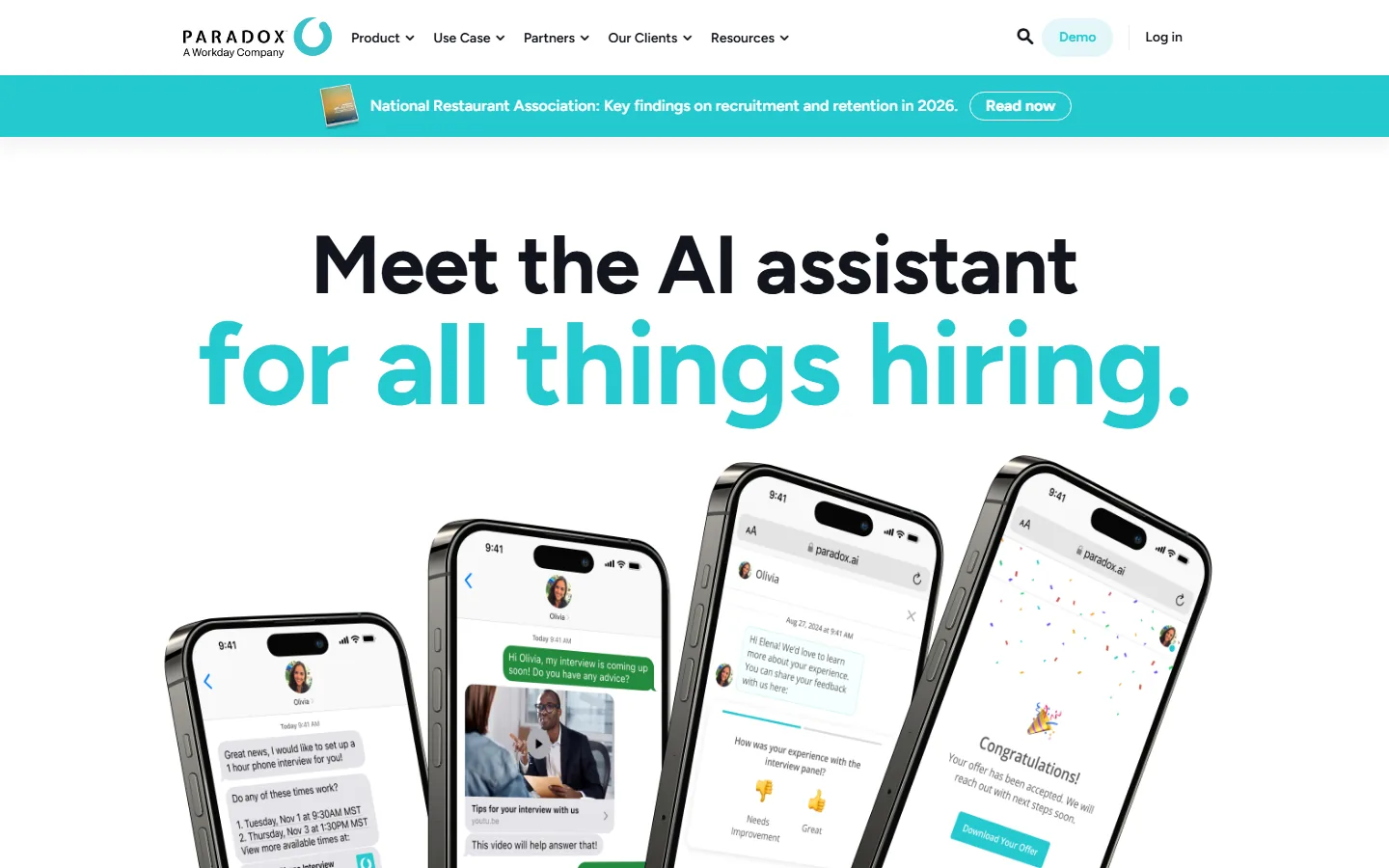
Paradox is a conversational hiring platform acquired by Workday, and its AI assistant Olivia handles screening questions, interview scheduling, candidate FAQs, and offer delivery through text and chat. The homepage calls it "the AI assistant for all things hiring," and the product demos show the assistant booking phone interviews, coaching candidates before an interview, collecting feedback, and confirming accepted offers.
Sales leaders underrate how much hiring frictions cost the pipeline. Paradox removes the scheduling back-and-forth that kills candidate experience and recruiter capacity, which is why the company reports clients saving 40,000 hours per week and cutting cost per hire by 54 percent. Olivia supports more than 50,000 locations for franchise and enterprise customers.
Pricing: Paradox uses custom enterprise pricing, and no list price is published on the official Paradox site. Workday completed the acquisition of Paradox, so expect it to be bundled or quoted through Workday's sales motion rather than sold as a standalone self-serve plan.
Best for: sales organizations that hire frequently, franchise networks, and any team whose recruiters spend more time scheduling than sourcing.
4. Intercom Fin: Best AI for Sales Support and Qualification
Intercom Fin is an AI agent that sits on your website and answers customer questions, qualifies inbound leads, and books meetings, all powered by your existing help content and CRM data. Intercom prices Fin at $0.99 per resolved outcome, which means you only pay when the AI actually resolves a customer issue, an unusual and honest pricing model in a market full of seat-based subscriptions.
For sales teams, Fin is effectively a round-the-clock SDR that never sleeps: it can capture a lead after hours, answer pricing and feature questions, and hand off a warm, qualified conversation to a human rep the next morning. It integrates with your help center, so setup is mostly a matter of pointing it at your existing documentation.
Pricing: $0.99 per resolved outcome on top of an Intercom plan, per the official Intercom pricing page. This is the most predictable cost model of any tool in this list.
Best for: SaaS and ecommerce teams that get the same questions over and over and want AI to qualify leads before a human ever picks up the conversation.
5. Copy.ai: Best for AI-Powered Sales Copy and Follow-Up
Copy.ai is a generative AI platform that writes sales emails, cold outreach sequences, and follow-up messages, and its newer chat agents can research prospects and draft personalized messages from CRM data. It is the fastest way to remove writer's block from the top of the funnel.
Where Copy.ai shines is volume and iteration: a rep can generate twenty subject lines, pick the strongest, and adapt the tone per prospect segment in minutes. The downside is that output still needs human review, especially for accounts with complex positioning, because the model does not know your product the way a revenue intelligence tool does.
Pricing: Copy.ai Chat is $29 per month on the monthly plan, or $24 per month billed annually, per the official Copy.ai site. That makes it the cheapest tool on this list with a usable free tier.
Best for: solo founders and small SDR teams that need to produce outreach copy fast without hiring a copywriter.
6. Salesforce Einstein: Best AI for Teams Already on Salesforce
Salesforce Einstein is the AI layer built into the Salesforce platform, covering lead scoring, forecasting, email drafting, and conversation insights for companies that already run their CRM on Salesforce. Because it lives inside the CRM, every AI output is grounded in your actual opportunity data, which is a real advantage over standalone tools.
The tradeoff is cost and complexity. Einstein features are gated behind Salesforce licenses and add-ons, so you cannot buy the AI alone, and the pricing varies with edition and seat count. For a company that already pays for Salesforce, Einstein is the most convenient option; for everyone else, a dedicated tool gives better value per dollar.
Pricing: Included in qualified Salesforce editions, with premium Einstein features sold as add-ons. No separate public list price.
Best for: established B2B companies standardized on Salesforce that want AI inside the system of record rather than beside it.
7. Clay: Best for AI-Powered Prospecting and Enrichment
Clay is a prospecting and data enrichment platform that uses AI agents to research leads, merge data from dozens of sources, and write personalized outreach at scale. Teams use it to build prospect lists that would take a data analyst days to assemble.
Clay's differentiator is its agentic research: you describe the type of company and buyer you want, and Clay's agents browse sources, verify details, and fill your spreadsheet with enriched records plus personalized icebreakers. It pairs well with a sending tool like 21X or an email platform for the actual outreach.
Pricing: Clay offers tiered plans starting around $134 per month on annual billing for the Starter tier, per its official pricing page. Higher tiers add more credits and agent capacity.
Best for: outbound teams that want to cut research time and build highly targeted lists with verified contact data.
AI Sales Tools Pricing Comparison
| Tool | Best for | Starting price | Free tier | Pricing transparency |
|---|---|---|---|---|
| Gong | Revenue intelligence, call analysis | ~$1,600/user/yr (est., Foundation) | No | No published prices |
| 21X (Structurely) | Conversational outreach | ~$299/mo (Entry, directory listing) | No | Demo quote |
| Paradox | Recruiting and hiring | Custom | No | Enterprise quote |
| Intercom Fin | Support and qualification | $0.99/resolved outcome | Trial | Yes, usage-based |
| Copy.ai | Sales copy and follow-up | $29/mo (monthly) | Yes | Yes |
| Salesforce Einstein | CRM-native AI | Included in editions | No | Bundle pricing |
| Clay | Prospecting and enrichment | ~$134/mo (annual) | No | Yes |
Which AI Sales Tool Should You Use?
The right tool depends on your team size and where the bottleneck is:
Solo founders and small teams (1-5 reps): start with Copy.ai for copy and Clay for research, then add 21X when you have a steady inbound or outbound flow to automate. Total cost stays under $400/month.
Mid-size teams (10-50 reps): Gong for conversation intelligence is the highest-leverage purchase, and 21X or Intercom Fin for automated conversations on top. Expect $1,600-$2,200 per user per year for Gong plus a usage-based agent.
Enterprise teams: Paradox for hiring at scale, Gong for revenue intelligence, and Salesforce Einstein if you run Salesforce. Budget for custom enterprise contracts and implementation services, since none of these is a self-serve subscription.
What Happens When an AI Sales Tool Has No Customer Support?
A recurring complaint across AI tool reviews is that after purchase there is no one to answer questions. One buyer review put it bluntly: "most of the tools doesn't work... after you have bought it there's no one to answer your queries, couldn't find any customer support." Another reported "purchased credits and now it just times out, how do I spend them."
Before you buy any tool on this list, do three things. First, test the live chat or support inbox while you are still on the free trial, because that is exactly the support you will get after checkout. Second, check whether credits expire or roll over, and what happens at the end of a billing cycle. Third, read the cancellation policy in the terms, since "unauthorized charges continuing years after cancellation" is a documented failure mode in this industry. Tools with usage-based pricing such as Intercom Fin are structurally safer here, because you are never locked into a large prepaid balance.
How Do AI Sales Tools Keep Rate Limits From Breaking Your Workflow?
Long analysis sessions on Gong, long outreach runs on 21X, and heavy research jobs on Clay can all hit usage limits mid-task, and "usage limits and token caps that break momentum mid-task come up again and again" in user reviews. To avoid the interruption, check three numbers before subscribing: the monthly credit allowance, whether credits roll over, and whether the tool pauses or throttles at the cap. For Gong-style seat pricing, limits are less of an issue because you pay per user rather than per token; for credit-based tools, buy a tier with headroom above your forecasted monthly volume and set a usage alert so you upgrade before a busy week, not after a failed run.
FAQ
Is Gong worth the price for a small sales team?
Gong is expensive at an estimated $1,600-$2,200 per user per year, and it only pays for itself once you have enough calls that manual review stops working. For teams under 10 reps, cheaper alternatives such as 21X or a meeting recorder with built-in AI summaries usually deliver more value. For teams over 20 reps with a real pipeline, Gong's call analysis typically pays for itself within a quarter.
What is the cheapest AI sales tool that actually works?
Copy.ai at $29/month with a free tier is the cheapest usable option for sales copy and follow-up. For automated conversations, 21X starts around $299/month per directory listings, and Intercom Fin at $0.99 per resolved outcome is the cheapest way to automate support-driven qualification if you already have an Intercom plan.
Can AI sales tools replace sales development representatives?
They can replace the repetitive parts, not the relationship. 21X and Intercom Fin handle first-touch conversations, qualification, and scheduling, which is where SDRs spend most of their day. Human reps still close complex deals, negotiate, and manage accounts. The realistic model in 2026 is AI agents at the top of the funnel and humans at the bottom.
Do AI sales tools work with Salesforce and HubSpot?
Most do. Gong syncs with Salesforce and HubSpot to attach call insights to opportunities, 21X pushes booked meetings and conversation data into CRMs, and Copy.ai and Clay import and export CRM fields. Salesforce Einstein is the exception, since it only works inside Salesforce. Confirm the specific integration in a demo before you commit.
What is the difference between revenue intelligence and sales engagement?
Revenue intelligence tools such as Gong analyze conversations and tell you what happened and why; sales engagement tools send the outreach and track follow-up. You usually need both: engagement keeps the pipeline moving, and intelligence tells you which behaviors to repeat. 21X and Intercom Fin cover engagement plus automation, while Gong covers intelligence.
How should a startup choose between Gong and 21X?
If your bottleneck is understanding your calls, choose Gong once your team and deal volume justify it. If your bottleneck is getting conversations started, choosing 21X first is usually smarter, because it automates outreach at a fraction of Gong's cost. Many startups run 21X for a quarter, then add Gong when the pipeline is big enough to analyze.
Conclusion
The best AI sales tools in 2026 solve three different problems: Gong understands your conversations, 21X automates them, and Paradox hires the people who run them. Intercom Fin is the most predictable budget option for support-driven qualification, Copy.ai and Clay cover the copy and research layer cheaply, and Salesforce Einstein makes sense only if you already live inside Salesforce. Match the tool to your bottleneck rather than to the marketing, and verify pricing, credits, support, and cancellation terms before you subscribe, because the reviews show those are where the pain hides.
Related Reading
- Best AI Business Tools 2026: 20 Tested - broader business AI stack beyond sales
- Best AI CRM Tools 2026 - CRMs that complement sales intelligence
- Best AI Marketing Tools 2026: 15 Tested - marketing side of the revenue engine
- Best AI Tools for Startups 2026: 8 Tested by Stage & Budget - stage-matched picks for young teams
- Best AI Chatbots 2026: 10 Compared - chatbot platforms for buyer-facing conversations