Claude Code vs GitHub Copilot 2026: Which AI Coding Agent Should You Use?
Quick Answer: Claude Code is an agentic coding tool from Anthropic that reads your codebase, plans implementations, edits files, runs tests, and iterates on failures autonomously. GitHub Copilot is GitHub's AI coding assistant that adds inline completion, chat, and a multi-model coding agent to the editor you already use. Claude Code wins for autonomous, multi-file refactors and deep codebase reasoning, while GitHub Copilot wins for inline completion, editor coverage, and price. Claude Code ships inside every paid Claude plan from $20/month and leads neutral agent benchmarks like the AA Coding Agent Index, but it has no free tier. Copilot starts at $0 with 2,000 free completions per month, costs $10/month on Pro, and works across VS Code, JetBrains, Visual Studio, Neovim, Xcode, and Eclipse. Most professional developers in 2026 use both: Copilot for typing-speed assistance in the editor, Claude Code for whole-task delegation from the terminal.
What Is Claude Code?
Claude Code is Anthropic's agentic coding tool that reads your codebase, edits files, runs shell commands, runs tests, and iterates largely unattended before reporting back for review. It is available as a terminal CLI, a VS Code and JetBrains extension, a desktop app, and a web interface, and it supports the Model Context Protocol (MCP) for connecting external tools such as Jira, Slack, and Google Drive. Since mid-2026, Claude Code is bundled into every paid Claude subscription tier rather than sold as a separate product, which means the $20/month Claude Pro plan includes full Claude Code access in the same usage pool as chat.
The defining trait of Claude Code is depth over breadth. It plans an implementation, executes it across multiple files, runs the test suite, and iterates on failures without waiting for step-by-step direction. Its 1-million-token context window lets it hold an unusually large slice of a repository in memory, which is why independent trackers place it at the top of neutral coding-agent leaderboards: the AA Coding Agent Index gives it a score of 67, and it posts 83.8% on Terminal-Bench 2.1. If your work is "refactor this module," "fix this flaky test," or "migrate this API," Claude Code is designed for exactly those tasks. Anthropic publishes the full model lineup and API rates on its official Claude page, which is the authoritative source for context windows and per-token pricing.

What Is GitHub Copilot?
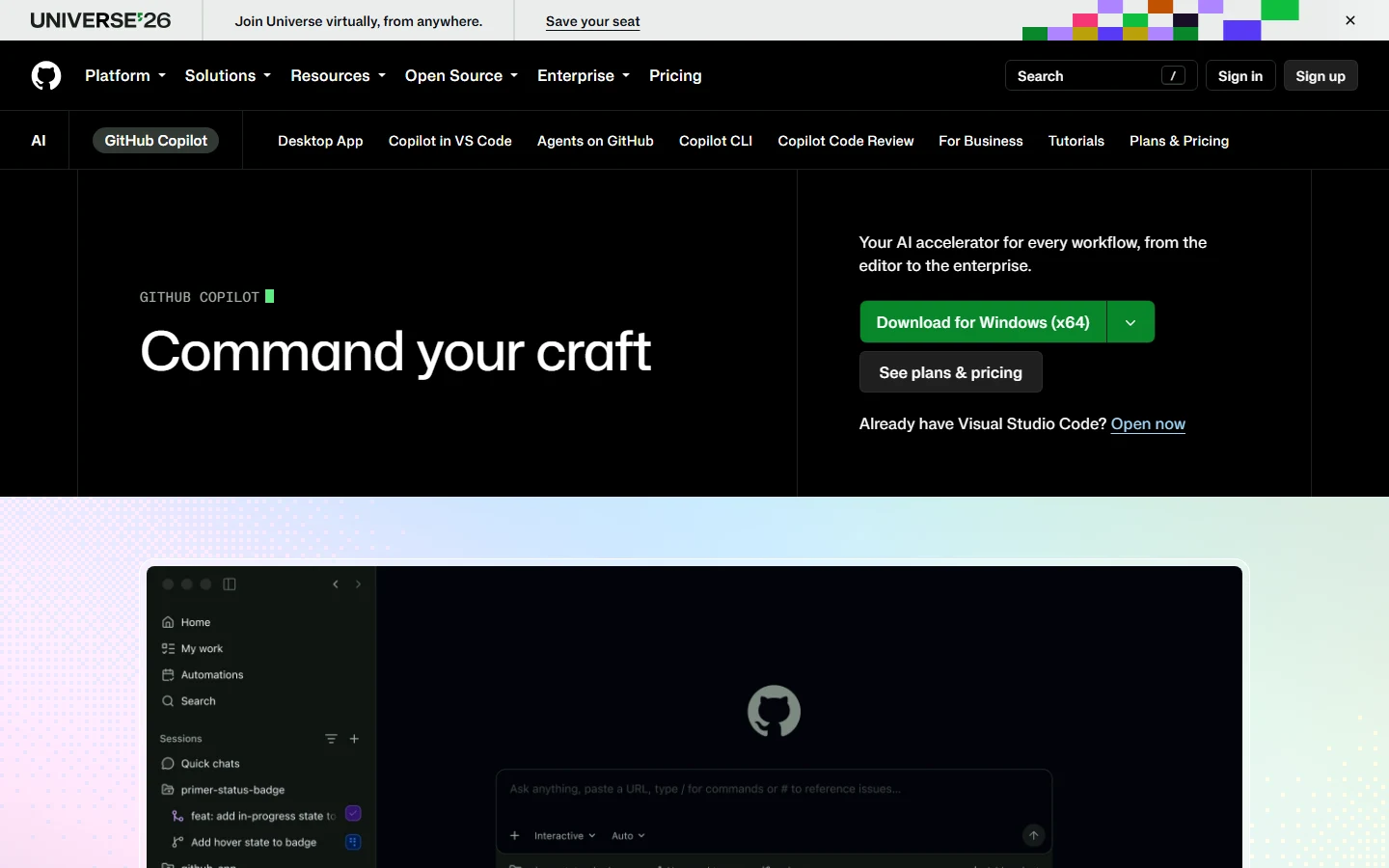
GitHub Copilot is GitHub's AI coding assistant, offered as inline code completion plus a multi-model agent mode that can plan and execute multi-file changes, open pull requests, and run a cloud-based coding agent. It installs as an extension into the editor you already use, which is the core of its appeal: VS Code, JetBrains IDEs, Visual Studio, Neovim, Xcode, and Eclipse are all natively supported. Copilot CLI, generally available since February 2026, adds a terminal interface on every plan including Free.
Copilot is built around not changing how you work. Ghost-text completions appear as you type with latency in the 100-300ms range, and the chat interface has no learning curve. The deeper differentiator is the GitHub-native workflow: you can assign a GitHub issue to Copilot's cloud agent and get back a self-reviewed pull request with built-in security scanning, and Agent HQ lets you route the same task to Claude, Codex, or a custom agent for comparison. As of February 2026, Claude by Anthropic and OpenAI Codex are available in public preview inside Copilot for Pro+ and Enterprise subscribers, so a Copilot user can run Claude on GitHub-hosted infrastructure without an Anthropic account. GitHub's Copilot product page is the authoritative source for plan details and the June 2026 AI Credits change.
Claude Code vs GitHub Copilot Pricing: Which Is Cheaper in 2026?
| Plan | Claude Code (Anthropic) | GitHub Copilot |
|---|---|---|
| Free tier | None. Claude chat is free, but Claude Code requires a paid plan or pay-per-token API | Free: 2,000 completions/mo, 50 chat requests/mo, Copilot CLI included |
| Entry paid | Claude Pro $20/mo ($17/mo annual): includes Claude Code | Pro $10/mo: unlimited completions, about $15 of AI Credits |
| Mid tier | None directly; Max 5x at $100/mo and Max 20x at $200/mo | Pro+ $39/mo: about $70 of AI Credits, premium models, cloud-agent delegation to Claude Code/Codex |
| Top individual | Max 20x $200/mo, usage expressed as multiples of Pro | Max $100/mo: about $200 of AI Credits |
| Team | Team Standard $25/seat/mo annual, Premium $125/seat/mo annual | Business $19/user/mo, Enterprise $39/user/mo |
Two pricing facts matter more than the sticker prices. First, on June 1, 2026, GitHub retired Premium Request Units and moved to GitHub AI Credits, a token-metered unit priced at $0.01 per credit. The $10 Pro plan carries roughly 1,500 included credits, Pro+ about 7,000, and Max about 20,000. Code completions and Next Edit Suggestions remain unmetered on every tier, but chat, agent mode, and CLI usage now draw from the credit pool. Independent trackers estimate that effective capacity for the heaviest agent-mode users fell several-fold even though headline prices did not change.
Second, Claude's plans are flat-fee with pooled usage limits that reset on a rolling five-hour session window, plus weekly caps on paid plans. When you hit a limit, you can wait for the reset, upgrade, or turn on usage credits to keep working at standard API rates: Claude Sonnet 5 runs $3/$15 per million input/output tokens (with an introductory $2/$10 through August 31, 2026), Opus 4.8 runs $5/$25, and Haiku 4.5 runs $1/$5. Output tokens cost exactly five times input on every current-generation Claude model, a ratio worth building into any cost estimate because coding tasks are output-heavy.
The honest summary: Copilot is cheaper at every rung until the top. Free beats nothing, $10 beats $20, $39 beats $100, and $19/seat beats $25/seat for teams. The comparison inverts only at the ceiling, where Copilot Max is $100 for a $200 credit pool that can run out, while Claude Max 20x is $200 for 20x Pro usage with no dollar meter at all. If your usage is heavy and steady, the flat Claude plan can be cheaper than a credit pool plus overage. If it is light or spiky, Copilot wins on price outright.
Which One Handles Long Sessions Better: Rate Limits and Reliability
A recurring complaint from real users is that usage limits break momentum mid-task. One widely cited review of Claude tools captures the pattern directly: "usage limits and token caps that break momentum mid-task come up again and again," and "two low scores both trace back to recent rate limits rather than model quality itself." If you have ever been cut off in the middle of a long refactor, you know exactly what that feels like.
Claude Code mitigates this with a flat-fee pool and an "extra usage" option. Once a plan's included limit is reached, you can opt into pay-as-you-go overage at standard API rates with a self-set monthly spend cap, rather than being cut off outright. Reported average daily spend for interactive individual use generally lands in the single-digit-to-teens of dollars per active day, with the large majority of users well under $30/day. Max-tier subscribers have reported aggressive rate-limit windows on long sessions, but the throttling is predictable: Anthropic states headroom as a multiple of Pro, so heavy weeks are slowed rather than invoiced.
Copilot takes the opposite approach. Every paid tier bills chat, agent, and CLI usage separately in AI Credits on top of the seat price, and GitHub's own documentation notes that additional usage "may be capped." You generally need to actively configure and fund a budget to keep working past your included allowance rather than being billed automatically without limit. The April 2026 rate-limit enforcement retroactively corrected undercounted token usage and locked some users out for days, which shows the risk of a metered system where the accounting is opaque. If predictable, interruption-free long sessions matter to you, model both tools against your actual token consumption before choosing.
What About Hallucinations and Accuracy in Coding Agents?
Accuracy friction is the second most common complaint across AI tools. A G2 analysis of user reviews found that up to 1 in 4 ChatGPT reviews (23%) and 1 in 5 Gemini reviews (20%) mention accuracy friction, and one reviewer of Claude models put it plainly: "it still hallucinates a lot... even on top models." For coding agents, the risk is not just wrong prose; it is confident changes to files, imports, or APIs that do not exist.
The practical difference in 2026 is verification tooling. Claude Code runs tests and iterates on failures as part of its normal loop, and its "review checkpoint" workflow shows you a diff you can accept or reject before anything is written to the repo. Copilot's coding agent builds in self-review, security scanning, and model picker controls, and its PR workflow makes every AI change reviewable in a pull request. Neither tool eliminates hallucinations, but both have moved the burden from "trust the output" to "review the diff," which is the right architecture for critical work. Independent audits have also noted that a meaningful share of "solved" tasks on SWE-bench Verified pass by coincidence rather than correct reasoning, so treat benchmark scores as directional, not proof.
Claude Code vs Copilot: Which One Should You Pick?
| Capability | Claude Code | GitHub Copilot |
|---|---|---|
| Free tier | No (needs paid Claude plan or API) | Yes, 2,000 completions/mo |
| Entry price | $20/mo (Pro, includes Claude Code) | $10/mo (Pro) |
| Model choice | Anthropic models only | Claude, OpenAI, Gemini + Copilot models |
| Editor coverage | Terminal first, VS Code/JetBrains extensions | VS Code, JetBrains, Visual Studio, Neovim, Xcode, Eclipse |
| Autonomous PR creation | Via subagents / Agent SDK | Yes, assign an issue and get a PR |
| Context window | 1M tokens | Model-dependent, 1M option via Claude models |
| Billing model | Flat-fee pooled usage | Token-metered AI Credits |
| Best for | Large refactors, unfamiliar codebases, multi-repo work | Inline coding, GitHub-native teams, budget buyers |
If your day is mostly typing inside VS Code or JetBrains, working in GitHub-hosted repositories, and you want a single subscription covering inline completions, chat, and an asynchronous coding agent, GitHub Copilot is the obvious pick in 2026. It is the broadest tool, it now hosts Claude and Codex as first-class third-party agents, and Pro is the cheapest serious option on the market.
If your day is mostly handing off whole tasks and you want an agent that actually plans, edits across files, runs tests, and reports back, Claude Code is the more capable tool. The terminal-first design, subagents, hooks, MCP ecosystem, and 1M-token context window are built for long-horizon autonomous work in a way Copilot's cloud agent has not reached.
For solo developers on a budget, start with Copilot: the free tier is genuine and Pro is the lowest paid entry of any major tool. For senior engineers doing complex refactors, large-scale migrations, or running multiple agents in parallel, Claude Code Max earns its higher seat cost in saved hours. And for most professional developers in 2026, the answer is both. Copilot Pro covers inline completions and quick agent tasks; Claude Code handles the 20% of tasks complex enough to justify an autonomous agent. The tools sit at different layers, and the cost of running both is small compared with the productivity delta.
This decision does not happen in isolation. Our best AI coding tools guide covers the full field, and the AI coding tools comparison test gives hands-on numbers across Cursor, Copilot, and Claude Code. If you are also weighing Cursor vs GitHub Copilot, our AI agent tools roundup explains where agentic coding fits, and the Claude vs Gemini comparison covers the models underneath both products.
FAQ
Q: Is Claude Code better than GitHub Copilot?
Claude Code wins for autonomous, multi-file work; Copilot wins for inline coding and GitHub-native workflows. Copilot operates at the line and function level, while Claude Code operates at the workflow and codebase level. Claude Code leads on neutral agent benchmarks such as the AA Coding Agent Index, but Copilot is faster for in-flow typing and has a much wider IDE footprint.
Q: Can I use Claude inside GitHub Copilot?
Yes, as of February 2026. Claude by Anthropic and OpenAI Codex are available in public preview on GitHub and in VS Code with a Copilot Pro+ or Copilot Enterprise subscription. This means a Copilot subscriber can run Claude on GitHub-hosted infrastructure without an Anthropic account.
Q: Which is cheaper, Claude Code or GitHub Copilot?
GitHub Copilot is significantly cheaper for individuals. Copilot starts at $0 with a usable free tier and $10/month Pro, while Claude Code needs a $20/month Claude Pro plan. At the top, Claude Max 20x costs $200/month and has no Copilot equivalent; Copilot's ceiling is its $100/month Max plan with a $200 credit pool.
Q: Is Claude Code included in the Claude Pro plan?
Yes. As of mid-2026, Claude Code is included in every paid Claude plan (Pro, Max, Team Standard, Team Premium, and Enterprise) and shares the same usage pool as the rest of that plan. There is no standalone Claude Code subscription and no free tier below Pro, though API users can pay per token.
Q: Can I use Claude Code and GitHub Copilot together?
Yes, and it is the most common professional setup in 2026. Use Copilot in the editor for inline autocomplete and chat, and Claude Code in the terminal for autonomous multi-file tasks. This combination is the standard answer for developers who need both speed and depth.
Conclusion
Claude Code and GitHub Copilot are not substitutes; they sit at different layers of the workflow. Claude Code is the stronger agent for autonomous, multi-file, multi-hour refactors and deep codebase reasoning, bundled into every paid Claude plan from $20/month. GitHub Copilot is the lower-friction, lower-price option with the widest editor support and a genuinely useful free tier, and it now routes to Claude and Codex models as well. Price, coverage, and billing style decide most purchases: Copilot wins on price at every rung until the top, while Claude wins on depth and predictable flat-fee usage. For most professional developers in 2026, the honest answer is to run both, because the productivity delta from having the right tool at each layer is larger than the combined subscription cost.
CTA
Ready to choose? Start with GitHub Copilot's free tier to see if inline AI assistance changes your workflow, then add Claude Code through a $20/month Claude Pro plan for the 20% of tasks that need a real agent. Both can be canceled monthly, and both now interoperate, so you can build the setup that matches how you actually work.