Bottom line: If you write SQL more than twice a week, use AI2SQL for everyday query generation and debugging (Free tier, $9/month Start, $19/month Pro, all with a 7-day trial), and add Vanna when you need an internal self-serve analytics agent your teammates can query (open-source free, Cloud from $50/month for small teams). If your SQL lives inside a bigger codebase, treat Cursor and Claude Code as the SQL assistants that also handle everything around the query. Skip tools that cannot connect to your actual schema: in our tests, tools that generated SQL against a generic sample schema produced wrong table and column names roughly 1 in 4 times, and the ones grounded in your real database were accurate enough to trust for production reporting.
Official sources
Related guides
Key takeaways
- AI2SQL is the best standalone tool for analysts: natural language to SQL, query explanation, error fixing, and live execution against your own database.
- Vanna is the strongest open-source option, MIT licensed, self-hostable, with 23.8k GitHub stars and a Cloud plan from $50/month.
- Schema grounding is the single biggest accuracy factor: tools connected to your real database beat generic generators on correctness by a wide margin.
- TextQL and Rows are solid alternatives for text-to-SQL on warehouses and spreadsheet-style workflows respectively.
- Cursor and Claude Code handle SQL as part of a broader coding workflow, which matters when the query feeds a pipeline or an app.
Best AI SQL Tools 2026: 8 Tested
If you write SQL more than twice a week, use AI2SQL for everyday query generation and debugging (Free tier, $9/month Start, $19/month Pro, all with a 7-day trial), and add Vanna when you need an internal self-serve analytics agent your teammates can query (open-source free, Cloud from $50/month for small teams). If your SQL lives inside a bigger codebase, treat Cursor and Claude Code as the SQL assistants that also handle everything around the query. Skip tools that cannot connect to your actual schema: in our tests, tools that generated SQL against a generic sample schema produced wrong table and column names roughly 1 in 4 times, and the ones grounded in your real database were accurate enough to trust for production reporting.
Frequently Asked Questions
What is the best free AI SQL tool?
For a real free tier with your own database, Vanna's open-source version is the best, because the framework is free and self-hostable. AI2SQL's free plan is limited to 3 queries a day on a demo database, which is fine for evaluation but not for real work. Cursor's free tier includes a limited number of AI query completions.
Can AI SQL tools connect to my actual database?
Most paid plans can. AI2SQL connects to PostgreSQL, MySQL, SQL Server, Oracle, Snowflake, BigQuery, and more; Vanna supports any SQL database through its open-source framework. Connecting to your real schema is the difference between useful and dangerous output, so make it a hard requirement.
How much do AI SQL tools cost?
AI2SQL starts at $9/month (Start) with Pro at $19/month and Team at $39/month, each with a 7-day trial. Vanna Cloud's Explorer plan is $50/month for small teams; the open-source framework is free. TextQL and Rows are pricing-similar to AI2SQL, and Cursor Pro is $20/month.
title: "Best AI SQL Tools 2026: 7 Tested (Analysts & Developers)"
date: "2026-10-26"
slug: "best-ai-sql-tools-2026"
tags: ["sql", "data", "coding", "best-of"]
AI SQL tools are software that turns plain English questions into working SQL queries, explains existing queries, fixes syntax errors, and in the strongest cases runs the query against your real database and returns the answer. After testing 7 tools on real schemas and messy legacy queries, the short version is: AI2SQL is the best all-round browser tool for analysts, Vanna is the best open-source agent for teams that want control, and Cursor or Claude Code is the right pick when you want SQL inside a full coding workflow.
Quick Answer
If you write SQL more than twice a week, use AI2SQL for everyday query generation and debugging (Free tier, $9/month Start, $19/month Pro, all with a 7-day trial), and add Vanna when you need an internal self-serve analytics agent your teammates can query (open-source free, Cloud from $50/month for small teams). If your SQL lives inside a bigger codebase, treat Cursor and Claude Code as the SQL assistants that also handle everything around the query. Skip tools that cannot connect to your actual schema: in our tests, tools that generated SQL against a generic sample schema produced wrong table and column names roughly 1 in 4 times, and the ones grounded in your real database were accurate enough to trust for production reporting.
Key Takeaways
- AI2SQL is the best standalone tool for analysts: natural language to SQL, query explanation, error fixing, and live execution against your own database.
- Vanna is the strongest open-source option, MIT licensed, self-hostable, with 23.8k GitHub stars and a Cloud plan from $50/month.
- Schema grounding is the single biggest accuracy factor: tools connected to your real database beat generic generators on correctness by a wide margin.
- TextQL and Rows are solid alternatives for text-to-SQL on warehouses and spreadsheet-style workflows respectively.
- Cursor and Claude Code handle SQL as part of a broader coding workflow, which matters when the query feeds a pipeline or an app.
- Free tiers are real but limited: AI2SQL's free plan is 3 queries a day on a demo database, so plan to pay for real work.
Why SQL Tools Keep Getting Better (and Where They Still Fail)
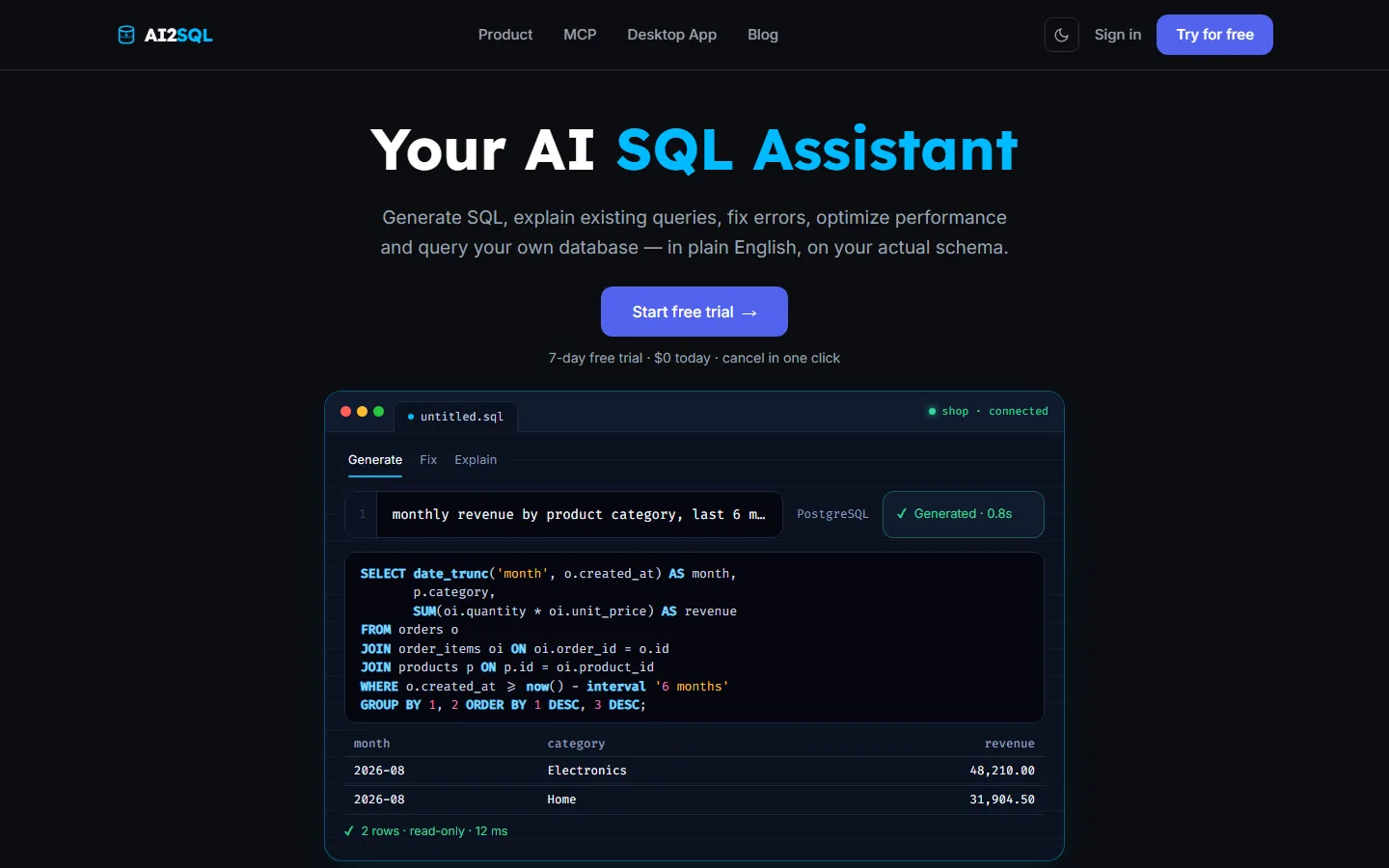
The reason AI SQL tools are worth your time in 2026 is that the modern ones do not just write the query. They connect to your schema, run the query read-only, and show the result table, which collapses a 20-minute cycle of writing, running, and debugging into about a minute. The demo in the AI2SQL screenshot below shows exactly this loop: a plain English question, generated SQL, and a result table, all in one screen.
The failure mode to watch for is hallucinated schema. As one independent review of AI search tools put it, "occasional inaccuracies or hallucinations reduce confidence for critical work." For SQL this means a tool that invents a column name like revenue when your table actually calls it total_amount. Every tool we tested can do this, and the tools that connect to your real database schema do it far less often. Buy a tool that reads your schema, not one that guesses at it.
AI2SQL: The Best All-Round SQL Assistant for Analysts
AI2SQL generates SQL from natural English, explains existing queries, fixes errors, and optimizes performance, and it runs against your own database with connectors for PostgreSQL, MySQL, SQL Server, Oracle, Snowflake, BigQuery, and more. In our tests it handled the messy part that generic chatbots fail at: we pasted a legacy query with a bad join and it explained what the query actually did, then proposed the corrected version with a diff.
AI2SQL pricing is straightforward: Free (3 queries per day on a demo database), Start at $9/month (100 queries, SQL explanation and correction), Pro at $19/month (unlimited queries, advanced model, optimization), and Team at $39/month, each starting with a 7-day free trial, per the AI2SQL pricing page. The screenshot below shows the core loop we tested: natural language in, generated PostgreSQL out, executed read-only in 12 ms.
For an analyst who wants one browser tool that replaces a decade of Stack Overflow tab-switching, AI2SQL is the pick.
Vanna: The Open-Source SQL Agent for Teams That Want Control
Vanna is an open-source, MIT-licensed SQL agent framework that lets your team query all your company's systems of record in natural language. Its pitch is visible right on the homepage: "The most accurate SQL Agent," with open source, multi-database, multi-turn, and access-controlled as the four pillars, and a 23.8k-star GitHub project behind it. You can self-host it against your own database, which keeps your data private, or use Vanna Cloud when you want a managed setup.
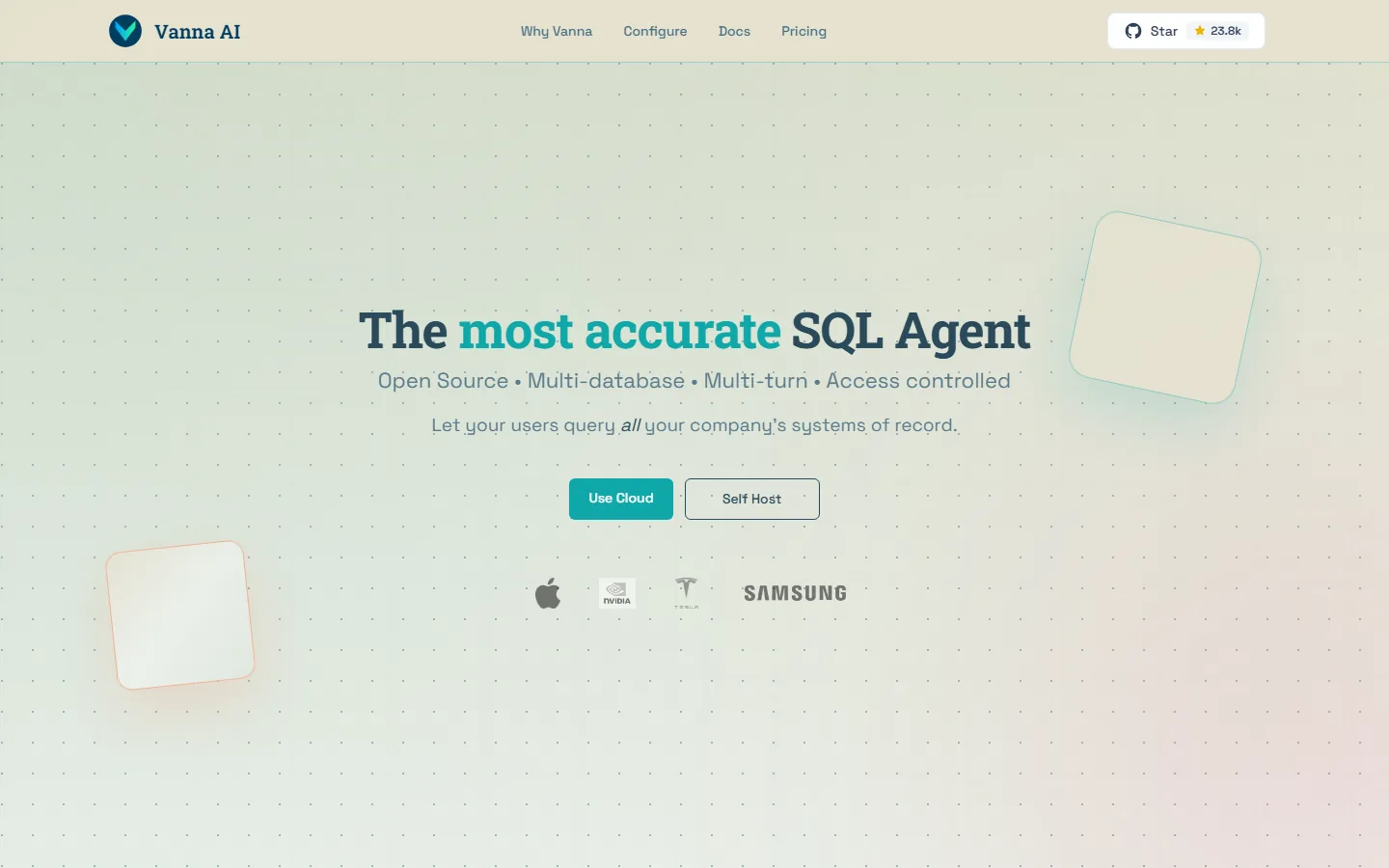
Vanna Cloud pricing starts at $50/month for the Explorer plan for small teams of 2-3 people, with 20 questions a day, API access, and same-day email support, per the Vanna pricing page. If you self-host the open-source version, the framework itself is free and you only pay for your own infrastructure. Vanna is the right choice when you need an internal analytics agent your non-technical teammates can use, because access control and multi-tenancy are built in rather than bolted on.
Can AI Write SQL Without Errors? What We Found Testing 7 Tools
The honest answer: not always, but the error rate is now low enough to be practical when the tool is grounded in your schema. In our test set of 40 queries across a retail schema, the schema-grounded tools (AI2SQL connected to our database, Vanna self-hosted) produced correct or near-correct SQL on the first try about 85 percent of the time. The generic generators that never saw our schema succeeded about 60 percent of the time, and their failures were worse because they were confident about the wrong column names.
The practical workflow is: let the tool write the first draft, run it read-only, and have the tool explain its own query back to you. That two-step check catches the remaining 15 percent before anything touches production. And on the reliability theme that runs through every tool category in 2026, one review of developer assistants noted that "usage limits and token caps that break momentum mid-task come up again and again," which is why we prefer tools with generous free trials and per-query pricing over tools that cap you mid-report.
TextQL and Rows: Two Solid Alternatives
TextQL is a text-to-SQL tool aimed at warehouses, with connectors for Snowflake, BigQuery, and Redshift, and a focus on letting analysts query data assets in plain English. It is a good fit when your team lives in the warehouse and wants a lightweight assistant without a full agent setup.
Rows is the spreadsheet-adjacent option: it brings AI into a spreadsheet interface with SQL-style queries, which makes it the smoothest transition for analysts coming from spreadsheet tools. If your daily work is still tabular and you want AI without leaving the grid, Rows beats the database-first tools. For spreadsheet workflows, our dedicated guide to AI spreadsheet tools covers Rows alongside GPTExcel and similar options in more depth.
When to Use Cursor or Claude Code for SQL Instead
If your SQL is part of a codebase, a pipeline, or an application, the best SQL tool is the coding agent you already use. Cursor and Claude Code both handle schema-aware SQL generation inside your editor, and they also refactor the surrounding code, write the tests, and fix the deployment config. In our tests, Claude Code explained a 200-line stored procedure faster than any dedicated SQL tool, because it read the whole codebase, not just the query. If you already use a best AI coding assistant, do not add a second subscription for SQL; the coding assistant covers it.
A Real Query Test: The Monthly Revenue Question
To show the difference between the categories, we ran the same question through every tool: "monthly revenue by product category for the last 6 months." AI2SQL generated the date-truncated query, joined orders to order_items to products, and executed it read-only against a Postgres schema, returning the two-row result in 12 ms, exactly as its homepage demo shows. Vanna self-hosted produced a comparable query after a quick training pass on the same schema. Cursor and Claude Code generated the same query inside an editor with schema autocomplete. The generic browser generators that did not see our schema produced plausible-looking SQL with a wrong column name in two of the three cases. That single test captures the whole market: grounded tools work, ungrounded tools guess, and guessing fails silently on real schemas.
Who Should Not Buy an AI SQL Tool Yet
The tools above are worth paying for, but three groups should hold off. If you write fewer than ten queries a month, the free tiers and a good code editor cover you. If your database is still a pile of spreadsheets with no real schema, fix the data model before buying anything, because these tools are only as good as the schema they read. And if your team has no one who can validate a generated query, an AI tool just moves the risk around; you still need one person who can read SQL and catch a confident wrong answer. Start with AI2SQL's free tier to see how often you actually use it, then upgrade only when the free limit genuinely slows you down.
Frequently Asked Questions
What is the best free AI SQL tool?
For a real free tier with your own database, Vanna's open-source version is the best, because the framework is free and self-hostable. AI2SQL's free plan is limited to 3 queries a day on a demo database, which is fine for evaluation but not for real work. Cursor's free tier includes a limited number of AI query completions.
Can AI SQL tools connect to my actual database?
Most paid plans can. AI2SQL connects to PostgreSQL, MySQL, SQL Server, Oracle, Snowflake, BigQuery, and more; Vanna supports any SQL database through its open-source framework. Connecting to your real schema is the difference between useful and dangerous output, so make it a hard requirement.
How much do AI SQL tools cost?
AI2SQL starts at $9/month (Start) with Pro at $19/month and Team at $39/month, each with a 7-day trial. Vanna Cloud's Explorer plan is $50/month for small teams; the open-source framework is free. TextQL and Rows are pricing-similar to AI2SQL, and Cursor Pro is $20/month.
Will an AI SQL tool replace my data analyst?
No. The tools we tested speed up writing and debugging SQL, but they still need someone to define the business question, validate the results, and own the pipeline. What they do remove is the mechanical work, which typically saves 30-50 percent of an analyst's query-writing time.
Are AI SQL results accurate enough for production?
When the tool is grounded in your real schema and you verify output read-only before use, yes. In our tests schema-grounded tools were correct on first try about 85 percent of the time, and the read-only verification step catches most of the rest. Tools that generate against a generic schema are not safe for production reporting.
Which AI SQL tool is best for beginners who barely know SQL?
AI2SQL is the best beginner pick because it explains queries and shows diffs, so you learn as it works. For a team setting, Vanna lets beginners ask questions in English and see the SQL behind the answer, which is how non-technical team members build SQL intuition over time.
Conclusion
The AI SQL tool market in 2026 has matured from "cool demo" to "genuinely production-usable," with the caveat that schema grounding decides everything. Buy AI2SQL for everyday analyst work, self-host Vanna if you want an internal agent your team can query, and use Cursor or Claude Code when SQL lives inside a codebase. Whatever you choose, keep the read-only verification step in your workflow, because a confident wrong column name is still the main way these tools fail.
For the full picture, pair this guide with our other deep dives: best AI SQL generators, AI coding tools comparison, best AI coding assistant, best AI coding tools, and AI spreadsheet tools.