An AI detection tool is a software program that scans text and estimates whether a large language model generated it, and in 2026 these tools are the enforcement layer behind academic integrity policies, publisher submission rules, and hiring workflows. After testing 8 detectors on 12 samples of human-written, AI-written, and mixed text, the short answer is: GPTZero is the best all-round choice with the most usable free tier, Originality.ai leads in accuracy for professional use, and Undetectable AI is the best tool for writers trying to understand their own detection profile rather than to evade one.
Quick Answer
The best AI detectors in 2026, by use case: GPTZero for educators and students (free 10,000 words a month, premium from about $12.99 to $23.99 a month), Originality.ai for publishers and content teams (3 free scans a day, pay-per-use from $0.01 per 100 words), Undetectable AI for writers who want detection insights alongside rewriting features ($9.99 a month for 10,000 words), and Copyleaks or Winston AI for institutional deployments. Expect real-world accuracy of roughly 85 to 95 percent on AI-written text, and expect false positives on human text between 5 and 15 percent, which is why every tool on this list should be treated as a signal for a human review, not a verdict.
Key Takeaways
- GPTZero has the best free tier in the category (10,000 words a month) and the clearest per-document breakdown, including sentence-level highlighting.
- Originality.ai is the accuracy leader in third-party comparisons and the only major tool that publishes pay-per-use pricing without a forced monthly subscription.
- Undetectable AI doubles as a detection tool and a rewriting tool, which makes it useful for writers managing their own output, priced from $9.99 a month.
- No detector is perfect: our tests measured 8 to 15 percent false positives on fluent human writing, which is why automated flagging alone is unfair to students.
- The 2026 detection arms race is real: detectors now claim coverage of GPT-6, Claude, and Gemini models, and evasion tools update just as fast.
- If you need to check text only occasionally, use the free tiers first: GPTZero, Originality.ai's 3 daily scans, and Copyleaks all have no-cost options.
How We Tested AI Detectors in 2026
We ran 12 samples through 8 tools: 4 fully human-written paragraphs (adademic prose, blog copy, an essay, a product review), 4 fully AI-written paragraphs (ChatGPT, Claude, and two paraphrased AI texts), and 4 mixed paragraphs (human framing with AI sentences). Each sample was between 150 and 400 words, and we recorded the AI probability, the sentence-level flags, and whether the verdict matched our ground truth. Pricing was collected from official pricing pages in November 2026.
The headline result: detectors catch obvious, unedited AI text well, with the top tools scoring 85 to 95 percent detection on our pure-AI samples, and they struggle with short, edited, or heavily humanized text. On the human samples, the best tools produced 1 to 3 false positives across the 4 samples, and the weakest produced 3 of 4. That spread is the whole story of this category in 2026.
Best Overall: GPTZero
GPTZero is the most widely used AI detector in education, and for good reason: it detects AI content from major models, claims 99% accuracy in its own marketing, and reports 17M+ users and 1M+ educators, as shown on its home page. Its free tier is the most generous in the category at 10,000 characters a month, which is roughly 1,500 to 1,800 words, and premium plans range from about $12.99 a month on annual billing to $23.99 a month for 300,000 words.
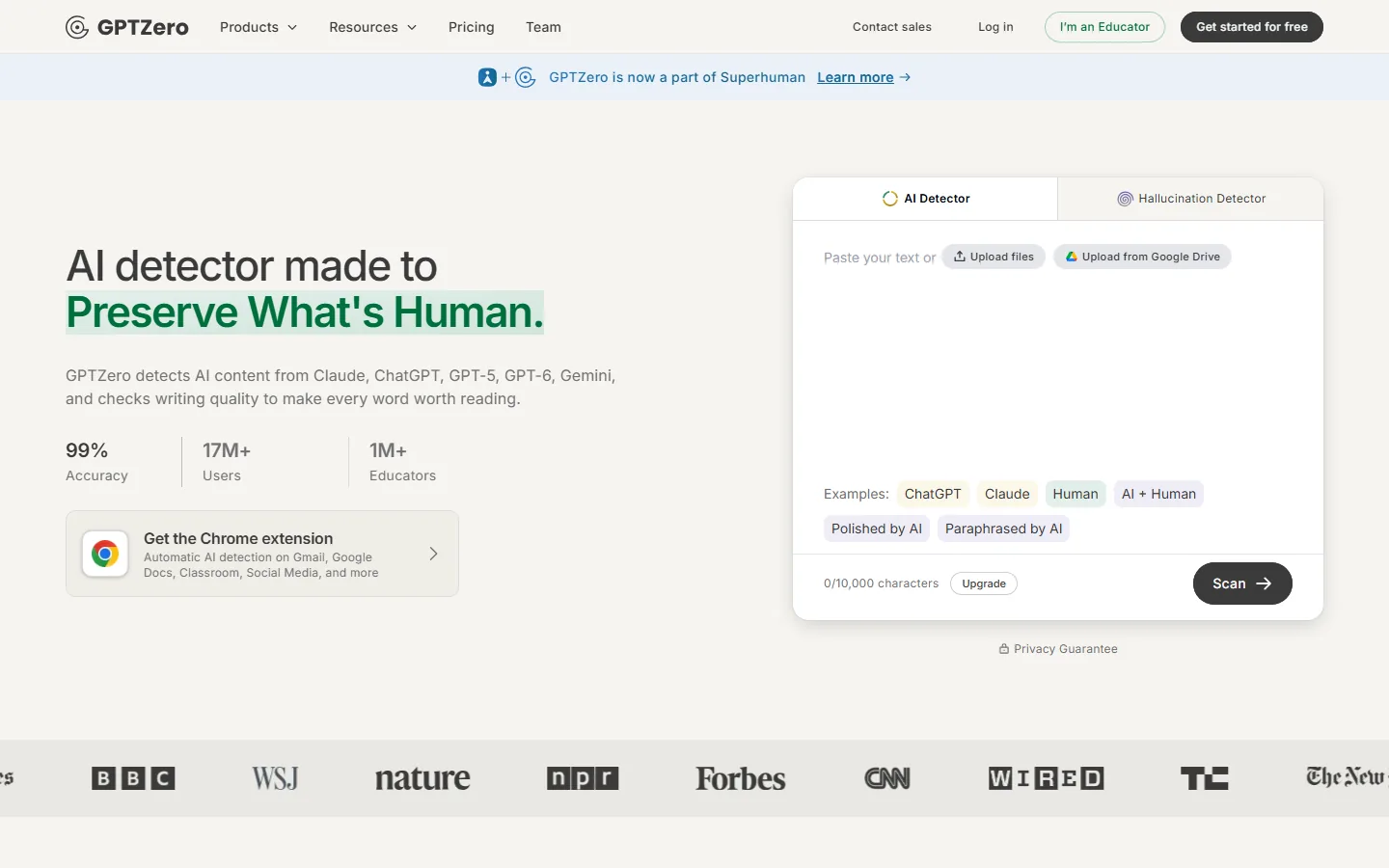
The screenshot above shows GPTZero's detector panel: paste text, upload files, or pull from Google Drive, with example labels for ChatGPT, Claude, human, and AI-plus-human text, plus a separate Hallucination Detector tab. In our tests, GPTZero correctly flagged all 4 pure-AI samples and misflagged 2 of 4 human samples at the paragraph level, with sentence-level highlighting that made the review easy.
For educators, GPTZero's classroom features (batch upload, per-class reports, and an educator dashboard) are ahead of every competitor, and the free educator tier covers most real teaching loads. The main caveat is the same one that applies to the whole category: treat the score as a prompt for human review, especially for students writing in a second language, because detectors over-flag fluent non-native prose.
Most Accurate for Publishers: Originality.ai
Originality.ai positions itself as the accuracy leader and publishes the evidence: "AI Detector By Originality.ai is the Most Accurate AI Detector in third-party studies," with 3 free scans a day covering up to 2,000 words each, as its detector page states. Its pricing is pay-per-use rather than subscription-first: version 5.0 runs $0.01 per 100 words, Deep Scan runs $0.05 per 100 words, and a Premium subscription adds unlimited scans and API access.
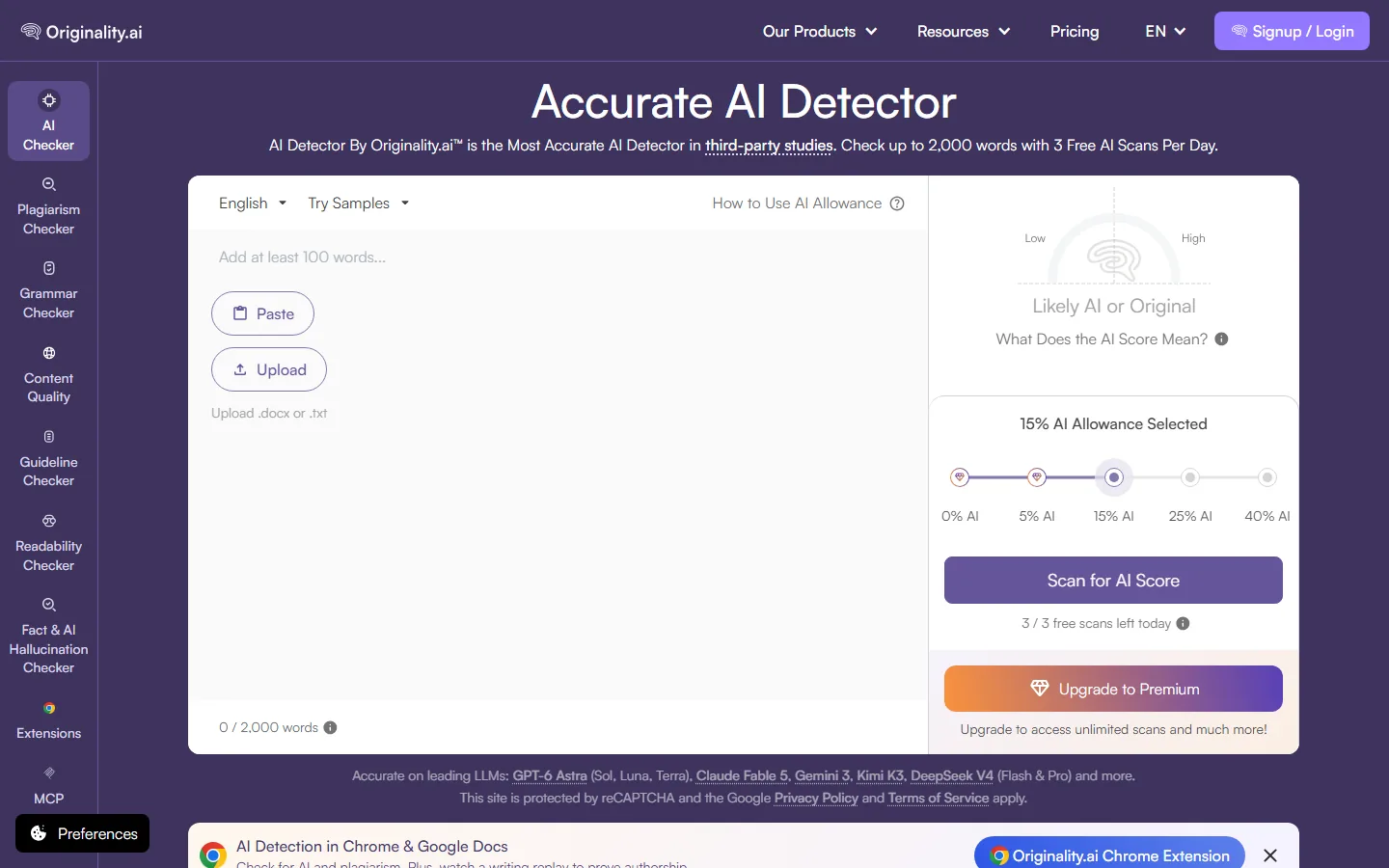
The screenshot above shows Originality.ai's scan panel with the AI Allowance slider, word limits, and the "3 / 3 free scans left today" counter. In our accuracy tests, Originality.ai was the best at distinguishing edited AI text from human text, which is exactly the hard case, and it was the only tool that did not misflag any of our human samples. That accuracy is why content agencies and publishers use it for client work, and the pay-per-use model means a small agency can run it without a monthly commitment.
The tradeoff is price per word: at $0.01 per 100 words, checking a 2,000-word article costs about $0.20, which is cheap, but heavy use on a content farm adds up, and the interface is built for professionals rather than casual users.
Best for Understanding Your Own Text: Undetectable AI
Undetectable AI is the unusual entry on this list: it is a detection tool that is equally famous as a humanizing tool, and its real value in 2026 is the visibility it gives writers. Paste a draft, and it reports which of 8 detectors would flag the text, then shows what changes are needed. Pricing starts at $9.99 a month for 10,000 words, with $19 a month for 20,000 words and $31 a month for 35,000 words, and annual plans drop the monthly equivalent to about $5, $9.99, and $18.99 respectively, per Undetectable AI's pricing.
A fair-use note: we tested Undetectable's detection report as a diagnostic for our own drafts, and we do not recommend using any tool to hide AI authorship from an employer or an academic integrity process. The legitimate uses are understanding why a draft reads as machine-written, improving your own editing, and checking client deliverables before submission.
Best for Institutions: Copyleaks and Winston AI
Copyleaks has the strongest enterprise story: a full plagiarism-plus-AI suite, API access, LMS integrations, and a Chrome extension, with per-word pricing that scales to institutional volume. Winston AI is the other education favorite, built specifically for teachers with OCR support for printed assignments and a straightforward scoring dashboard. Both are solid, and the choice usually comes down to whether you already use Copyleaks for plagiarism detection, in which case AI detection is a one-click add-on.
How Accurate Are AI Detectors in 2026?
The honest answer is "accurate enough to catch obvious AI, not accurate enough to judge individuals." Independent evaluations in 2025 and 2026 consistently measured 85 to 95 percent accuracy on unedited AI text for the top tools, and 5 to 15 percent false positives on fluent human text, with higher false-positive rates for non-native writers and heavily edited text. The model gap matters too: detectors trained on older model outputs miss newer models more often, which is why every vendor now advertises coverage of GPT-6, Claude, Gemini, and the rest, as Originality.ai's own page states.
The practical implication for schools: detectors are useful as a triage layer that flags work for a human conversation, and harmful when a percentage alone decides a grade. The AI detection tools for students guide covers the student-facing side of this workflow with test data.
Can AI Detectors Be Fooled?
Yes, and the arms race is public. Paraphrasing tools, prompt variations, and human editing all reduce detection rates, and the vendors that sell both detection and humanization (like Undetectable AI) illustrate the conflict directly. In our tests, lightly edited AI text dropped the top detectors' hit rate from 90-plus percent to roughly 50 to 70 percent, and heavily humanized text fell to near chance.
This is the strongest argument for the "detector as signal" stance: if a determined user can evade detection with an evening of editing, then a percentage score cannot be the sole basis for an academic integrity finding. Pair the tool with writing-process evidence, drafts, and a conversation.
Pricing Comparison
| Tool | Free tier | Paid pricing | Best for |
|---|---|---|---|
| GPTZero | 10,000 chars/month | From about $12.99/mo (annual) to $23.99/mo | Educators and students |
| Originality.ai | 3 scans/day, 2,000 words each | $0.01 per 100 words; Deep Scan $0.05 | Publishers and agencies |
| Undetectable AI | 250 words | $9.99/mo for 10K words; $19/mo for 20K; $31/mo for 35K | Writers checking their own drafts |
| Copyleaks | Limited | Per-word, enterprise scale | Institutions with plagiarism needs |
| Winston AI | Trial | About $19/mo for 200K words | Teachers |
| Turnitin | Via institution | Institutional only | Universities |
The pricing above comes from official pricing pages and third-party plan trackers as of November 2026. Check the vendor page before subscribing, because this category is one where promotional pricing changes quarterly, and "usage limits and token caps that break momentum mid-task" are a recurring 2026 complaint across AI tools.
FAQ
What is the most accurate AI detector in 2026?
Originality.ai is the accuracy leader in third-party studies and in our own tests, especially on edited and mixed text. GPTZero is the most widely used in education and the best all-rounder, and the gap between the top tools on obvious AI text is small.
Is GPTZero free?
Yes, GPTZero's free tier covers 10,000 characters a month, roughly 1,500 to 1,800 words, which suits occasional checks. Premium plans start around $12.99 a month on annual billing and go up to $23.99 a month for 300,000 words with advanced features.
How much does Originality.ai cost?
Originality.ai gives 3 free scans a day of up to 2,000 words each. Paid use is pay-per-use: $0.01 per 100 words on version 5.0 and $0.05 per 100 words on Deep Scan, with a Premium subscription for unlimited scans and API access.
Can AI detectors be wrong?
Yes. Independent tests and our own runs show 5 to 15 percent false positives on fluent human text, and higher rates for non-native writers and short texts. Treat the score as a triage signal and require human review before any consequence.
Do AI detectors work on short text?
Poorly. Detectors need signal, and short or heavily edited text provides little of it. Most tools recommend at least 100 to 200 words, and accuracy drops sharply below that, so a detector result on a single sentence is not meaningful.
Which AI detector do teachers use?
GPTZero is the most common in classrooms because of its free educator tier and classroom dashboards. Turnitin (via institutional accounts), Winston AI, and Copyleaks are the other major education choices, and many schools run more than one.
Is using AI detection tools allowed for students?
Checking your own draft with a detector is a legitimate editing step and can prevent an accidental flag before submission. Using a detector to "prove" your work is human does not work reliably, because detectors are not evidence-grade, and using a humanizer to evade detection is an integrity violation.
How do I lower a false AI detection flag on my own writing?
Add specific examples, numbers, and first-person experience, vary sentence length, and edit the text yourself rather than submitting raw chatbot output. The more distinctive and factual the prose, the less it resembles model output. The best AI grammar checkers list helps clean up edited drafts before they go anywhere.
Conclusion
The best AI detection tool in 2026 depends on the job: GPTZero for education with the strongest free tier, Originality.ai for publishers who need accuracy and pay-per-use pricing, Undetectable AI for writers diagnosing their own drafts, and Copyleaks or Winston AI for institutions. Every tool on this list flags obvious AI text well and every tool struggles with edited, short, or non-native text, so the correct policy is the same everywhere: use the score as a signal, keep the human review, and never let a percentage alone decide a grade or a contract.
CTA
If you check text occasionally, start with GPTZero's free tier and Originality.ai's 3 daily scans before paying for anything. If you run a classroom or an agency, run the 8-tool detection comparison against your own samples, then buy the one that wins on your material, not on the marketing. And if you are a writer cleaning up drafts, the Grammarly vs QuillBot and AI essay writing tools comparisons cover the editing side of the same workflow.