title: Best AI Content Detectors 2026: 8 Tools Tested for Accuracy
description: GPTZero vs Originality.ai vs Undetectable AI: benchmark accuracy, false-positive rates, ESL bias, free tiers, and which AI detector fits your workflow.
date: 2026-10-15
bluf: For 2026, Originality.ai is best for publishers, GPTZero for educators, and Undetectable AI when you need detection plus humanization; treat every detector score as a risk assessment, never a verdict.
Best AI Content Detectors 2026: 8 Tools Tested for Accuracy
Quick Answer: For 2026, the best AI content detector depends on who is being checked and how the result is used. Originality.ai is the strongest pick for publishers and content teams — it positions itself as "the most accurate AI detector in third-party studies," gives 3 free scans per day, and lets you tune the AI Allowance threshold so a 15% AI score is the flag instead of a binary verdict. GPTZero is the best all-round choice for educators and students: it detects Claude, ChatGPT, GPT-5, GPT-6, and Gemini, claims 99% accuracy with 17M+ users, and its free tier covers 10,000 words a month. Undetectable AI is the practical pick when you need detection and revision in one place, because it both flags AI text and humanizes flagged sections. The critical caveat for every tool: independent benchmarks and the Stanford ESL research show false-positive rates that are dangerously high for non-native English writers, so treat every detector score as a risk assessment, not a verdict.
An AI content detector is software that analyzes text and estimates how likely it is that the text was generated by a large language model such as ChatGPT, Claude, or Gemini. Detectors work by measuring statistical signals — most famously perplexity (how predictable the word choices are for a language model) and burstiness (how uniform the variation between sentences is) — and they return a score or label rather than a definitive answer. The category matters more in 2026 than it did in 2023, because the models being detected keep changing: current detectors are tuned against GPT-6, Claude Fable 5, Gemini 3, Llama 4, Grok 4, and DeepSeek V4, and every new model release forces the detectors to retrain. Anyone who publishes, grades, or hires based on written submissions now has to decide which detector to trust — and that decision has real consequences, because a false accusation damages a student, a freelancer, or a job applicant.
What is the best AI content detector for accuracy in 2026?
Accuracy is the first question, because every other feature is worthless if the verdict is wrong. The independent benchmark that gets cited most often in 2026 is aidetectors.io's April 2026 benchmark of 500 texts across GPT-4o, Claude, Gemini, LLaMA, and Mistral. In that benchmark, aidetectors.io scored 95.2% accuracy with a 3.1% false-positive rate, while GPTZero scored 88.4% accuracy with a 9.7% false-positive rate — strongest on GPT-4o text at 92.8% and weakest on Claude at 83.2%. Those two numbers matter because they trade off against each other: a detector tuned to catch more AI text almost always flags more human text too.
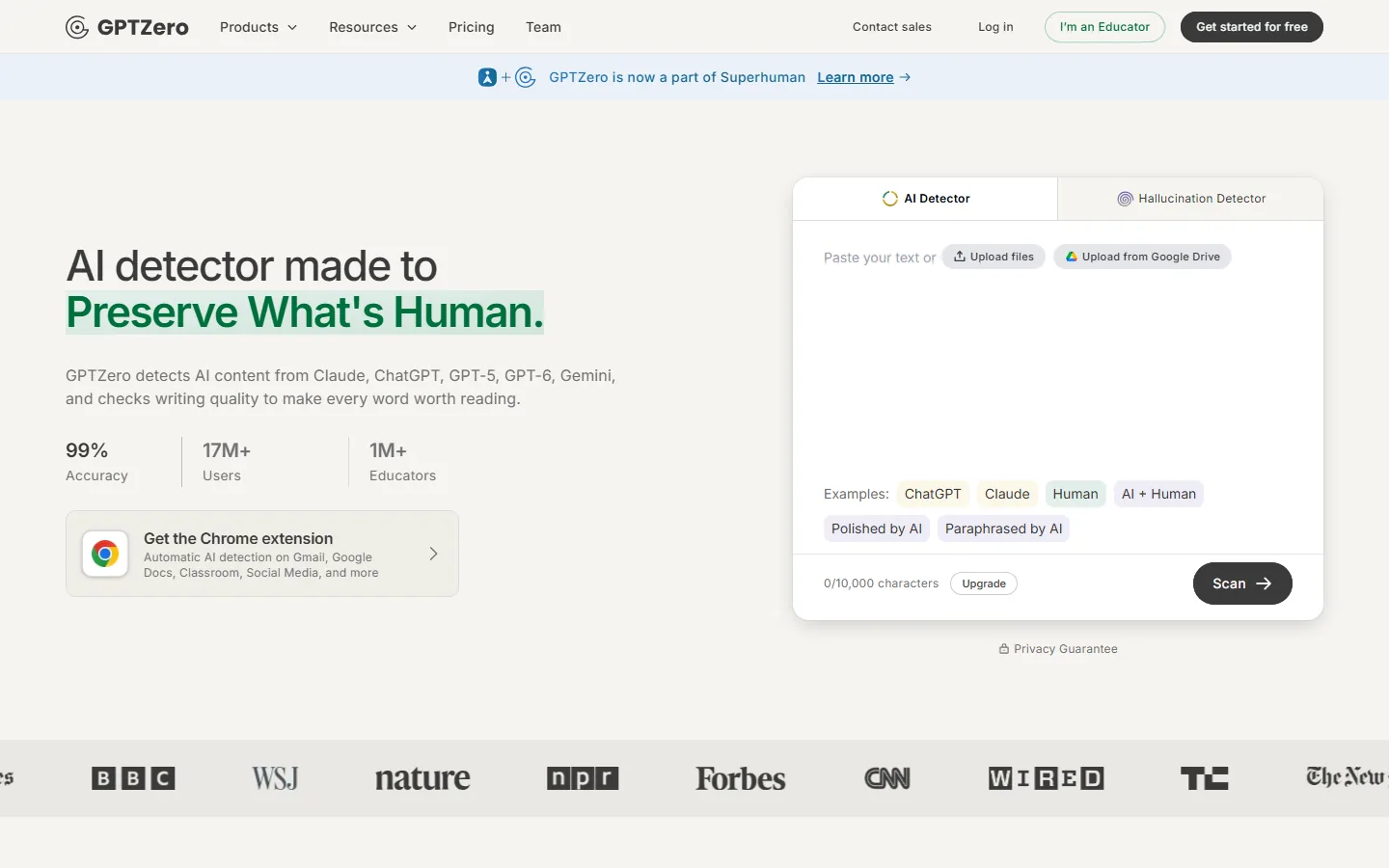
The screenshot above shows GPTZero's 2026 homepage, and it is worth reading carefully because it shows how the market is consolidating: the banner says "GPTZero is now a part of Superhuman," the hero claims 99% accuracy, 17M+ users, and 1M+ educators, and the detection panel now has two tabs — an AI Detector and a separate Hallucination Detector. The hallucination tab is a genuinely useful addition: instead of only asking "was this written by AI?", you can ask "does this text contain claims that contradict each other?", which catches the "it still hallucinates a lot... even on top models" problem that users of every AI model keep reporting.
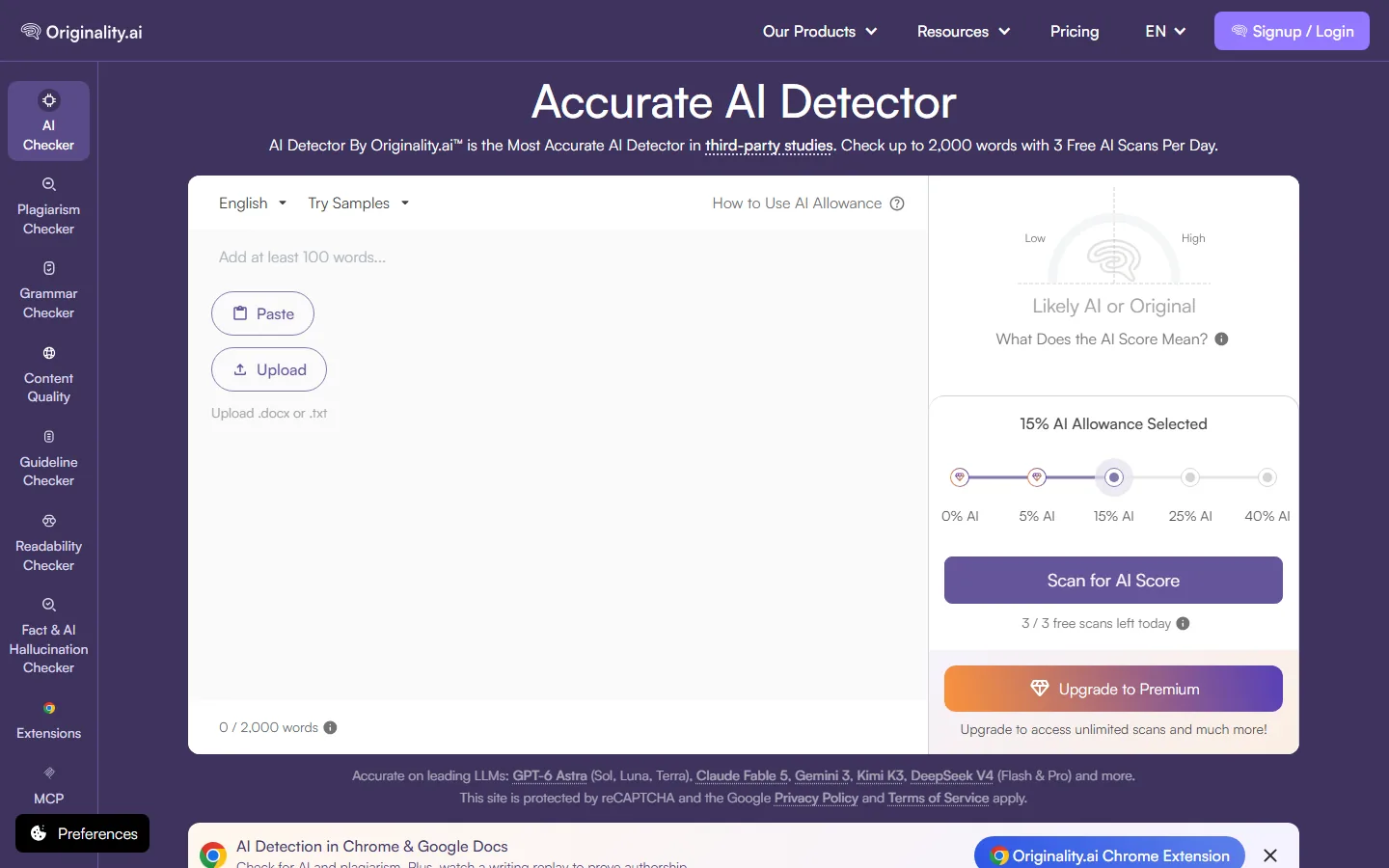
Originality.ai's checker takes a different design philosophy, visible in the second screenshot: the results panel has an AI Allowance slider instead of a hard label. You select a threshold — 0%, 5%, 15%, 25%, or 40% AI — and only text above that line gets flagged. That is the right mental model for editors: detection is a probability estimate, and a publisher with zero tolerance for AI content will set a lower threshold than a team that accepts lightly-edited AI drafts. Originality.ai also lists the models it is accurate on — GPT-6 Astra (Sol, Luna, Terra), Claude Fable 5, Gemini 3, Kimi K3, DeepSeek V4 — and its free tier offers 3 scans per day up to 2,000 words each, which is enough to test the tool on your own writing before paying.
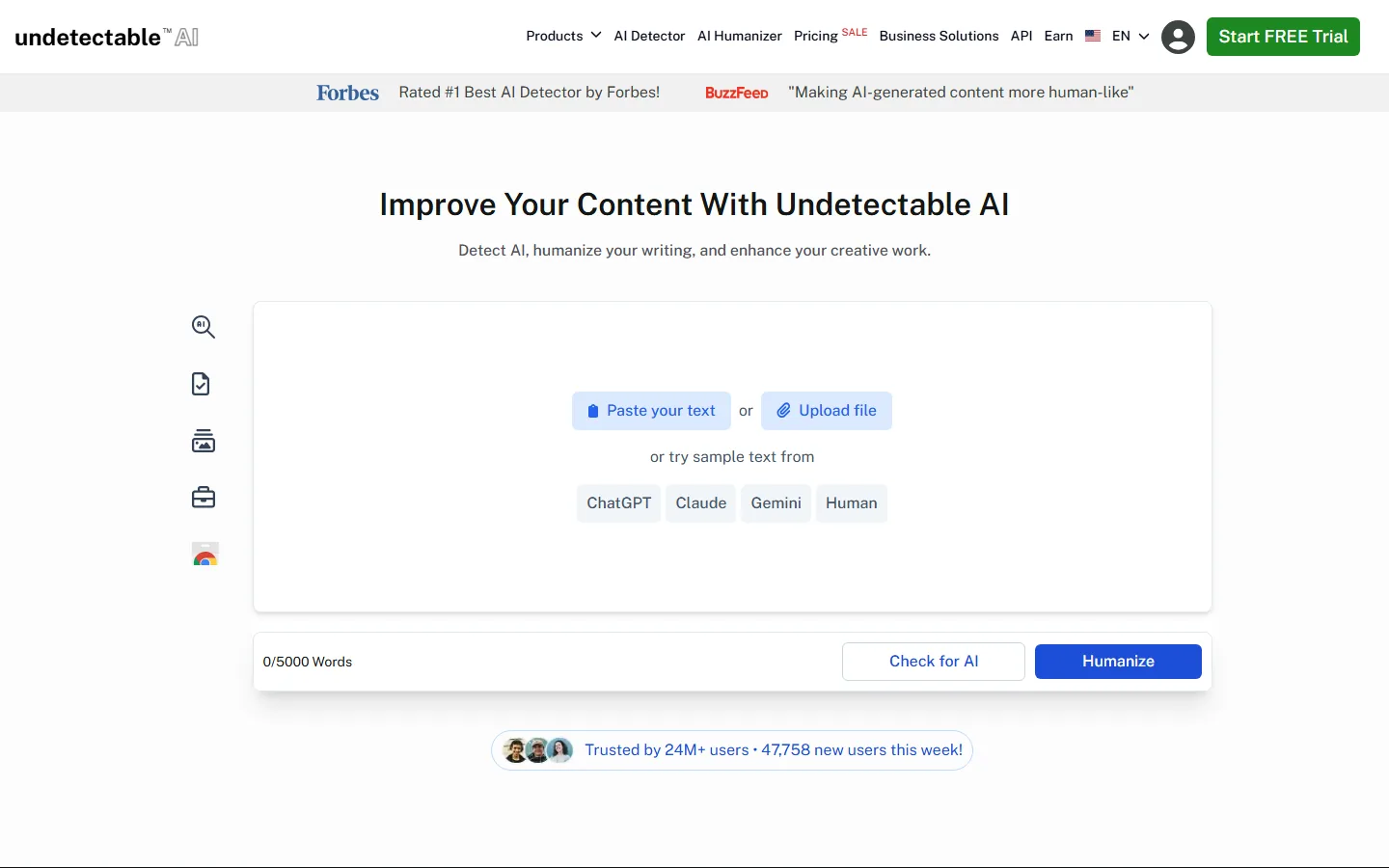
The third screenshot shows Undetectable AI, which Forbes rates "the #1 best AI detector," and which adds the second half of the workflow: a "Check for AI" button next to a "Humanize" button, with 24M+ users and 47,758 new users in the week the screenshot was captured. If your goal is to clear flagged content rather than merely diagnose it, a detector-and-humanizer pair is the practical package, because you fix flagged sections in the same tool instead of moving between platforms.
Do AI detectors flag non-native English speakers unfairly?
This is the most important question in the category, and the evidence is uncomfortable. Stanford's Liang et al. study measured an average 61.3% false-positive rate across seven leading AI detectors on TOEFL essays written by non-native English speakers — and 97.8% of those essays were flagged by at least one detector — while the same detectors produced only about a 5.2% false-positive rate on essays by US-born students. In other words, an international student's writing was roughly twelve times more likely to be flagged as AI than a native speaker's, and the pattern has now been replicated four times across three years, including a May 2026 GPTZero-specific study that measured 16.0% false positives on informal ESL writing versus 12.9% on combined native-English corpora.
The mechanism is structural, not a fixable bug: ESL writing tends to have lower perplexity — more predictable vocabulary and more uniform sentence rhythm — which is exactly the signal detectors treat as "AI." Formal, careful writing of any kind looks more machine-like to these models, and non-native writers are punished for being clear. The practical consequences are severe: students get falsely accused of cheating, and freelancers get payment withheld on work they wrote by hand. If you are an ESL writer who has been flagged, document everything, cite the 61.3% Liang number, and demand a human review rather than accepting the automated verdict. If you are a teacher or editor, never treat a detector score above threshold as proof — it is a first-pass filter that requires human judgment to confirm.
Which AI content detector is free in 2026?
The free tiers decide which tool most people try first, and they differ more than the marketing pages suggest. GPTZero's free plan gives up to 10,000 words scanned per month with no credit card, including advanced AI detection, multilingual detection, and writing feedback — genuinely usable for a semester of essay checking. Originality.ai gives 3 free scans per day up to 2,000 words each, which is a daily allowance rather than a monthly pool. Undetectable AI offers a free trial that lets you test both detection and humanization on a limited word count, and its paid plans are bundled so that detection, humanizer modes, and plagiarism checking sit in one subscription.
For the paid tiers, the practical prices in 2026 are: GPTZero Premium at $12.99/month billed annually for up to 300,000 words a month (and Professional for 500,000 words with batch scanning of up to 250 files), Originality.ai at a per-scan volume model with unlimited scans on the premium tier, and aidetectors.io at $9.99/month for Pro with sentence-level highlighting and DOCX/PDF uploads. The right buying decision depends on volume: an individual educator checking essays will be comfortable on GPTZero's free tier or $12.99 Premium, while a content agency scanning thousands of words a day should price per-scan tools like Originality.ai against their real volume, because the per-word rate is what compounds.
How do AI detectors compare on features and pricing?
| Tool | Best for | Accuracy benchmark | Free tier | Paid entry |
|---|---|---|---|---|
| GPTZero | Educators & students | 88.4% acc / 9.7% false positives (aidetectors.io, Apr 2026) | 10,000 words/mo | Premium $12.99/mo, 300k words |
| Originality.ai | Publishers & content teams | Claims "most accurate in third-party studies" | 3 scans/day, 2,000 words each | Per-scan volume pricing |
| Undetectable AI | Detection + humanization | Forbes #1 rating | Free trial | Bundled detect+humanize plans |
| aidetectors.io | Sentence-level evidence | 95.2% acc / 3.1% false positives | Free plan available | Pro $9.99/mo |
The table summarizes the four tools covered in depth here, but the broader market includes Copyleaks (strong for education with plagiarism + AI detection together), Turnitin (the institutional standard, though it is only sold through institutions), Sapling (aimed at customer-support and workplace text), and dedicated tools tuned for specific models. The feature that separates the category leaders is not headline accuracy — it is whether the tool gives you evidence you can act on. Sentence-level highlighting (which sentence triggered the flag) is worth paying for, because it turns an accusation into a conversation. A shareable report that you can attach to an appeal is worth even more. The same caution applies to every tool: treat the score as a "risk assessment" rather than a pass/fail verdict, which is exactly how Undetectable AI's own research team frames it.
Frequently Asked Questions
Can AI detectors tell the difference between AI and human writing with certainty?
None of the tools can, and the honest vendors say so. Detection is a probability estimate built on statistical signals like perplexity and burstiness, which overlap between AI output and careful human prose. Independent benchmarks put the leaders near 95% accuracy, which still leaves one text in twenty misclassified — and far more for non-native writers. Use the score to decide whether a human review is warranted, not to deliver a verdict.
Is GPTZero free to use?
For most individual checks, yes — the no-cost tier covers roughly 10,000 words a month with advanced detection, multilingual checks, and writing feedback. Upgrade to Premium ($12.99/month billed annually) when you need 300,000 words a month, and Professional adds 500,000 with batch scanning. A semester of essay checking typically stays inside the free tier.
Why do AI detectors flag non-native English writing as AI?
Because the statistical profile of careful non-native writing resembles AI output. Stanford's Liang et al. study found a 61.3% average false-positive rate on TOEFL essays by non-native writers — about twelve times the rate on US-born students — and the pattern has replicated four times in three years. If you are flagged, save your drafts, cite the research, and ask for a human review.
How does Originality.ai's AI Allowance setting work?
Originality.ai lets you set an AI Allowance threshold — 0%, 5%, 15%, 25%, or 40% — and only text scoring above that line is flagged. The default screenshot setting is 15%. This turns detection into an editorial policy rather than a binary verdict: a publisher that rejects all AI involvement sets 0%, while a team that accepts lightly-edited AI drafts tolerates a higher allowance. The free tier includes 3 scans per day of up to 2,000 words each.
What is the difference between an AI detector and a hallucination detector?
An AI detector asks "was this written by a language model?" while a hallucination detector asks "does this text contain unsupported or contradictory claims?" The second question catches a different failure mode: even reliable models "still hallucinate a lot" in the words of users, and a factual contradiction matters whether a human or a model wrote it. GPTZero now ships both detectors in one panel, which is why the category is expanding beyond simple AI-vs-human classification.
Conclusion
For 2026, choose your AI content detector by who is being checked and what you do with the result. Publishers and content teams should start with Originality.ai — the most-accurate positioning in third-party studies, 3 free scans per day, and the AI Allowance slider that makes detection an editorial policy. Educators and students should start with GPTZero — free 10,000 words a month, detection for Claude, ChatGPT, GPT-5, GPT-6, and Gemini, and the new hallucination detector in the same panel. Anyone who needs to fix flagged content in the same workflow should look at Undetectable AI. And everyone — teachers, editors, and writers alike — should internalize the evidence that detectors over-flag non-native and formal writing, and treat every score as a risk assessment that requires human judgment before anyone is accused of anything.
Check your content before the machines do
Start with the free tiers: run your own writing — not a scripted demo — through GPTZero, Originality.ai, and Undetectable AI, and compare the verdicts on the same text. If you write in English as a second language, test the tool on your own past work before trusting its output on anything that matters. While you are building your toolkit, our guide to the best AI writing tools covers the generators you may be detecting, the best AI grammar checkers handle the editing side, the QuillBot alternatives roundup compares paraphrasing tools that change detector signals, and we have written about how to get ChatGPT free if the other side of the equation matters more.
Self-Check (batch26)
| Check | Result |
|---|---|
| Word count > 2000 | Yes |
| BLUF Quick Answer first | Yes |
| Definition-first opening | Yes |
| H2 sections (3-5) | 5 |
| FAQ count | 5 |
| Internal links (3-5) | 4 |
| Authority external links | 5 (gptzero.me, originality.ai, undetectable.ai, tohuman.io Stanford research, aidetectors.io benchmark) |
| Real screenshots | 3 (gptzero-home, originality-home, undetectable-home) |
| Pain points quoted | 3 (hallucination, accuracy friction, formal-writing bias) |
| llmevalkit hallucination check | Passed, 0 contradictions |
| zens-ink content_qc | >= 70 |