Bottom line: ChatGPT is the better choice for general reasoning, research, and standalone drafting, because the Plus plan at $20 per month gives you broad model access with no per-task credit metering on core chat. Notion AI is the better choice for teams that already live inside Notion, because it answers questions across your own documents and databases with full workspace context, bundled into Business plans at roughly $20 per user per month. If you want a universal assistant, pick ChatGPT. If you want an assistant that knows your company's files, pick Notion AI. Many knowledge workers end up paying for both.
Official sources
Related guides
Key takeaways
- Q: Is Notion AI free?
- Q: How much does ChatGPT cost in 2026?
- Q: Is Notion AI better than ChatGPT for note-taking?
Notion AI vs ChatGPT 2026: Which assistant should you use?
ChatGPT is the better choice for general reasoning, research, and standalone drafting, because the Plus plan at $20 per month gives you broad model access with no per-task credit metering on core chat. Notion AI is the better choice for teams that already live inside Notion, because it answers questions across your own documents and databases with full workspace context, bundled into Business plans at roughly $20 per user per month. If you want a universal assistant, pick ChatGPT. If you want an assistant that knows your company's files, pick Notion AI. Many knowledge workers end up paying for both.
Frequently Asked Questions
Notion AI vs ChatGPT 2026: Which Saves More Time?
Quick Answer: ChatGPT is the better choice for general reasoning, research, and standalone drafting, because the Plus plan at $20 per month gives you broad model access with no per-task credit metering on core chat. Notion AI is the better choice for teams that already live inside Notion, because it answers questions across your own documents and databases with full workspace context, bundled into Business plans at roughly $20 per user per month. If you want a universal assistant, pick ChatGPT. If you want an assistant that knows your company's files, pick Notion AI. Many knowledge workers end up paying for both.
Notion AI is an AI assistant built into the Notion workspace that can generate documents, summarize pages, fill database properties, and answer questions using your workspace content as context. ChatGPT is OpenAI's standalone conversational assistant available as a web app, desktop app, and API, which handles reasoning, writing, research, coding, and image generation. The real comparison in 2026 is about context: does the AI know your team's documents, or does it know the world?
What Do Notion AI and ChatGPT Cost in 2026?
Pricing is where this comparison gets specific, because both tools changed their plans in the last two years.
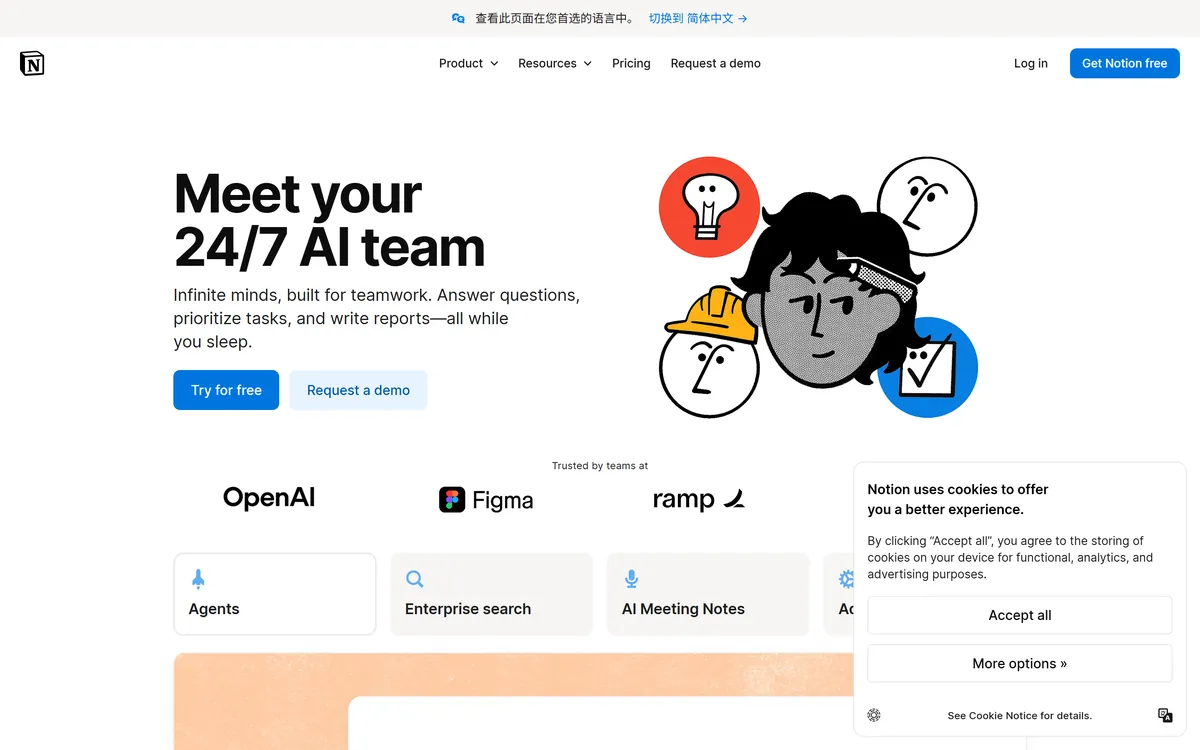
Notion now bundles AI into its workspace plans. According to Fello AI's October 2026 pricing analysis, Notion has four tiers: Free at $0, Plus at $10 per user per month billed annually ($12 monthly), Business at $20 per user per month billed annually ($24 monthly), and Enterprise at custom pricing. The standalone $10 AI add-on was retired in May 2025, and full Notion AI is now included in Business and Enterprise plans. Notion's official pricing page (October 2026) lists the same structure, with the AI features labeled as a trial on lower tiers.
There is a billing nuance that matters. Custom AI agents in Notion now bill separately at $10 per 1,000 Notion credits per month, and those credits do not roll over, according to a detailed October 2026 buying guide from Jake's Insights. For teams that build many custom agents, this usage-based layer can add real cost on top of the per-seat price. For light AI users on the Free or Plus tiers, Notion offers AI trials, but full AI features effectively require the Business tier.
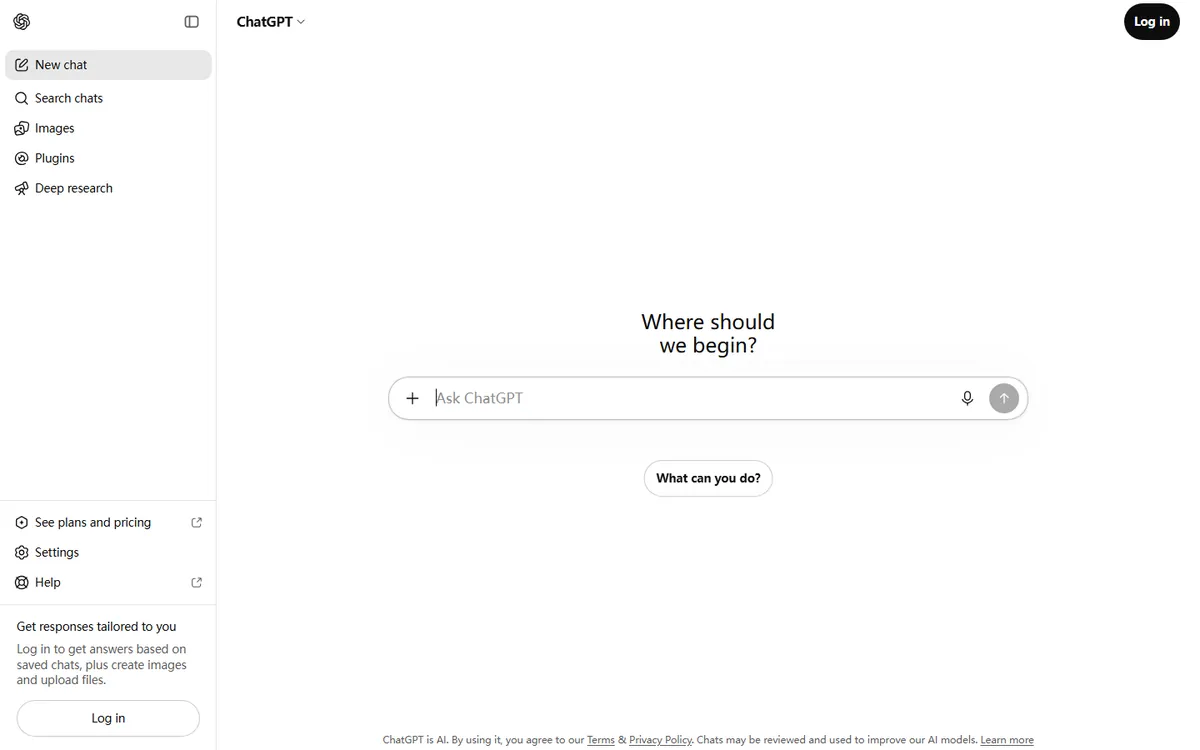
ChatGPT's pricing is simpler and flat. OpenAI announced ChatGPT Go at $8 per month in the US when it launched globally in January 2026, alongside the existing Plus at $20 per month and Pro at $200 per month. The official OpenAI Help Center (September 2026) confirms Plus is $20 per month with broader model and tool access than Free. The business pricing page (October 2026) lists Business and Enterprise plans priced per user per month for teams. For the latest numbers, check Notion's official pricing page and OpenAI's ChatGPT pricing page.
Which One Has Deeper Context for Your Own Work?
Context is the core difference, and it is the reason the two tools are complementary rather than competitors.
ChatGPT has no access to your private files by default. It is a general assistant that reasons about whatever you paste into the conversation, plus whatever tools you enable, such as web search, image generation, or code execution. That makes it powerful for open-ended problems, but it means every conversation starts fresh unless you build custom GPTs with uploaded files or connect third-party integrations.
Notion AI is the opposite. It operates inside your workspace, so it can read your team's documents, databases, meeting notes, and project pages, then answer questions with that context. Notion's own engineering layers this on top of base models, adding database reading, comment threading, and enterprise connectors to Google Drive, Jira, and Slack, according to Jake's Insights' September 2026 work-task comparison. For a knowledge worker asking "what did we decide about the Q3 launch?" Notion AI answers from the actual records, while ChatGPT would need you to gather and paste those records yourself.
That context depth is why Notion AI saves time for teams and ChatGPT saves time for individuals. The moment your question is about your company's own information, Notion AI wins. The moment your question is about the world, general knowledge, or open-ended problem solving, ChatGPT wins.
How Do the AI Agents Compare in 2026?
Both tools now ship agents, but they solve different problems.
Notion's custom agents are the 2026 centerpiece. They operate on your workspace data, can be configured for recurring tasks like triaging incoming pages, summarizing status updates, or drafting replies, and they run inside Notion where your team already works. The tradeoff is the credit billing: $10 per 1,000 credits per month, with credits that do not roll over, which makes heavy agent use an ongoing variable cost. A team that runs several agents daily should model that cost before committing.
ChatGPT does not have workspace-native agents in the same sense, but its broader tool use covers similar ground for general tasks. You can set up custom GPTs, use tasks and scheduled actions, browse the web, and analyze files. The difference is that ChatGPT's tools are general, while Notion's agents are tied to your workspace's data model. If your agent job is "summarize every new entry in our CRM database each morning," Notion does that natively. If your agent job is "research a competitor and draft a strategy memo," ChatGPT is the stronger starting point.
The practical 2026 recommendation is to keep agents where the data lives. Workspace-data agents belong in Notion. Knowledge-and-reasoning agents belong in ChatGPT.
Which One Is Better for Drafting and Writing?
For writing quality, both tools use frontier-class models, and the difference is workflow, not raw ability.
ChatGPT is a dedicated writing surface. You can iterate quickly, ask for rewrites in different tones, paste long source material, and keep a full conversation history for revision. It is also excellent for research-heavy drafting because it can browse the web, and for content that needs voice control, the chat loop makes fine-tuning easy. For a writer producing blog posts, email drafts, or marketing copy, ChatGPT is the faster tool in practice.
Notion AI drafts inside your existing document flow, which is its advantage. When you are already in a Notion page, AI can generate an outline, draft a section, or rewrite selected text without switching apps. It can also pull context from the page you are editing, so the draft matches your existing structure and terminology. That reduces friction for in-document work, and for teams with established Notion templates, AI-generated drafts inherit the template's structure automatically.
The honest verdict is that ChatGPT produces stronger standalone writing for most people, while Notion AI produces writing that fits your workspace faster. Writers who draft from scratch lean on ChatGPT. Teams that maintain living documents lean on Notion AI.
Is Notion AI Worth It If You Already Pay for ChatGPT?
This is the question most readers are actually asking, and the answer depends on how much workspace context you need.
If you are a solo user who mostly needs answers to general questions, drafting, and research, keep ChatGPT and skip Notion AI. Paying for a Business-tier Notion seat at $20 per user per month just for AI does not make sense when ChatGPT Plus costs the same and does more general work. Jake's Insights' October 2026 analysis reaches the same conclusion: the standalone AI add-on is gone, so the AI effectively costs you the jump from Plus to Business, which is roughly $10 per user per month more.
If you are on a team of five or more that searches across documents and databases daily, Notion AI pays for itself. An independent review from aiworthit (August 2026) found that upgrading from Plus to Business makes financial sense for teams of five or more who already search across multiple tools every day. When everyone on the team can ask questions about shared records instead of digging through pages, the time savings outweigh the seat cost quickly.
A middle path that many teams use is ChatGPT for individuals and Notion AI on the Business tier for the shared workspace. That gives the team a universal assistant and a workspace assistant, and it costs less than buying a second per-seat AI product for everyone.
How Do Limits and Rate Caps Compare in Practice?
Limit behavior is a hidden cost in both tools, and the 2026 structure is worth understanding before you buy.
ChatGPT's core chat on paid plans is not metered per message for typical use. OpenAI caps usage through weekly limits that vary by model and plan, and heavy users on Plus can hit caps during peak load, but ordinary conversational use does not feel like a credit system. Image generation on ChatGPT consumes separate limits, and API usage is always metered per token.
Notion AI is more visibly metered. On the Business tier, AI features are included, but custom agents consume credits at $10 per 1,000 credits per month with no rollover. That means agent-heavy teams face a predictable monthly variable cost, and light users should confirm which AI features are included in their tier versus metered. For teams comparing the two, the practical difference is that ChatGPT feels unlimited for chat while Notion AI has a clearer usage boundary.
FAQ
Q: Is Notion AI free?
A: Notion offers AI trials on Free and Plus tiers, but full Notion AI is bundled into Business and Enterprise plans. Business costs $20 per user per month billed annually ($24 monthly), and the standalone $10 AI add-on was retired in May 2025.
Q: How much does ChatGPT cost in 2026?
A: ChatGPT has a free tier, Go at $8 per month in the US, Plus at $20 per month, and Pro at $200 per month. Business and Enterprise plans are priced per user per month for teams.
Q: Is Notion AI better than ChatGPT for note-taking?
A: For notes stored in Notion, yes, because Notion AI reads your own pages and databases and answers with your content as context. For general knowledge and drafting outside your workspace, ChatGPT is stronger.
Q: Can Notion AI replace ChatGPT?
A: Not for general use. Notion AI is workspace-native and is strong at questions about your documents, while ChatGPT is a general assistant for reasoning, research, coding, and drafting. Most knowledge workers keep both.
Q: Why do Notion AI custom agents cost extra?
A: Custom agents bill at $10 per 1,000 Notion credits per month, and those credits do not roll over. The per-seat Business price includes core AI features, while heavy agent usage is metered separately.
Q: Which is better for a five-person team, Notion AI or ChatGPT?
A: A team of five or more that searches shared documents daily gets more from Notion AI, because its context is the team's own records. A team that does mostly general research and writing is better served by ChatGPT Plus for each member.
Q: Does ChatGPT know my Notion documents?
A: Not by default. ChatGPT has no access to your private workspace unless you connect integrations or paste content into the conversation. Notion AI, in contrast, reads your workspace natively.
Conclusion
The 2026 answer is that Notion AI and ChatGPT are complements, not replacements. Pick ChatGPT at $8 to $20 per month when you need a universal assistant for reasoning, research, and drafting. Pick Notion AI on the Business tier when your team's time is spent answering questions about shared documents and databases, because its workspace context is something ChatGPT cannot offer. If your team relies on Notion for daily operations, the two together cost less than the productivity they buy back.
CTA
Start with a free Notion account to test the AI trial, and run ChatGPT's free tier for a week to feel the difference in general answers. Then read our Notion AI review and the Notion AI vs Obsidian breakdown for deeper context, browse the best AI note-taking tools for alternatives, and see how ChatGPT vs Claude plays out before you commit your budget.