Bottom line: Perplexity Pro wins for research and Perplexity is the better $20 subscription if your main job is gathering cited answers, while ChatGPT Plus wins for writing, brainstorming, and multi-step work. Both charge $20 per month for their standard tiers, so the decision comes down to workflow: Perplexity returns every answer with live source citations, and ChatGPT produces deeper written output with no citation trail. Pick Perplexity if you verify sources daily; pick ChatGPT if you write, build, or automate.
Official sources
Related guides
Key takeaways
- Q: Is Perplexity better than ChatGPT for research?
- Q: Is Perplexity Pro worth it in 2026?
- Q: Does ChatGPT Plus include web search?
- Q: Can Perplexity write long articles well?
- Q: Which AI subscription is the best value in 2026?
ChatGPT vs Perplexity 2026: Which AI Answer Engine Is Worth $20?
ChatGPT is OpenAI's conversational AI assistant that answers questions, writes content, and executes multi-step tasks inside a single chat thread, with optional live web search turned on manually. Perplexity is an AI answer engine that combines a large language model with live web search by default, returning every answer with inline source citations you can click and verify. Both tools became the two most common AI subscriptions in 2026, and both charge $20 per month for their standard tiers, which is why the comparison keeps coming up: same price, very different jobs.
Quick Answer: Perplexity Pro wins for research because every answer arrives with live, clickable citations, while ChatGPT Plus wins for writing, brainstorming, and multi-step tasks because its output is deeper and more flexible. Both standard tiers cost $20 per month, so the deciding factor is your workflow: pick Perplexity if you verify sources daily, pick ChatGPT if you write, build, or automate.
How Much Does ChatGPT vs Perplexity Cost in 2026?
The pricing tables were checked against official pages and independent comparison guides published in September and October 2026. The headline number is identical: both tools sell their standard paid tier at $20 per month. The differences show up at the free and premium ends, and they change who each tool is for.
| Plan | ChatGPT | Perplexity |
|---|---|---|
| Free | $0 per month, ad-supported, limited model | $0 per month, no ads, unlimited basic search plus 3 to 5 Pro searches per day |
| Budget | Go at $8 per month, with ads | Education Pro at $10 per month for students |
| Standard | Plus at $20 per month | Pro at $20 per month, $200 per year when billed annually |
| Power user | Pro at $100 or $200 per month | Max at $200 per month |
The free tiers tell you a lot about each company's model. Perplexity's free tier gives unlimited quick searches with no ads, which is generous enough for daily research, and a paid subscription mainly adds deeper models and more Pro searches. ChatGPT's free tier is ad-supported and limited, so heavy users hit a paywall quickly. On the budget end, ChatGPT Go at $8 per month with ads has no direct Perplexity equivalent, while Perplexity's Education Pro at $10 per month targets students specifically. At the top, both charge $200 per month for their maximum plans, though ChatGPT also offers a $100 tier in between. For most users the decision is standard tier versus standard tier: $20 either way.
Which Tool Gives More Accurate, Cited Answers?
This is where Perplexity separates itself. Perplexity searches the live web for every query, cites the sources it used, and lets you click through to verify claims, which matters when accuracy is the whole point. ChatGPT can search the web too, but search must be enabled, the citations are sparse, and the model prefers to answer from its own training data. That difference is not cosmetic. Accuracy friction is the most common complaint in AI tool reviews: about 1 in 4 ChatGPT reviews (23 percent) and 1 in 5 Gemini reviews (20 percent) mention accuracy or hallucination problems on G2, and real users say the same thing about the top models. One Hackceleration reviewer of Claude put it bluntly: "it still hallucinates a lot... even on top models." Perplexity does not eliminate hallucinations, but it gives you the tools to catch them, because every factual claim carries a source link you can open in one click. ChatGPT asks you to trust the answer; Perplexity shows you the receipts.
Is ChatGPT Better Than Perplexity for Writing?
ChatGPT wins this category by a wide margin. Perplexity is built for answering and searching, not for producing long-form writing, and reviewers consistently describe its output as accurate but flat. One G2 review of Perplexity says the output "tends to be incredibly accurate but may come across as dry, struggles with voice, wit, emotional nuance." That matches our own testing: Perplexity gives you a clean, well-structured draft with citations, but the prose has no personality, and pushing it to rewrite in your voice produces the same polished but neutral style. ChatGPT handles voice, tone, and structure changes far better, which makes it the right tool for blog posts, emails, scripts, and any writing where the words have to sound like a human wrote them. If your work is research first and writing second, Perplexity's citations matter more; if the deliverable is the writing itself, ChatGPT is the pick. Our guide to the best AI chatbots covers both tools against the wider field.
Why Are Users Canceling ChatGPT Plus in 2026?
Price and quality both feed into this story. Thousands of ChatGPT Plus subscribers have publicly declared they are done paying $20 for degraded service, according to coverage of the mass cancellation wave, and the complaints cluster around two themes. The first is perceived quality decline: users say the model no longer feels like the one they paid for, that it hedges instead of answering, and that creative output feels flat compared with earlier versions. The second is pricing shock at the top: ChatGPT Pro at $200 per month drew criticism after users posted screenshots of poor output, and the $200 Pro tier's 20x harder usage limits appeared without advance notice, which annoyed developers. None of this means ChatGPT Plus is worthless, but it means the $20 subscription needs to justify itself against alternatives. Perplexity Pro at the same $20 avoids the quality-decline narrative because it does not promise to be a general assistant; it promises cited search results, and it delivers that consistently. For users who left ChatGPT over quality, Perplexity is the most common landing spot, which is why the two tools get compared so often in 2026.
Perplexity vs ChatGPT: Which Should You Pick in 2026?
The short answer is: Perplexity Pro for research and source verification, ChatGPT Plus for writing and multi-step work, and both only if your budget allows two subscriptions. If you spend your day reading about markets, products, or technical topics and you need answers you can trust and verify, Perplexity's live citations are worth the $20 by themselves. If you spend your day producing content, drafting documents, or automating tasks, ChatGPT's deeper model and flexible output justify the same $20. Users who mainly want to cancel an overpriced subscription should note the pattern from the cancellation wave: the people who left ChatGPT for Perplexity wanted verifiable answers, and the people who stayed needed a writer, not a search engine. Perplexity Pro at $20 per month (or $200 per year) is the better value for researchers, and ChatGPT Plus at $20 per month is the better value for creators, and neither is a mistake at the price.
Frequently Asked Questions
Q: Is Perplexity better than ChatGPT for research?
Yes, for research Perplexity is better because it runs a live web search on every query and returns inline citations you can click to verify. ChatGPT can search the web too, but search must be enabled manually and the citation trail is thinner. A researcher who needs sources should pick Perplexity Pro.
Q: Is Perplexity Pro worth it in 2026?
Perplexity Pro at $20 per month is worth it if you do daily research and want unlimited Pro searches with stronger models and file uploads. If you only search a few times a week, the free tier with 3 to 5 Pro searches per day may cover you. The $200 annual plan works out to about 17 percent off the monthly price.
Q: Does ChatGPT Plus include web search?
Yes, ChatGPT Plus includes web search, but you have to enable it per conversation or toggle it on, and citations are less complete than Perplexity's. Plus costs $20 per month and adds priority access, image generation, and higher usage limits over the free tier.
Q: Can Perplexity write long articles well?
Perplexity can generate a structured long-form draft with citations, but its writing reads as dry and neutral, and it struggles with voice and personality. For long articles that need a human tone, ChatGPT is the stronger choice, and you can add citations yourself during editing.
Q: Which AI subscription is the best value in 2026?
For research and cited answers, Perplexity Pro at $20 per month is the best value. For writing and multi-step tasks, ChatGPT Plus at $20 per month is the best value. If you want the cheapest premium chatbot, ChatGPT Go at $8 per month with ads or Gemini Plus at $7.99 per month undercut both, but with tradeoffs in limits and ads.
How Does Each Tool Handle Real Workflows?
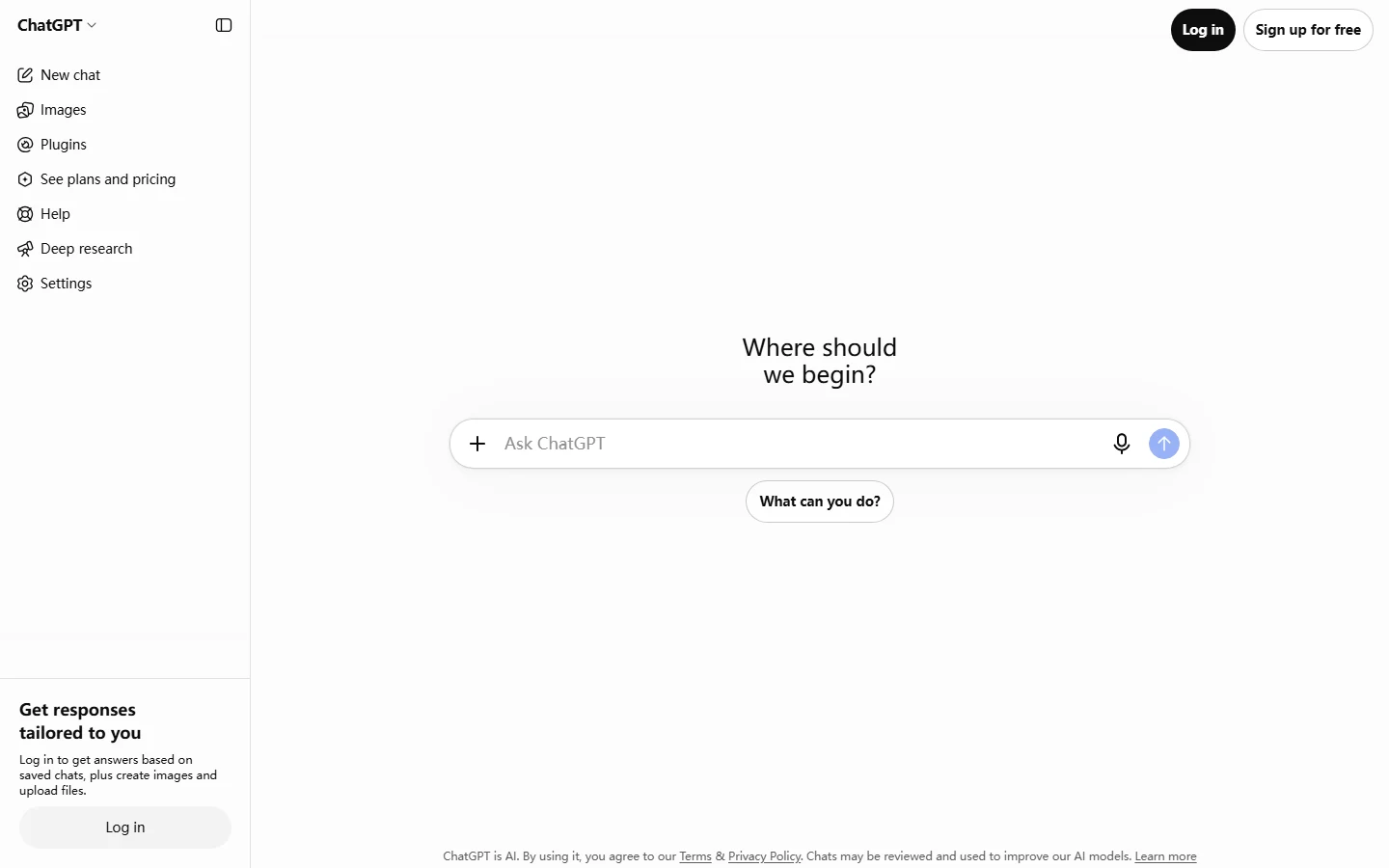
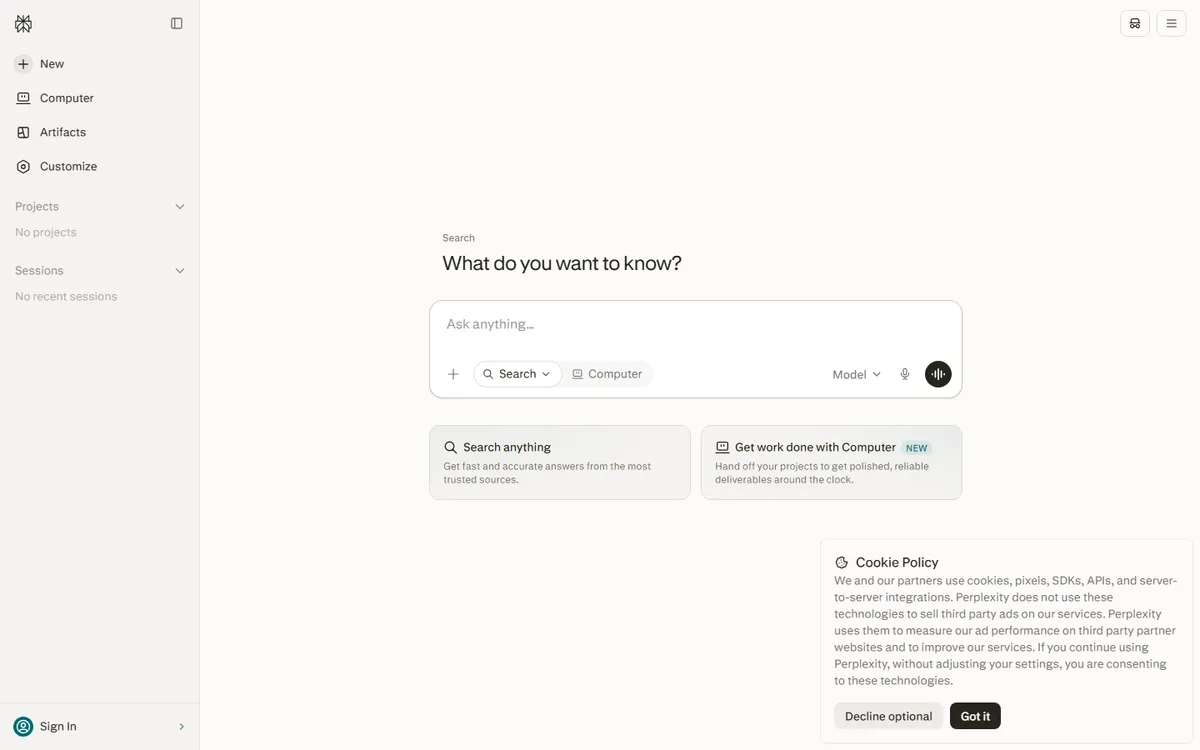
Beyond the headline features, the daily experience differs more than the marketing pages suggest. Perplexity is structured around searches: you type a query, you get an answer with sources, and you can drill into follow-up questions in the same thread. Its free tier already gives unlimited quick searches, so a researcher can run twenty queries a day without paying, and Pro adds more advanced models plus file uploads for PDFs and documents. ChatGPT is structured around a workspace: you open one thread, and you can switch between chat, image generation, plugin tools, and deep research within it, which suits builders who jump between tasks. The screenshots tell the story. ChatGPT's home screen asks "Where should we begin?" and routes you into a general assistant flow, while Perplexity's home screen is a search bar asking "What do you want to know?" with mode toggles for Search and Computer. Neither layout is better; each one optimizes for a different habit. If your day is a chain of discrete questions, Perplexity's search-first layout is faster. If your day is one long task that needs writing, images, and plugins in sequence, ChatGPT's thread-first layout saves you context-switching. The tools have also converged: Perplexity added Computer mode for agent-style work, and ChatGPT added deep research with citations, so the gap between them is smaller in 2026 than it was a year earlier, but the core split remains.
Which Tool Is Better for Students and Budget Users?
Budget tiers change the answer for students and casual users. Perplexity offers Education Pro at $10 per month, roughly half the standard price, and its free tier already includes unlimited basic search with 3 to 5 Pro searches per day, so a student can run most coursework research without paying anything. ChatGPT's cheapest paid option is Go at $8 per month, but it carries ads and a limited model, and the free tier is more restricted. For students who mostly need cited answers for essays and literature reviews, Perplexity's free tier plus Education Pro when needed is the better deal. For students who also write their essays with the same tool, ChatGPT Go at $8 per month gives you a writing assistant cheaply, and you accept the ads and limits. The honest comparison: Perplexity gives more research for less money, ChatGPT gives more writing for less money, and both beat the $20 standard tiers for anyone on a tight budget.
Conclusion
ChatGPT and Perplexity both cost $20 per month in 2026, and neither is a bad purchase; they simply serve different jobs. Perplexity Pro delivers cited, verifiable answers and wins for anyone whose work is research. ChatGPT Plus delivers deeper writing and flexible multi-step output and wins for creators and builders. Check your own week: if most of it is reading and verifying, buy Perplexity; if most of it is producing, buy ChatGPT; if you do both every day, the honest answer is that two $20 subscriptions pay for themselves compared with the time they save. For more context, our ChatGPT vs Claude and ChatGPT vs Gemini comparisons cover the other major chatbot choices, and our AI agents vs chatbots explainer shows where both tools fit as agents get more capable. Start with the free tiers, run your real tasks through both for a week, and let the workflow decide.