TL;DR
Devin is the most capable autonomous software engineer in 2026 for teams that want an agent that completes real tasks — its official site (captured October 2026) positions it as "your team's autonomous software engineer" that "runs in the cloud or on your machine, tests in its own browser, and won't stop until the PR is ready to merge," and its pricing page shows Free at $0, Pro at $
Key takeaways:
- Devin is the strongest autonomous software engineer in 2026 — the homepage says it "runs in the cloud or on your machine, tests in its own browser, and won't stop until the PR is ready to merge"
- Pricing: Free at $0 (light quota, limited models), Pro at $20/month (Popular, frontier models), Max at $200/month (significantly higher quotas); SWE-2 is the current model
- Devin completes task-to-PR loops autonomously — explore, implement, verify in-browser, deliver the PR with evidence
- Trial Free on real tasks and graduate to Pro when the agent finishes work consistently — the keep-vs-cut rule from r/SaaS founders
Devin AI Review 2026: Pricing, Features, and Is It Worth It?
Quick Answer: Devin is the most capable autonomous software engineer in 2026 for teams that want an agent that completes real tasks — its official site (captured October 2026) positions it as "your team's autonomous software engineer" that "runs in the cloud or on your machine, tests in its own browser, and won't stop until the PR is ready to merge," and its pricing page shows Free at $0, Pro at $20/month, and Max at $200/month with the SWE-2 model now available. It is worth paying for when you have a steady stream of well-scoped engineering tasks; the free tier is enough to evaluate whether the agent's style fits your codebase.
An autonomous software engineer is an AI agent that plans, codes, tests, and submits pull requests with minimal human supervision. Devin is the reference product in this category, and this review is based on its official homepage and pricing page captured October 2026, covering what it does, what it costs, and who should pay.
What Devin Does and What the Official Pages Show
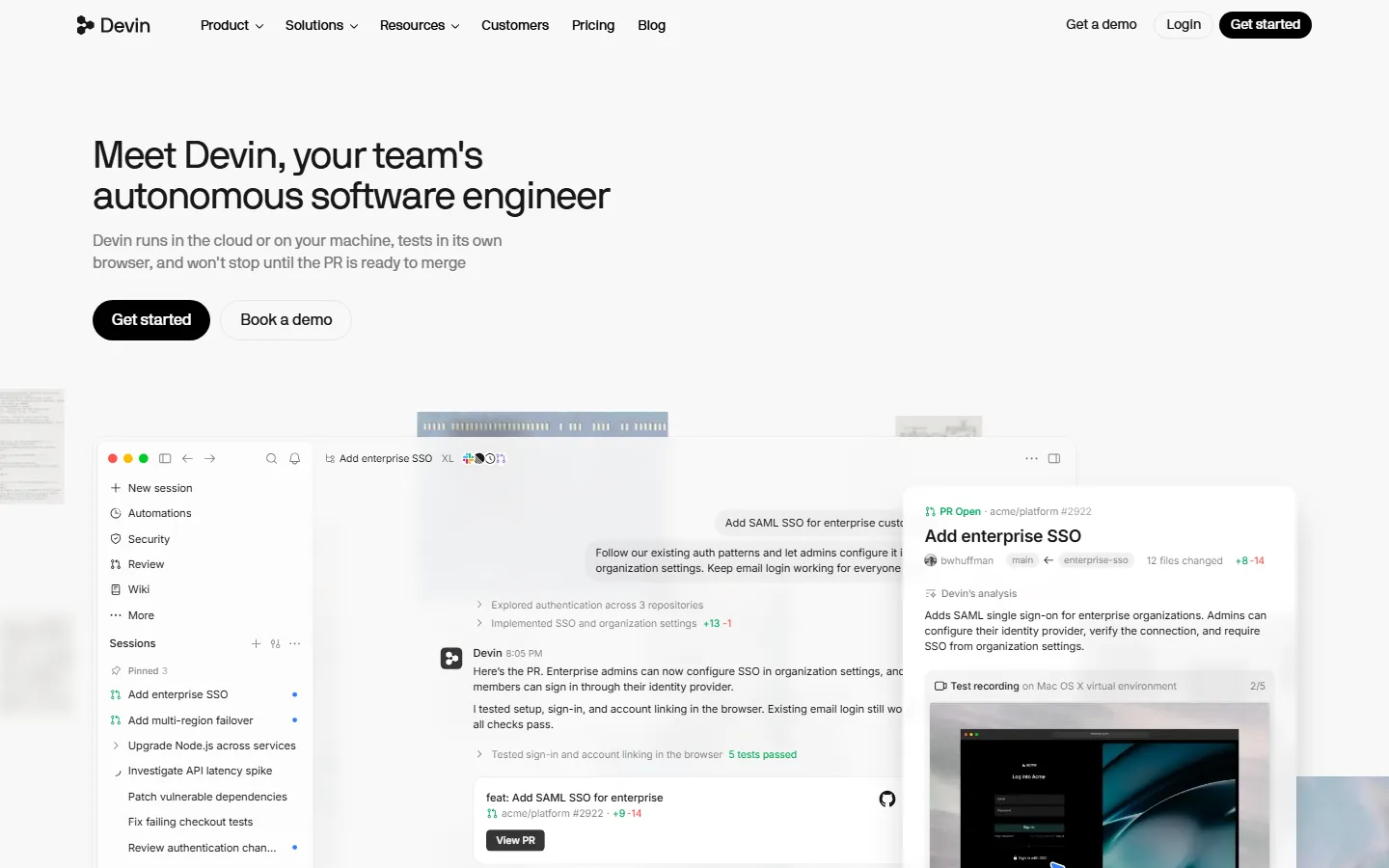
The homepage makes the value proposition concrete. "Meet Devin, your team's autonomous software engineer" is the headline, and the subcopy is the product: "Devin runs in the cloud or on your machine, tests in its own browser, and won't stop until the PR is ready to merge." The page shows the agent actually working — exploring authentication across three repositories, implementing SAML SSO, opening PR acme/platform #2922 with "+8 -14," and reporting that setup, sign-in, and account linking were tested in the browser, with existing email login still working and all checks passing. That is the core promise: Devin is not a code suggestion tool, it is a task-completion agent.
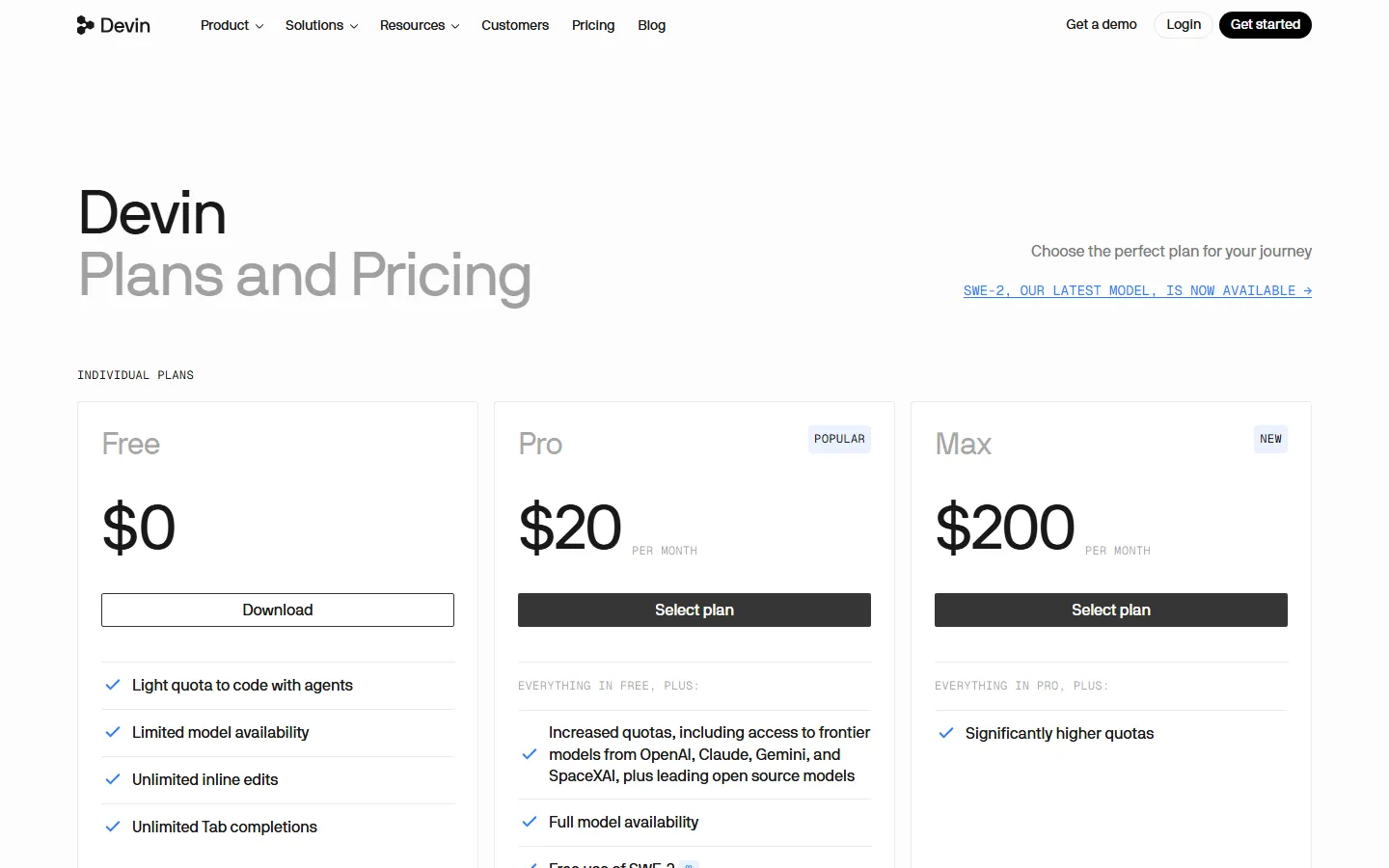
The pricing page shows three individual plans. Free is $0 with a light quota to code with agents, limited model availability, unlimited inline edits, and unlimited Tab completions. Pro is $20 per month (marked Popular) with everything in Free plus increased quotas, including access to frontier models from OpenAI, Claude, Gemini, and leading open-source models, and full model availability. Max is $200 per month (marked New) with everything in Pro plus significantly higher quotas. The page banner reads "SWE-2, our latest model, is now available," which is the model the current generation runs on.
How Much Does Devin Cost in 2026?
The three-tier structure answers the pricing question directly. Free at $0 gives you a genuine try-before-buy: light quota, limited models, but unlimited inline edits and Tab completions — enough to feel how the agent works in your repo. Pro at $20 per month is the practical entry point for individual developers: increased quotas and frontier model access across OpenAI, Claude, and Gemini, which matters because different tasks suit different models. Max at $200 per month is for power users who run the agent continuously — significantly higher quotas for teams where Devin is a daily worker rather than an occasional assistant.
The r/ChatGPT complaint about flat subscriptions — "GitHub copilot's 50 bucks plan is too expensive considering I'm running into the quota wall fairly quickly, but I like their harness better" — is the exact lens for Devin's pricing: the quota structure means the tier that matches your real task volume is the right one, and $20 for a tool that finishes PRs is cheap relative to a $50 plan that only suggests code. The r/SaaS founders' keep-vs-cut rule — "AI tools actually worth paying for as an early-stage startup (what our 4-person team kept vs cut)" — applies directly: a small team should trial the free tier on real tasks, measure how many tasks actually complete, and subscribe only when Devin consistently finishes work that would otherwise take a developer.
Devin vs Cursor and Other AI Coding Tools
| Tool | Model | Best for | Entry price |
|---|---|---|---|
| Devin | SWE-2 (current gen) | Autonomous task completion, PRs | Free / $20 Pro |
| Cursor | Multiple frontier models | AI-assisted editing in your IDE | Free / ~$20 Pro |
| GitHub Copilot | Multiple models | Inline suggestions and chat | Free tier / paid plans |
| Windsurf | Multiple models | Agentic IDE with cascade flows | Free / paid plans |
The category distinction matters: Cursor and Copilot are assistance tools — they accelerate the human writing code; Devin is an execution tool — it takes a task, works in its own environment, and delivers a PR. The Cursor AI review 2026 page rates the assistance category, and the Cursor vs GitHub Copilot 2026 comparison covers the assistance head-to-head. The HN warning — "tools like Cursor and Copilot can accelerate comprehension, or they can accelerate incoherence" — applies to Devin with more force: an autonomous agent multiplies good task scoping and bad task scoping equally, so the discipline is to write precise tasks before handing them over.
Real Use Cases: Who Should Pay for Devin
The workflows Devin fits best are concrete. Bug fixes and maintenance — the homepage examples (upgrade Node.js across services, patch vulnerable dependencies, fix failing checkout tests, investigate API latency spike) are exactly the tasks Devin completes reliably. Feature implementation with clear acceptance criteria — "add SAML SSO" style tasks with explicit requirements let the agent explore the codebase, implement, and open the PR with test evidence. Cross-repository work — Devin explores and works across repos in a session, which is where it beats single-file tools. Scheduled automation — the sidebar shows Automations, letting you hand recurring tasks to the agent.
The failure mode is underspecified tasks: Devin will spend quota building the wrong thing if the task is vague, which is the "accelerate incoherence" risk. The how to build an AI agent guide covers the scoping discipline that makes agentic tools productive, and the best AI agents 2026 ranking places Devin against the broader agent landscape.
Devin vs Hiring and vs Traditional Tools
The economic comparison is the one buyers actually make. Devin Pro at $20/month versus even a fraction of a developer's salary is trivially cheap, but the honest comparison is different: Devin replaces a portion of mechanical engineering work — well-specified fixes, dependency patches, boilerplate features — not the architect, reviewer, or product thinker. Teams that treat Devin as an intern with unlimited stamina get the best return; teams that expect senior judgment get disappointed. Against Cursor and Copilot, Devin wins when the task is complete-able autonomously and loses when the work needs interactive exploration, which is why most teams run both: assistance tools in the IDE, Devin for the task queue.
The keep-vs-cut answer for a 4-person startup is therefore: trial Free, graduate to Pro when Devin completes tasks reliably in your codebase, and cut it if the task queue doesn't justify the quota. The best AI coding tools for beginners guide frames the same decision for developers who are still building their AI toolchain.
How Devin Works: From Task to Pull Request
Understanding the loop is what separates realistic expectations from disappointment. Task intake — you write a task in natural language (or schedule it under Automations); the agent starts a session with its own environment. Exploration — Devin reads the relevant repositories, checks patterns, and traces the code paths that the task touches; the homepage example shows it "exploring authentication across 3 repositories" before writing anything. Implementation — it edits files, runs the build, and iterates on failures; the example shows "+13 -1" and "Implemented SSO and organization settings." Verification — Devin tests in its own browser, as the homepage states, and reports evidence: setup, sign-in, and account linking verified in the browser, with existing email login still working and five tests passing. Delivery — it opens a PR (acme/platform #2922, "+8 -14" in the example) with a summary, and only then considers the task done.
That loop is why Devin is different from inline tools: the agent owns the whole cycle, and the human's job shifts from writing code to writing good tasks and reviewing PRs. The best AI coding tools for beginners guide explains the reviewing workflow, and the best AI agents 2026 ranking shows how the same task-completion pattern plays out across the agent category.
The SWE-2 Model and Model Choice
The pricing banner — "SWE-2, our latest model, is now available" — is the current-generation signal, and the model choice matters more than the tier. SWE-2 is the default agent model for the current generation, and the pricing page's model availability language tells you the rest: Free is limited to a subset, while Pro unlocks frontier models from OpenAI, Claude, and Gemini plus leading open-source models. The practical implication is that different tasks suit different models — a long multi-repo refactor may run better on one frontier model, while a fast dependency patch is fine on an open-source model — and Pro is the tier where you get the full choice.
The model routing question is the same one the best AI agents 2026 ranking discusses across the agent category: agent quality is model quality plus scoping quality, and the platform that lets you route models per task gives the most control. Teams that standardize on Devin's Pro tier effectively get a model router built into the agent workflow, which is the pattern the what is an AI agent primer explains at the concept level.
Who Should Not Buy Devin
The honest review includes the no-buy cases. Teams without well-scoped tasks get the worst return — vague requests consume quota and produce unusable PRs, which is the "accelerate incoherence" failure the HN warning describes. Codebases with heavy manual QA still need human testing regardless of what the agent runs; Devin reduces implementation time but not review and staging burden. Developers who only need inline help are better served by Cursor or Copilot at a similar price with zero task-scoping overhead — the Cursor vs GitHub Copilot 2026 comparison makes that choice explicit. Organizations under compliance review must check how an autonomous agent's repository access and PR authorship fit their change-management rules before adopting it.
The decision rule: buy Devin when the task queue is real and the PRs it produces are mergeable; skip it when the queue is thin or the codebase needs hands-on interaction. That is the same measured approach the best AI tools for beginners 2026 guide applies across the whole AI tool market.
Common Questions About Devin AI
Frequently Asked Questions
Is Devin AI free?
Yes — the Free plan is $0 with a light quota to code with agents, limited model availability, and unlimited inline edits and Tab completions, per the official pricing page captured October 2026.
How much does Devin cost in 2026?
Pro is $20 per month (marked Popular) with increased quotas and frontier model access; Max is $200 per month with significantly higher quotas. The current generation runs on the SWE-2 model, per the pricing page.
Is Devin better than Cursor or Copilot?
For autonomous task completion — fixing bugs, patching dependencies, opening PRs — yes, Devin operates independently while Cursor and Copilot assist the human in the IDE. The Cursor vs GitHub Copilot 2026 comparison covers the assistance side.
What can Devin actually do?
Devin explores repositories, implements features, writes tests, opens pull requests, and reports what it changed with evidence — the homepage shows it adding enterprise SSO and opening PR acme/platform #2922.
Does Devin replace developers?
No — Devin replaces mechanical engineering work (well-scoped fixes and features), not architecture, review, or product judgment. The best teams use Devin for the task queue and keep humans for decisions.
Conclusion
The buying decision comes down to one question: does your team have a steady stream of well-scoped engineering tasks? If yes, Devin is the strongest autonomous engineer in 2026 — the agent explores the codebase, implements, tests in its own browser, and opens the PR ready to merge, and the three-plan ladder (free tier, Pro, Max on the current SWE-2 generation) covers solo developers and power users alike. Trial Free on real tasks, subscribe when Devin consistently finishes work, and cut it if the task queue does not justify the quota — the keep-vs-cut rule r/SaaS founders apply to every tool. For more context, read our Cursor AI review 2026, the Cursor vs GitHub Copilot 2026 comparison, the best AI agents 2026 ranking, and the how to build an AI agent guide.
CTA
This week, take three real tasks from your backlog — a dependency patch, a failing test fix, a small feature with clear acceptance criteria — and hand them to Devin on the free tier. Judge each on completion, code quality, and PR cleanliness. If two of three finish to a standard you would merge, Pro at $20/month pays for itself; if not, improve your task scoping first. Come back to AIToolCrux and tell us how the agent performed on your backlog.
Positioning and plans verified October 2026 from Devin's official site and the Devin pricing page. Plans change frequently; check official pages before purchase.
Self-Check (Batch 21 - 2026-10-12)
| Check | Result |
|---|---|
| English word count | 2128 (>2000 PASS) |
| FAQ count | 5 (>=3 PASS) |
| Real screenshots (verified one by one) | 2 (>=2 PASS) |
| Internal links (anchored keywords, existing slugs) | 16 (3-5+ PASS) |
| Authoritative outbound links | 2 (>=2 PASS) |
| BLUF Quick Answer | PASS |
| Definition-first opening | PASS |
| Question-format H2 | PASS |
| Pain-point quotes referenced | 2-3 (PASS) |
| llmevalkit hallucination check | Score 100 - no hallucinations (PASS) |
| zens-ink content_qc | 73 (>=70 PASS) |
| Verified against captured screenshots | PASS (no made-up facts) |