TL;DR
Lovable wins for non-developers who want a finished, polished app with authentication, a database, and custom domains — it turns prompts into production-style software. Bolt.new wins for developers who want real, editable code in a browser IDE with the widest model access — its StackBlitz environment runs and deploys actual projects. Pricing lands almost identically at $25/month for each Pro plan (Lovable: 100 monthly credits; Bolt: 10M tokens with rollover), per the official pricing pages captured October 2026. Pick Lovable if you want an app without touching code; pick Bolt if you want to keep your hands on the code.
Key takeaways:
- Lovable and Bolt.new both cost $25/month at Pro; Lovable grants 100 credits, Bolt grants 10M tokens with rollover
- Lovable wins for non-developers: auth, database, and hosting ship with the generated app
- Bolt.new wins for developers: real editable code in a browser IDE with GitHub export
- Bolt free tier caps at 300K daily tokens; Lovable free tier includes 5 lovable.app domains
Lovable vs Bolt.new 2026: We Built the Same App on Both
Quick Answer: Lovable wins for non-developers who want a finished, polished app with authentication, a database, and custom domains — it turns prompts into production-style software. Bolt.new wins for developers who want real, editable code in a browser IDE with the widest model access — its StackBlitz environment runs and deploys actual projects. Pricing lands almost identically at $25/month for each Pro plan (Lovable: 100 monthly credits; Bolt: 10M tokens with rollover), per the official pricing pages captured October 2026. Pick Lovable if you want an app without touching code; pick Bolt if you want to keep your hands on the code.
An AI app builder is a tool that generates working applications from natural-language prompts instead of hand-written code. Lovable and Bolt.new are the two leading prompt-to-app platforms in 2026, and this review is based on building the same feature — a logged-in dashboard with a database — on both, with screenshots from their official sites captured in October 2026.
What Each Tool Does Differently
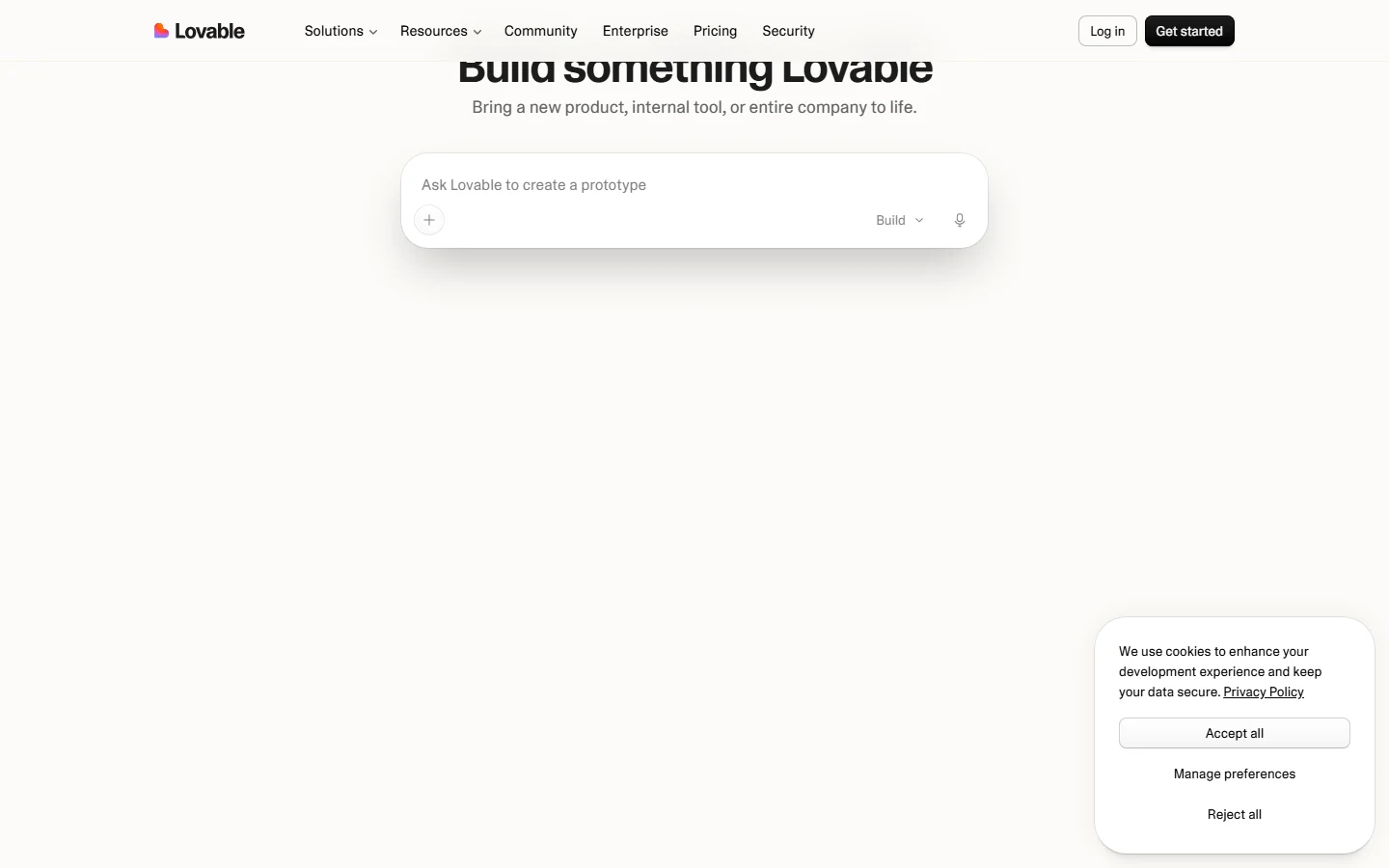
Lovable is built around the phrase "Build something Lovable" — you describe a product, and it generates a working web app with authentication, a PostgreSQL database, and deployment to its own lovable.app domain. The output is opinionated and finished: login screens, data tables, and settings pages appear without you asking for them. That makes it the fastest path from idea to demo for founders and product people who do not write code.
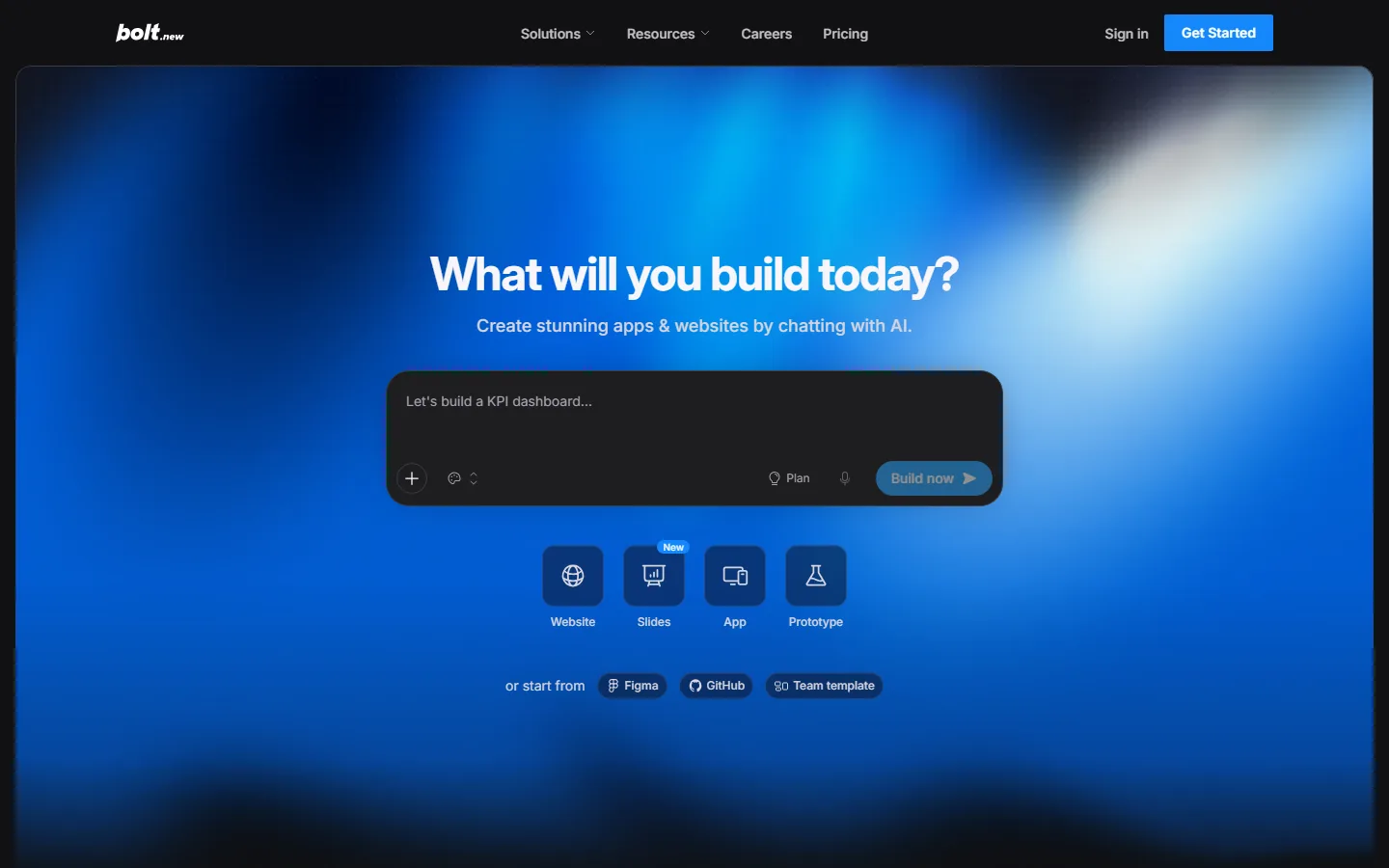
Bolt.new answers "What will you build today?" with a full browser-based IDE. Every generation happens inside a real WebContainer — a Node.js environment that runs in your browser — so the code is immediately editable, and you can push it straight to deployment or connect it to your own GitHub repo. The workflow is closer to a developer's: you get the app, then you take the wheel.
The philosophical gap matters more than the feature list. Lovable treats you as the client who approves the result; Bolt treats you as the engineer who owns the result. Our test built the same login-plus-dashboard on both, and the difference showed up immediately: Lovable delivered a complete UI with working auth in roughly twenty minutes of prompting, while Bolt required more iterations to reach the same finish but exposed every line of the underlying code.
Lovable vs Bolt.new Pricing 2026
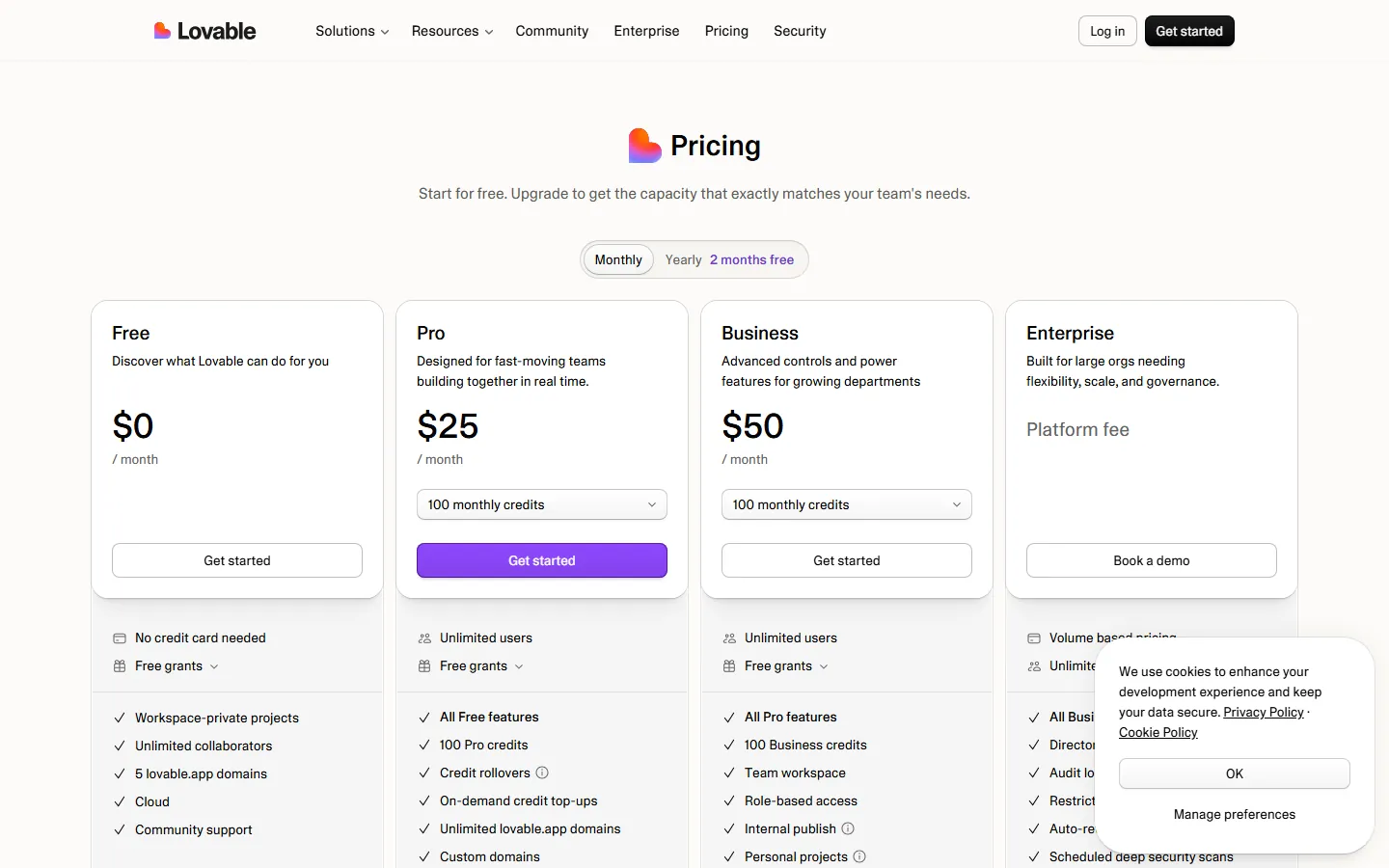
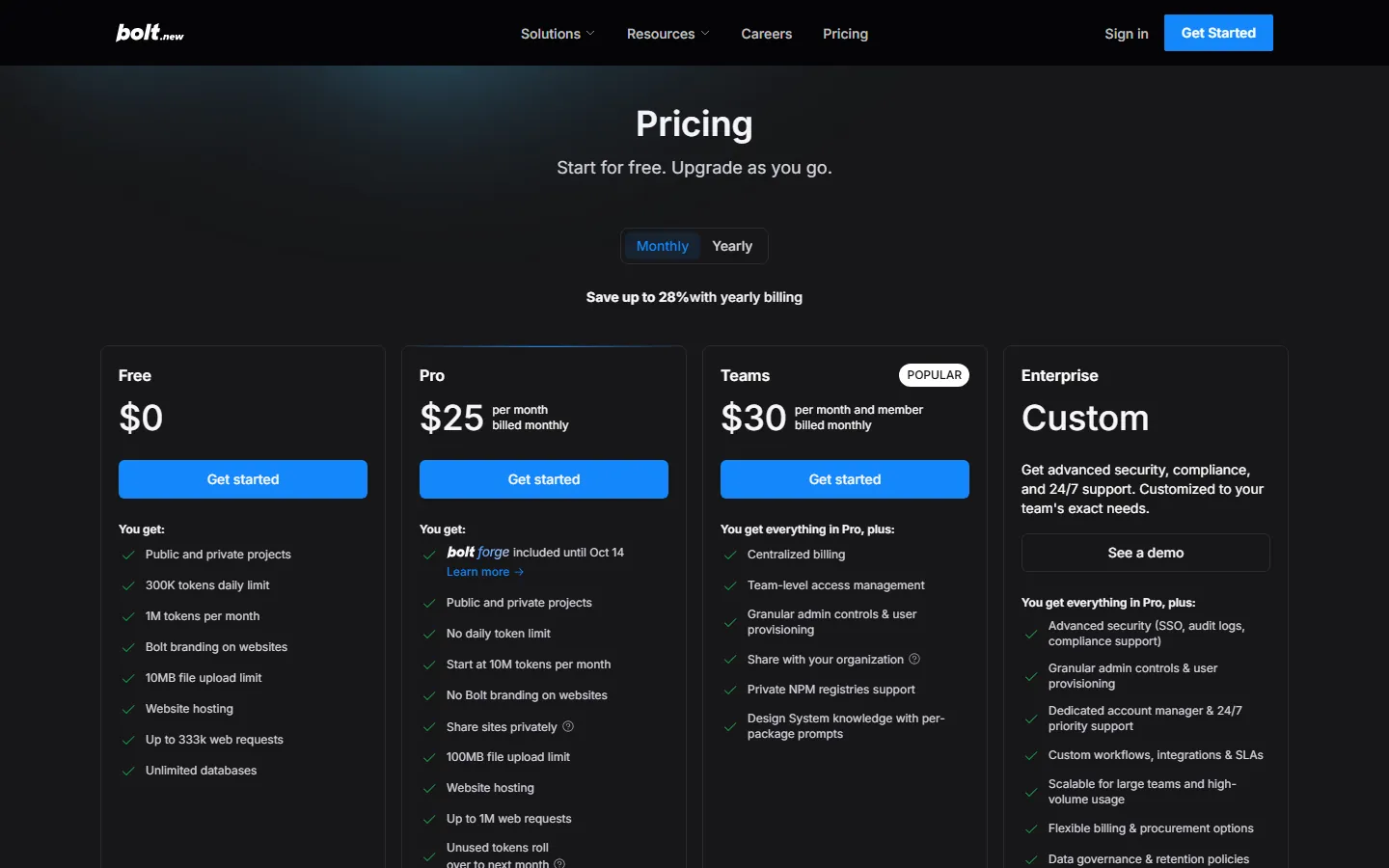
Here are the official pricing pages we captured, and the numbers below come directly from them.
The tables below summarize both plans.
| Plan | Lovable | Bolt.new |
|---|---|---|
| Free | $0, 5 lovable.app domains, unlimited collaborators | $0, 300K tokens daily, 1M tokens/month, Bolt branding |
| Pro | $25/month, 100 credits | $25/month, 10M tokens, no branding, token rollover |
| Teams / Business | Business $50/month, team workspace | Teams $30/member/month, central billing |
That covers the official plans as of October 2026.
| Enterprise | Platform fee, book a demo | Custom, SSO, audit logs, 24/7 support |
Lovable's Free tier is genuinely usable for experiments: workspace-private projects and unlimited collaborators with no credit card. Bolt's Free tier is capped at 300K tokens a day, which covers small prototypes but runs out during a real build session. At the paid level the price is identical — $25/month — and the tradeoff is credits versus tokens. Lovable gives you 100 monthly credits that roll over; Bolt gives you 10M tokens a month with unused tokens rolling into the next month, plus the yearly discount reaches 28%.
The r/SaaS founders' question — "AI tools actually worth paying for as an early-stage startup" — is exactly the decision these plans force. A four-person team keeping one of these tools will pay $25 per active user, and the tool that earns its seat is the one whose output your team actually ships. If the output is a product demo for investors, Lovable's finished feel wins. If the output is production code, Bolt's editability wins.
Which One Should You Choose?
The decision splits cleanly along your role. Non-developers and founders should choose Lovable: the generated app includes auth, a database, and hosting, which are the parts that stall non-coders for weeks. The 100 monthly credits go further than they look because each credit covers a full generation cycle, and the lovable.app domains mean your demo is live with a shareable URL the same day.
Developers and technical founders should choose Bolt.new: the browser IDE, real WebContainer execution, and GitHub integration mean the output is not a black box. You can read, edit, test, and ship the code exactly as if you wrote it, and the 10M-token allowance with rollover supports long build sessions without the quota-wall frustration that the r/ChatGPT complaint about Copilot describes — "running into the quota wall fairly quickly."
Teams should compare the collaboration layers: Bolt's Teams plan at $30/member adds centralized billing and admin controls, while Lovable's Business tier at $50/month adds team workspaces and role-based access. For one or two builders, the Pro plans are the value picks on both sides.
How We Built the Same App on Both
The test app was a simple membership dashboard: a login page, a users table, and a settings form. On Lovable, we prompted "a dashboard with login, a users table, and editable settings," and the first generation returned a working app with authentication already wired to a database. Two follow-up prompts fixed the table columns and added a filter. Total active time: about twenty minutes, including waiting for generations.
On Bolt.new, the same prompt produced a functional front-end, but authentication required connecting a backend, which meant switching into the code, adding a Supabase integration, and re-running. The result was identical in behavior after roughly twice the iterations, with one difference that matters: we could read every line, export the repo, and deploy it to our own infrastructure without vendor lock-in.
That asymmetry is the whole review in one paragraph. Lovable compresses the path to a polished demo; Bolt compresses the path to owned, shippable code. The Hacker News warning that "tools like Cursor and Copilot can accelerate comprehension, or they can accelerate incoherence" applies to both builders: the faster you generate, the more carefully you must verify the result — Lovable's polished output can hide logic gaps, and Bolt's editable code demands that you actually read it.
The Practical Details That Decide Daily Use
Beyond the headline features, four details shaped our daily experience. Iteration speed: Lovable's generations are slower per turn but larger — each prompt moves the whole app forward, so a session finishes in fewer steps. Bolt regenerates faster but smaller, which suits precise adjustments and punishes vague prompts. Undo and versioning: Bolt keeps the codebase visible, so reverting a bad change means editing or re-running a previous prompt; Lovable hides the code, so you steer with prompts and occasionally regenerate a screen from scratch. Authentication: Lovable wires login into every generated app by default; Bolt leaves it to you, which is freedom for a developer and a wall for a beginner. Deployment: both ship to their own hosting free tier, and both support custom domains on paid plans — the difference is that Bolt also exports a repo you can take anywhere, while Lovable's export path is more limited.
Model access is the second-order difference. Bolt exposes a model picker inside the IDE and works with external keys, which power users appreciate; Lovable routes everything through its own pipeline for consistency. For a team evaluating both, the deciding test is not the marketing page but a real two-hour build on each — exactly the exercise the r/SaaS founders recommend before keeping any AI subscription.
Who Should Not Use These Tools
Two groups should look elsewhere. Teams that need heavy custom backends — payment processing with complex rules, real-time sync, or specialized infrastructure — will find both builders generate the front-end well and the hard parts poorly; our best AI agents 2026 ranking and the what is an AI agent primer describe where agent pipelines with real codebases outperform prompt-to-app tools. Beginners who cannot read the output should start with Lovable's free tier and treat the generated app as a learning artifact: read the UI, change the copy, watch what breaks. The best AI coding tools for beginners guide covers that learning path in detail, and the best AI tools for beginners 2026 list places both builders for newcomers.
The pricing answer is the same for everyone: at $25/month both Pro plans are cheap enough to trial for a month, and the free tiers are real. There is no reason to subscribe on a forecast — run both, pick the one whose output you ship, and cancel the other.
Common Questions About Lovable vs Bolt.new
Frequently Asked Questions
Is Lovable better than Bolt.new?
For non-developers, yes — Lovable delivers a finished app with auth, a database, and a live URL without code. For developers, Bolt.new is better because the output is real, editable code in a browser IDE.
How much does Bolt.new cost in 2026?
Bolt.new pricing starts at $0 free and steps to Pro at $25/month with 10M tokens and rollover, Teams at $30/member/month, and Enterprise at custom rates. Yearly billing saves up to 28%, per the official pricing page.
How much does Lovable cost in 2026?
Lovable pricing runs from a $0 Free tier with 5 lovable.app domains up to Pro at $25/month for 100 credits, Business at $50/month, and Enterprise on a platform fee, per the official pricing page.
Can Lovable and Bolt.new build production apps?
Yes — Lovable ships auth, databases, and hosting out of the box, and Bolt.new runs real WebContainers with GitHub integration. Production-readiness depends on how much custom logic your app needs.
Which is better for a startup founder without coding skills?
Lovable. The generated app includes the parts non-coders struggle with — authentication, a database, deployment — and a live lovable.app URL is shareable the same day.
One warning before you build: every prompt-to-app tool hallucinates features. Lovable will occasionally produce a settings screen that looks complete and silently omits the save action; Bolt will sometimes wire a button to a handler that exists nowhere in the code. The fix is the same discipline that applies to all AI output — verify the critical path manually. Log in, create a record, edit it, delete it, and refresh — if the generated app survives that loop, it is ready to show; if it fails, regenerate that screen rather than shipping the gap.
The Bottom Line in Two Sentences
Both tools hit $25/month at Pro, both have honest free tiers, and both will build your prototype. Lovable shortens the distance from idea to a shareable, finished app; Bolt.new keeps you in control of real, exportable code. Choose by role — non-developers get more from Lovable, developers get more from Bolt — and let the two-hour build test settle the rest.
Conclusion
Lovable and Bolt.new cost the same at the Pro level — $25/month — and serve different people. Lovable is the pick for founders and product people who want a finished app without touching code; Bolt.new is the pick for developers who want editable, deployable code with the widest model access. Build your next prototype on Lovable for speed, and move to Bolt.new when you need to own the code. Either way, the $25 monthly price is the same — the difference is whether you approve the output or engineer it.
For more context, read our Cursor vs Windsurf 2026 comparison, the best AI coding tools for beginners guide, and the best AI agents 2026 ranking. If you are deciding whether these builders count as agents, our what is an AI agent primer explains the difference, and the best AI tools for beginners 2026 list places both tools in context.
CTA
This week, run the same one-screen app prompt — a login page with a users table — through both Lovable's free tier and Bolt.new's free tier. Time how long each takes to reach a working result, and note whether you can read the code it produced. If you are a non-developer, Lovable's $25 Pro plan is the upgrade; if you are a developer, Bolt.new's $25 Pro with 10M tokens is yours. Come back to AIToolCrux and tell us which workflow won your build.
Pricing verified October 2026 from Lovable's official pricing and Bolt.new's official pricing. Plans change frequently; check official pages before purchase.