Quick Answer: Claude rate limits in 2026 work on a rolling five-hour session window with a weekly cap on paid plans, and every surface, web, desktop, mobile, and Claude Code, draws from the same pool. Free users get Sonnet and Haiku with everyday-question capacity, Pro subscribers get at least five times the per-session usage of Free for $20 a month, and Max users choose five or twenty times Pro's usage from $100 a month. There is no fixed message count, and the official escape valve is usage credits at standard API rates when you hit a wall mid-session.
A rate limit is a usage cap that resets on a schedule, and Claude's rate limits are rolling five-hour session windows plus weekly caps that apply across all models and surfaces. Understanding the exact mechanics matters because the cap is not a message count, and the fix is not obvious: upgrading changes the size of the window, not the shape of the system. This guide uses Anthropic's official pricing page and help center, checked on October 21, 2026, plus the public API rate-limit documentation, to explain what the limits actually are and how to stop them from breaking your work.
What Exactly Are Claude's Rate Limits in 2026?
Anthropic's official pricing page, updated in October 2026, states that every plan has usage limits that reset on a rolling five-hour session window, and paid plans add weekly limits on top. Your activity across Claude on web, desktop, mobile, and Claude Code all draws from the same pool. There is no fixed message count, because how much you can do depends on the length and complexity of your conversations, the model you choose, and the features you use. When you reach a limit, you can wait for the window to reset, move to a higher plan, or, on paid plans, turn on usage credits to keep working at standard API rates. You can see where you stand at any time under Settings, Usage. That last detail matters: the limit is visible in real time, so the surprise wall is avoidable.
Free vs Pro vs Max: How Much Usage Does Each Plan Give?
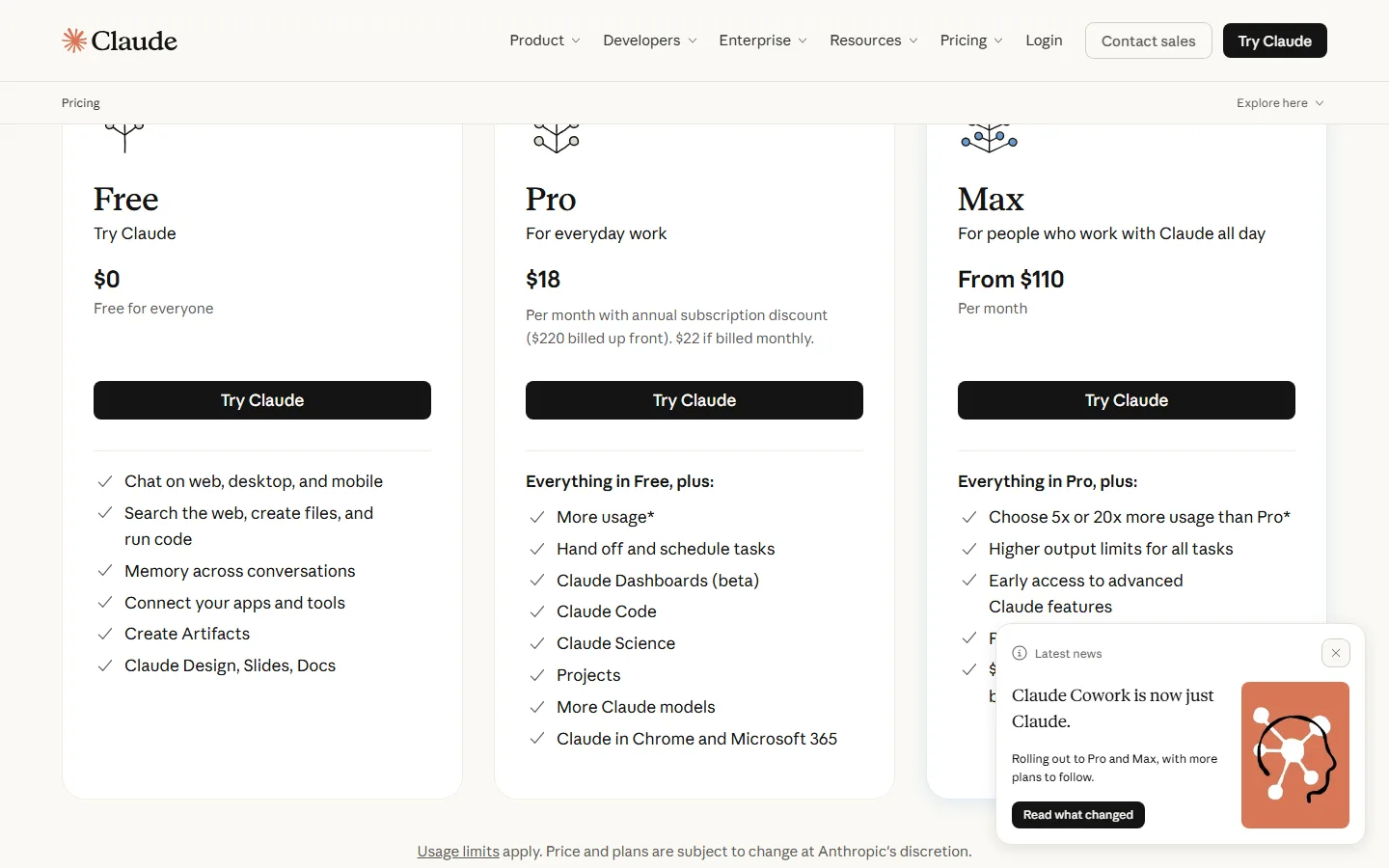
The official comparison is straightforward. Free is $0 and covers everyday questions on Sonnet and Haiku, with up to 1 million token context, web search, Artifacts, and up to five Projects, but no Claude Code, no Opus, and no usage credits. Pro costs $20 per month, or $17 per month billed annually, and offers at least five times the usage per five-hour session compared to Free, plus a weekly limit, Claude Code, Opus access, usage credits, and Claude in Chrome and Microsoft 365. Max starts at $100 per month and lets you choose five times or twenty times Pro's per-session usage, with higher output limits, priority access at high traffic times, and $100 to $200 per month in API credits. Team plans sit above Pro, where Standard seats get more usage than Pro and Premium seats get five times Standard. The practical takeaway is that the multiplier ladder is consistent: Free, then Pro at 5x, then Max at 5x or 20x Pro, then Team.
| Plan | Price | Per-session usage | Claude Code | Opus | Weekly cap |
|---|---|---|---|---|---|
| Free | $0 | Baseline, everyday questions | No | No | No |
| Pro | $20/mo ($17 annual) | At least 5x Free | Yes | Yes | Yes |
| Max 5x | From $100/mo | 5x Pro | Yes | Yes | Yes |
| Max 20x | From $100/mo+ | 20x Pro | Yes | Yes | Yes |
| Team Standard | $20-25/seat | More than Pro | Yes | Yes | Yes |
Why Does Claude Hit a Wall Mid-Conversation?
Hitting a wall mid-conversation is the number one complaint about Claude in 2026, and independent reviews describe it as "usage limits and token caps that break momentum mid-task", a phrase that shows up again and again across long-session reviews. Two mechanics cause it. First, the five-hour window is shared across everything you do, so a long Claude Code session burns the same pool as your chat windows, and heavy file attachments count against the session. Second, the cap is based on tokens, not messages, so a few very long conversations exhaust the window faster than many short ones, and there is no message counter you can game. The wall feels sudden because the official limits page says there is no fixed message count, so users cannot predict the exact threshold. The fixes are the same in every review: check Settings, Usage before starting a long session, split work across the window, or move to usage credits when the session must not stop.
How Do Claude Code Sessions Count Against Your Limits?
Claude Code draws from the same usage pool as web, desktop, and mobile, so heavy coding sessions can drain the window that your chat uses. On the paid plans, Anthropic removed the peak-hours limit reduction on Claude Code for Pro and Max accounts in May 2026, which means Claude Code no longer gets throttled at high traffic times the way it previously did. The official guidance is that Claude Code is included in all paid plans and shares the same usage limits, and for heavy coding sessions you can switch to pay-as-you-go API credits through a Console account. For free users, Claude Code is not included at all, which is the single biggest reason serious developers pay. In practice, the shared pool means your choice is between discipline, like running shorter agent tasks and letting windows reset, and paying, like usage credits or a Max tier that gives five to twenty times the session allowance.
What Are the API Rate Limits for Claude in 2026?
For developers using the API, the limits are expressed differently, in requests per minute and tokens per minute, and Anthropic raised API rate limits considerably in May 2026. The public documentation, checked October 20, 2026, lists Claude Opus 5 at 1,000 maximum requests per minute, 2,000,000 input tokens per minute, and 400,000 output tokens per minute, with other models following the same structure. API usage is separate from chat usage, so heavy automation does not drain your Claude chat window, but it is billed at API rates. For most users the API numbers are generous enough that the practical limit is cost, not rate, and the same May 2026 announcement that raised limits also removed the peak-hours reduction on Claude Code, which points in one direction: Anthropic is loosening limits where users complained and monetizing the rest through credits and higher tiers.
Is Claude Pro Worth It Just to Avoid Rate Limits?
If rate limits are your only problem, Pro is the cheapest fix: $20 per month buys at least five times the per-session usage, which removes the wall for most everyday and light coding work, and it adds Claude Code, Opus, and usage credits as overflow. If you work with Claude all day, Pro's 5x still hits walls, and the reviews that complain about "usage limits and token caps that break momentum mid-task" mostly come from users who outgrew Pro, which is exactly the audience Max targets. The value test is simple: count how many times per week you hit the wall and how long you wait. Once a day, Pro is fine and the weekly cap rarely bites. Multiple times a day, the Max tier pays for itself in unbroken sessions, and the $100 to $200 monthly API credits on Max offset the price for people who also build with the API. If you mostly ask short questions, stay free and never pay for limits you never hit.
How Do Claude Limits Compare With ChatGPT and Gemini in 2026?
The structural comparison is fairer than the marketing suggests. Claude, ChatGPT, and Gemini all moved to rolling window systems with weekly or monthly caps, and all three share one pool across their chat, apps, and coding tools, so none of them lets you multiply usage by switching surfaces. The differences are in multipliers and prices. Claude Pro at $20 gives 5x Free, ChatGPT Plus also sits around $20, and Gemini Plus undercuts both at around $8 per month, which matters if price convergence is your concern: reviewers note "all major AI assistants priced at $19.99-$20/mo, choosing on features not price". Claude's Max tier is the aggressive end of the market at 5x or 20x Pro, while the others offer smaller premium multipliers. For rate-limit avoidance specifically, the practical ranking is Gemini Plus for the cheapest paid ceiling, Claude Pro for the best mid-tier coding value with Claude Code, and Claude Max for the highest per-session ceiling available to individuals.
FAQ
Q: What is Claude's usage limit for free users in 2026?
A: Free users get a rolling five-hour session window with no weekly cap, limited to Sonnet and Haiku, up to 1 million token context, and up to five Projects. Claude Code, Opus, and usage credits are not included in Free.
Q: How many messages can I send with Claude Pro?
A: There is no fixed message count. Pro offers at least five times the per-session usage of Free within a five-hour window, plus a weekly limit, and the actual number varies with conversation length, file attachments, model, and features.
Q: Do Claude rate limits reset every 5 hours?
A: Yes. The session limit resets on a rolling five-hour window, and paid plans add a weekly cap on top. Activity on web, desktop, mobile, and Claude Code all draws from the same pool.
Q: Why does Claude say I am at my limit when I just started?
A: Because the five-hour window is shared across all surfaces and counts tokens, not messages. If you used Claude Code or long conversations earlier in the window, they consumed the same pool, and there is no fixed message count to check in advance.
Q: What is Claude Max 5x and 20x?
A: Max lets you choose five or twenty times Pro's per-session usage, from $100 per month, with higher output limits, priority access at high traffic times, and $100 to $200 per month in API credits.
Q: Can I buy more Claude usage instead of upgrading?
A: Yes. On paid plans you can turn on usage credits to keep working at standard API rates after hitting the session limit. Claude Code users can also switch to pay-as-you-go API credits through a Console account.
Q: Does Claude Code have separate limits?
A: No. Claude Code shares the same usage limits as web, desktop, and mobile on all paid plans. In May 2026 Anthropic removed the peak-hours limit reduction on Claude Code for Pro and Max accounts.
Conclusion
Claude rate limits in 2026 are a simple ladder wearing a complicated costume. The ladder is Free, Pro at five times Free, and Max at five or twenty times Pro, with weekly caps on paid plans and one shared pool across every surface. The costume is the rolling five-hour window, the token-based accounting, and the absence of a fixed message count, which makes walls feel random until you check Settings, Usage. The practical conclusion is boring but true: check your usage before long sessions, match your plan to how often you actually hit the wall, and use usage credits for the sessions that must not stop.
CTA
Check your own usage first: open Settings, Usage inside Claude and see where your current five-hour window stands before you upgrade on vibes. Then read our Claude vs Gemini comparison and ChatGPT vs Claude to see the full picture, and our AI coding tools comparison for how Claude Code limits stack against Cursor and Devin. If ChatGPT pricing is your baseline, our how to get ChatGPT free guide and is ChatGPT getting worse analysis cover the other side of the same subscription debate.