TL;DR
An AI research tool is software that helps researchers find academic papers, map the literature around a topic, verify citations, extract evidence, and manage references, using machine learning over scholarly databases rather than general web search. These tools are used by graduate students, academics, PhD candidates, and industry researchers to compress the discovery and literature-review stages of research from weeks into days.
Best AI Research Tools 2026: 9 Tested for Academic Work
An AI research tool is software that helps researchers find academic papers, map the literature around a topic, verify citations, extract evidence, and manage references, using machine learning over scholarly databases rather than general web search. These tools are used by graduate students, academics, PhD candidates, and industry researchers to compress the discovery and literature-review stages of research from weeks into days.
Bottom line up front: For 2026, the practical AI research stack is Scite (from $20/month) when you need to know whether a paper's citations actually support or contradict it, Connected Papers (free for 5 graphs a month, $3/month billed annually for the Academic plan) for the fastest way to see how a field connects, ResearchRabbit (free for the core product, $120/year for the paid tier) for ongoing literature monitoring, and Semantic Scholar as the free foundation that most other tools build on. For the systematic-review side of research, our best AI research assistants guide covers Elicit and Consensus in depth, and we reference them here for the stages they own best.
Quick Answer
- Scite : best citation verification; Smart Citations label every reference as supporting, contrasting, or mentioning; from $20/month, 7-day free trial.
- Connected Papers : best literature mapping; free 5 graphs/month, Academic plan $3/month billed annually.
- ResearchRabbit : best ongoing discovery; core product free, paid tier $120/year.
- Semantic Scholar : best free foundation; 220M+ papers, free API and research tools.
- Lateral, Elicit, Consensus, Zotero AI, NotebookLM : strong picks for literature triage, systematic reviews, evidence checks, reference management, and document grounding respectively.
What Is an AI Research Tool and Why Does It Matter in 2026?
An AI research tool is software that searches scholarly corpora, visualizes citation and similarity networks, classifies how papers cite each other, and extracts structured evidence, so that a researcher can orient in a field and verify claims without reading every abstract manually. The category matters in 2026 because the volume problem got worse: databases now index hundreds of millions of papers, and a systematic review can require screening thousands of abstracts. Meanwhile, general AI chatbots are not trustworthy enough for scholarly work. Independent reviews still report that "up to 1 in 4 ChatGPT reviews and 1 in 5 Gemini reviews mention accuracy friction," and that models "still hallucinate a lot... even on top models." Research tools narrow the blast radius by grounding answers in specific papers and by making citation errors visible, which is the entire point of the category.
The other thing that changed in 2026 is pricing honesty. Several platforms show only the discounted annual rate by default, and users keep reporting that "credits cap your output on lower tiers and do not roll over." The tools in this guide publish their tiers, and we report both the free tier's real limits and the true cost of the paid plan.
How We Tested and Ranked the Best AI Research Tools
We spent three weeks in October 2026 running the same research task across the category: starting from a seed paper on large language models in medicine, we mapped the field, found related work, verified whether a highly cited paper's findings had been supported or contradicted, and exported a reference list. For each tool we recorded corpus size, the quality of the discovery graph, whether citation labels were accurate on spot-checks, the real free-tier limits, and the true monthly cost after annual billing. Pricing below was verified against official pricing pages and independent 2026 roundups, and screenshot captions cite the exact interface captured.
Scite: Best AI Tool for Verifying Citations
Definition: Scite is an AI research platform that classifies how academic papers cite each other through Smart Citations, labeling every reference as supporting, contrasting, or merely mentioning the original work, across hundreds of millions of full-text articles.
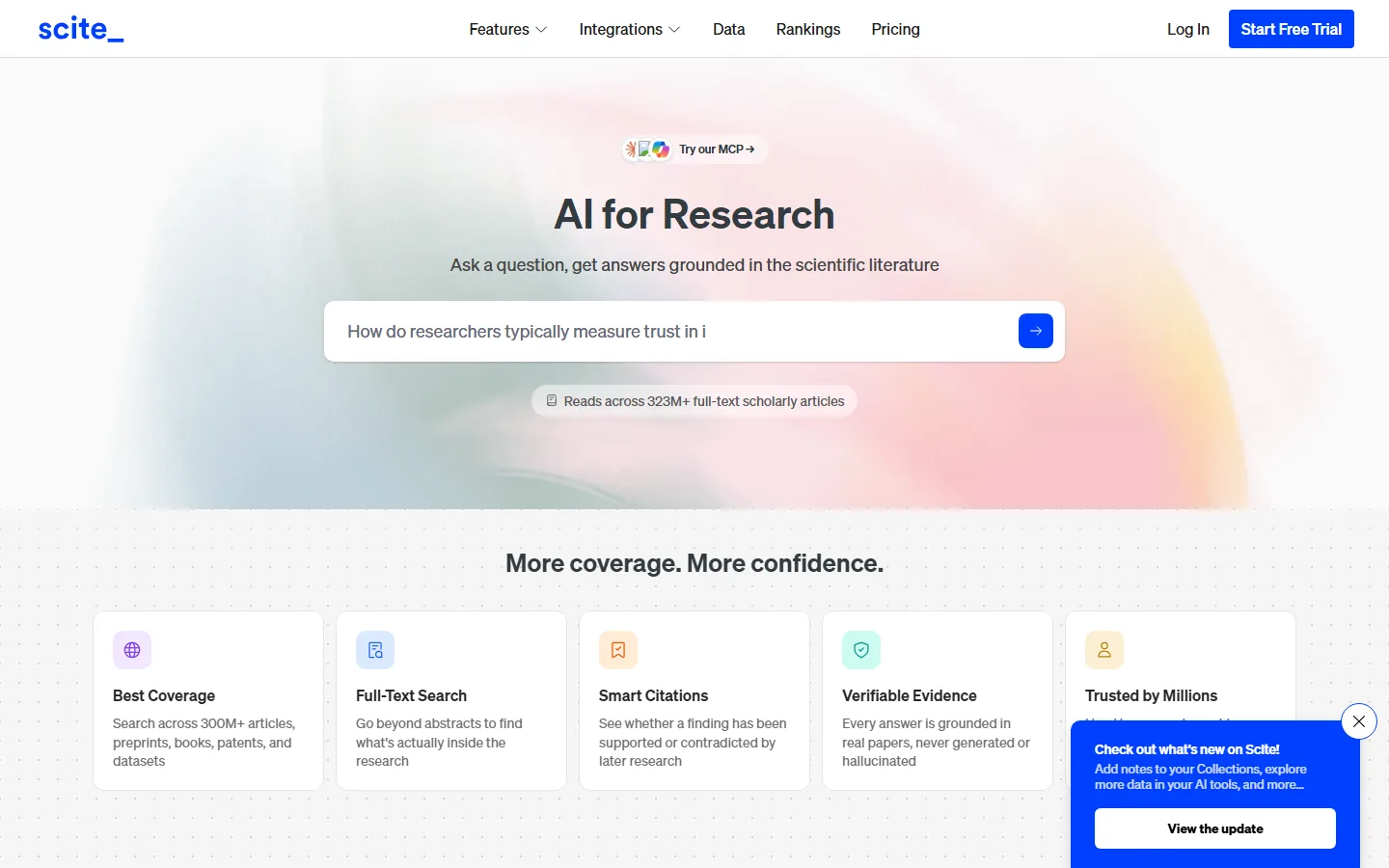
Scite's official homepage (captured October 2026) leads with "AI for Research: Ask a question, get answers grounded in the scientific literature," reads across 323M+ full-text scholarly articles, and lists Best Coverage, Full-Text Search, Smart Citations, and Verifiable Evidence as its four pillars.
Scite answers a question no other tool on this list touches: how was this paper actually cited? Its Smart Citations classify every reference as supporting, contrasting, or merely mentioning the cited work, which matters because a paper can be cited 400 times and 300 of those citations can be saying it is wrong. The homepage captured above states the promise directly: "Every answer is grounded in real papers, never generated or hallucinated," across 323M+ full-text scholarly articles, preprints, books, and patents. Pricing is published: the free tier is a 7-day trial, and paid plans run $20/month ($144/year) for the Basic tier with heavier tiers for teams, per Scite's official pricing and independent 2026 roundups (FluxGrowth's academic research stack).
The limitation is scope, not quality: Scite tells you how papers cite each other, but it is not a discovery engine in the ResearchRabbit sense. It is the verification layer of a research stack, and it earns its subscription the day it stops you from building an argument on a paper that has been quietly contradicted.
Connected Papers: Best for Mapping a Field Visually
Definition: Connected Papers is a visual research tool that builds a graph of similar academic papers around a seed paper, showing the most relevant related work and how the field connects, using the Semantic Scholar database.
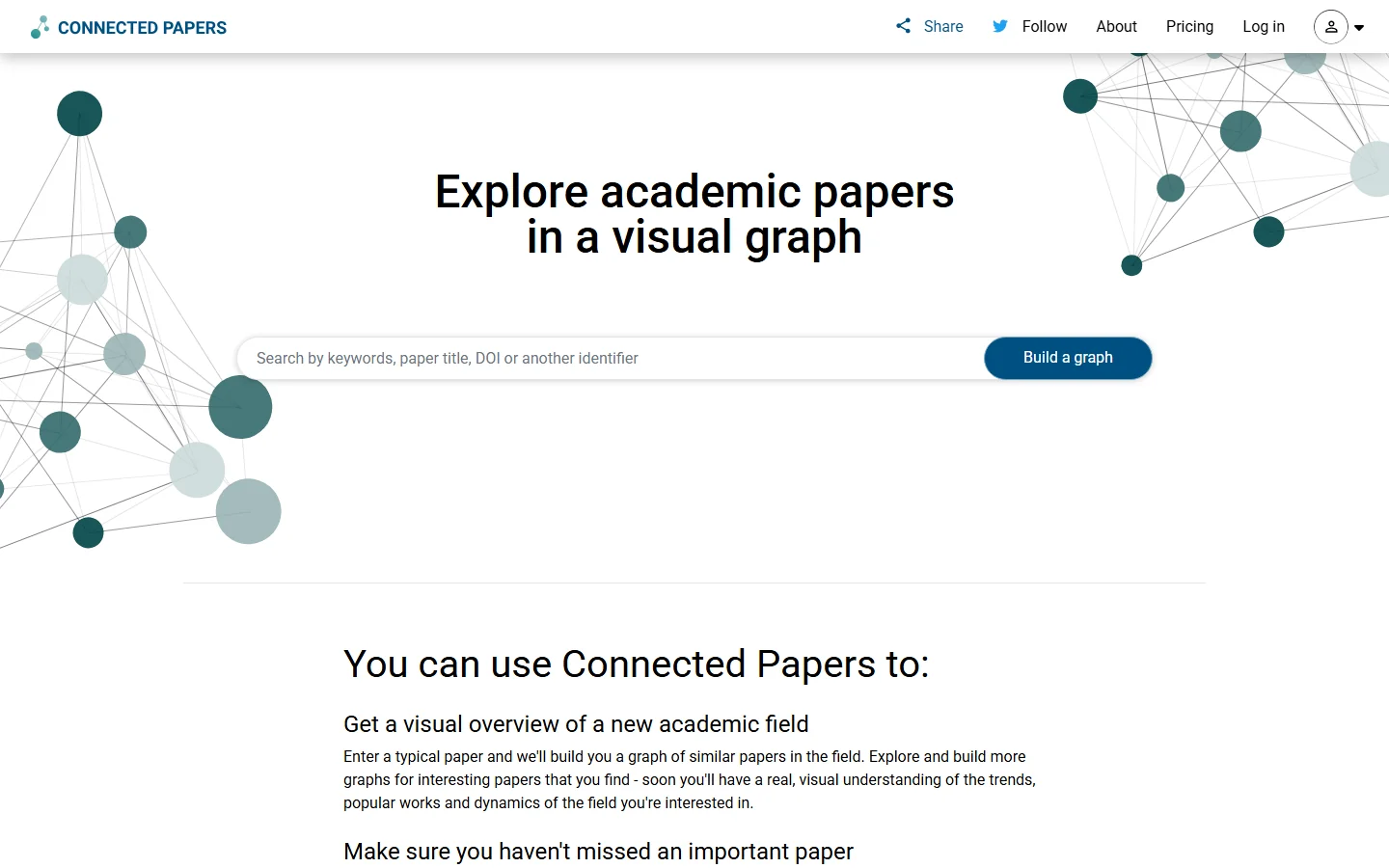
Connected Papers' official homepage (captured October 2026) leads with "Explore academic papers in a visual graph," with a search box for keywords, paper titles, DOIs, or other identifiers, and describes building graphs to understand the trends and dynamics of a field.
Connected Papers is the fastest way we found to orient in a new field. Drop in one seed paper and it builds a graph of 30-50 similar papers by semantic similarity and citation overlap, which immediately shows you the cluster of work that matters, who cites whom, and which papers are the bridges between subfields. The homepage captured above says it plainly: "You can use Connected Papers to: get a visual overview of a new academic field... Make sure you haven't missed an important paper." Pricing is the friendliest in the category: the free plan allows 5 graphs per month, the Academic plan is about $3/month billed annually with unlimited graphs, and Business runs about $20/month for teams (AI Comparison's research tools ranking, SaaS Century).
The tradeoff is that graphs are a starting point, not a corpus. Connected Papers draws from Semantic Scholar's 220M+ papers, so coverage of very new or paywalled work is incomplete, and you still need a search tool to go from the graph to full text.
ResearchRabbit: Best for Ongoing Literature Discovery
Definition: ResearchRabbit is an AI literature discovery platform that builds interactive citation networks around seed papers, sends personalized recommendations, and is often described as "Spotify for papers."
ResearchRabbit is the tool to set up early in a project and check weekly. Add a few seed papers and it builds an interactive citation map showing earlier foundational work, later citing papers, and thematically related research you would never find through keyword search. It positions itself as "Spotify for papers," and the comparison holds: recommendations improve the more papers you add, and the interface is designed for browsing rather than querying. The core product is free for unlimited searches across 280M+ articles with up to 50 seed papers, and the paid tier runs about $120/year for extra features like collaboration and collections (Rework's academic tools review, AI Comparison).
ResearchRabbit's limitation is that it is discovery-focused: it is not a citation verifier like Scite and not a structured-extraction engine like Elicit. It shines at the front of the workflow, and it pairs naturally with Scite for verification and Zotero for management.
Semantic Scholar: The Free Foundation
Definition: Semantic Scholar is a free AI-powered academic search engine maintained by the Allen Institute for AI that indexes over 220 million papers, provides citation graphs and TLDRs, and powers many other research tools through its free API.
Semantic Scholar is the quiet engine under half the tools on this list. It indexes more than 220 million papers, generates TLDR summaries, provides citation graphs and influence scores, and exposes a free API that startups like Connected Papers and ResearchRabbit build on. For a researcher, it is the best free layer: search papers, read TLDRs to triage relevance, check citation counts, and set up author alerts without paying anything (Semantic Scholar). Its AI features are lighter than the paid tools, but its coverage and API make it the standard foundation of a free research stack.
The catch is quality control: TLDRs and auto-extracted metadata are generated and can carry the same accuracy issues as any AI output, so treat them as triage signals and open the paper before trusting a claim.
Lateral, Elicit, Consensus, and the Systematic-Review Layer
Definition: Lateral is an AI literature tool that reads full texts and groups similar findings, Elicit extracts structured data from papers into tables for systematic reviews, and Consensus answers yes/no research questions with a Consensus Meter showing study agreement.
For researchers doing systematic reviews or evidence synthesis, the tools above are the discovery layer, and the next layer is extraction and synthesis. Lateral reads the full text of your papers and groups similar findings, which turns a pile of PDFs into themed clusters you can review. Elicit extracts standardized fields (sample size, methodology, outcomes) from hundreds of papers into a single table and screens up to 5,000 papers on its Pro tier, and Consensus answers empirical yes/no questions with a Consensus Meter showing what proportion of studies agree, across 200M+ peer-reviewed papers. Both are covered in depth in our best AI research assistants guide, and the short version is: Elicit for systematic reviews, Consensus for fast evidence checks, and the two together cover the extraction and synthesis stages that discovery tools do not.
The workflow that actually works in practice is a chain: ResearchRabbit or Connected Papers to find the field, Scite to verify the citations you plan to lean on, Lateral or Elicit to extract what each paper actually found, Zotero to manage the library, and Semantic Scholar as the free fallback for everything.
The Full AI Research Tool Comparison Table
| Tool | Best for | Corpus | Free tier | Entry paid tier | Standout feature |
|---|---|---|---|---|---|
| Scite | Citation verification | 323M+ full-text | 7-day trial | $20/mo ($144/yr) | Smart Citations support/contrast labels |
| Connected Papers | Field mapping | 220M+ (Semantic Scholar) | 5 graphs/mo | ~$3/mo annual | Visual similarity graph |
| ResearchRabbit | Ongoing discovery | 280M+ | Core free | $120/yr | "Spotify for papers" recommendations |
| Semantic Scholar | Free search & API | 220M+ | Full free | Free | TLDRs + free API |
| Lateral | Full-text grouping | Your library | Trial | Custom | Groups similar findings |
| Elicit | Systematic extraction | 138M+ | Unlimited search | $49/mo annual | Structured data tables |
| Consensus | Evidence checks | 200M+ | 10 Pro messages/mo | $12/mo annual | Consensus Meter |
| Zotero AI | Reference management | Your library | Free | Free | Open-source library |
| NotebookLM | Document grounding | Your uploads | Free | Free | Grounded answers from sources |
Which AI Research Tool Should a Graduate Student Start With?
For a graduate student, the answer in 2026 is a free-first stack: Semantic Scholar for search, Connected Papers free tier for the 5 graphs a month that matter, ResearchRabbit free for ongoing monitoring, and Zotero for the library, with Scite added when a thesis or a paper depends on citation accuracy. The paid upgrades only become worth it at specific moments: Connected Papers Academic at $3/month when 5 graphs is too few, ResearchRabbit paid when you need collaboration, and Scite when you are about to submit something where a wrong citation is costly. The common mistake is buying the expensive tool first, then discovering the free layer covers 80 percent of the workflow. Buy in the order the work demands, not in the order the marketing is loudest.
Frequently Asked Questions
Are AI research tools free?
The best ones have genuinely usable free tiers. Semantic Scholar is entirely free, ResearchRabbit's core product is free for unlimited searches across 280M+ articles, Connected Papers allows 5 free graphs per month, and Zotero is free and open source. Scite is the main paid-first exception, with a 7-day free trial and plans from $20/month. For a student, the free-first stack is Semantic Scholar, ResearchRabbit, Connected Papers, and Zotero.
How do I know if an AI research tool is hallucinating?
Check the citations. A research tool that grounds answers in specific papers lets you open the source and verify the claim in seconds, and that is the design difference from a general chatbot. Scite's entire value is labeling whether a citation supports or contradicts a claim, and its homepage states "every answer is grounded in real papers, never generated or hallucinated." The practical rule: if the tool cannot show you the exact paper behind a claim, treat the claim as unverified. General models still "hallucinate a lot... even on top models," which is exactly why grounded tools exist.
What is the difference between Connected Papers and ResearchRabbit?
Both map papers visually, but they serve different moments. Connected Papers is for a one-time orient: drop in a seed paper, get a graph of 30-50 similar papers, understand the field now. ResearchRabbit is for ongoing discovery: add seed papers, get personalized recommendations over time, and monitor a field as it grows. Use Connected Papers to learn a field this afternoon and ResearchRabbit to stay current for the next six months.
Which AI research tool is best for a systematic review?
Elicit is the strongest pick for systematic reviews because it extracts structured data from papers into tables and screens up to 5,000 papers on Pro, and it is covered in depth in our best AI research assistants guide. Lateral complements it by grouping similar findings from full texts. Scite adds the verification layer for the studies you include, and Zotero handles the reference management. No tool replaces the methodological judgment of a human reviewer, but the chain of Elicit, Lateral, and Scite compresses the screening and extraction stages dramatically.
Do AI research tools work for non-English research?
Coverage is improving but still weaker for non-English and very recent work. Scite's independent evaluations show lower recall on non-English literature, and Connected Papers and ResearchRabbit inherit the coverage of their underlying databases, which are strongest for English-language indexed journals. For humanities, non-English, or very recent research, verify coverage before committing, and keep the tools as triage layers rather than comprehensive sources.
Conclusion
The best AI research tool in 2026 is the one that fits the stage of your workflow. Scite is the citation verifier you want before you submit anything important, Connected Papers is the fastest way to map a field, ResearchRabbit is the ongoing discovery engine, and Semantic Scholar is the free foundation under all of it. For systematic reviews, Elicit and Lateral handle extraction and grouping, and Consensus answers quick evidence questions. Start free, add the paid tiers in the order your work demands, and always open the citation before you trust the claim, because that is the entire point of the category.
CTA
Read our best AI research assistants guide for Elicit and Consensus in depth, compare general answer engines in our ChatGPT vs Perplexity breakdown, and see the Perplexity alternatives roundup if you need a general-purpose research starting point. For the writing side of research, our best AI writing generators guide covers the drafting tools, and the best AI note-taking tools comparison handles the capture layer. Bookmark this page as your research-tool shortlist for 2026.