Quick Answer: Perplexity is the best tool for fast, cited answers from the live web, with a permanent free tier of about 3 to 5 Pro searches a day and Pro at $20 a month. But its output tends to be accurate yet dry, so for writing, ChatGPT and Claude are the stronger switches; for your own files, NotebookLM; for systematic literature review, Elicit and Consensus; and for ad-free search, Kagi. Keep Perplexity for fact-checking and pay for a writing tool where voice matters.
Perplexity is an AI search engine that answers questions with cited sources from the live web, and its alternatives are tools that cover the same research job with different strengths. One reviewer's complaint sums up the gap: the "output tends to be incredibly accurate but may come across as dry, struggles with voice, wit, emotional nuance". That is the whole case for switching: you do not need a better fact engine, you need a tool that writes like a person or digs deeper than a web search. This guide compares seven alternatives across four jobs, writing, your-own-documents research, academic review, and ad-free search, using pricing and limits verified in October 2026.
What Are the Best Perplexity Alternatives for Writing?
ChatGPT and Claude are the two switches that fix Perplexity's weakest point, tone. ChatGPT at free tier or $20 a month for Plus handles drafts, edits, files, code, and repeatable assistant work, and it is the pick when research needs to turn into finished copy. Claude, free tier or $20 a month for Pro, is the stronger choice for long-document research and careful editorial review, because it keeps a whole brief in context and its voice reads natural rather than encyclopedic. Both also do web research, which is why top comparison lists rank ChatGPT as the best overall Perplexity alternative when your research has to become output. The trade is that both feel slower for quick lookups, which is fine: quick lookups are what the free Perplexity tier is for. A practical setup is to use Perplexity to find the facts with citations, then paste the answer into ChatGPT or Claude and ask for a rewrite in your voice. That two-step flow beats either tool alone.
How Does NotebookLM Compare for Your Own Documents?
NotebookLM is Google's free, source-grounded research tool, and it is the best Perplexity alternative when the material is already yours. It accepts PDFs, Docs, and videos, up to 50 sources per notebook, and every answer is grounded in those sources, which means no invented citations and no drift outside your corpus. That is a fundamentally different job from Perplexity: Perplexity searches the whole web, NotebookLM searches your files. Independent comparisons put it plainly, sources you already have go to NotebookLM, fast cited web answers go to Perplexity, and long written briefs from the live web go to ChatGPT, Gemini, or Claude deep research. NotebookLM is free to start, which makes it a zero-cost addition rather than a replacement. Teams writing proposals, legal teams, and students with lecture PDFs are the users who switch and never go back, because the grounding removes the hallucination risk that Perplexity-style search still carries on niche topics.
What Is the Best Perplexity Alternative for Academic Research?
For systematic literature review, Elicit and Consensus beat Perplexity because they are built for the workflow, not for search. Elicit runs guided, PRISMA-aligned reviews with structured extraction, with Plus at $10 a month billed annually covering four guided reviews per month and Pro at $49 covering twelve, and it is the tool to use when the job is "find every study on X and extract the outcomes". Consensus sits on the free-leaning side and is built for checking whether a claim has academic evidence behind it, which makes it faster than reading papers and safer than trusting a web summary. Scite.ai adds citation context at Personal $12 a month, showing whether a paper is supported or contradicted by later work. The pattern across the reviews is consistent: Perplexity gives you cited web answers fast, Elicit and Consensus give you an evidence base you can defend, and that difference matters the moment a review has to be defensible.
Which Paid Search Alternative Should You Try Instead?
If the problem is ads, noise, and AI synthesis you cannot verify, Kagi and You.com are the paid search alternatives. Kagi is an ad-free paid search engine with a free trial of 100 searches, and it routes around AI summaries when you want the raw primary sources, which reviewers call the safer budget fallback when source verification matters more than synthesis. You.com pushes the other direction, with an agent that processes 400-plus sources and, per its own tests, beat OpenAI's Deep Research in 76 percent of cases, at Pro $15 a month billed annually. Both cost less than Perplexity Pro on annual billing. The honest verdict is that neither replaces Perplexity for day-to-day cited answers, but Kagi is the right buy if you are tired of ad-blocker whack-a-mole, and You.com is the right buy if you want an agent doing the digging instead of you.
How Do the Pricing and Limits Compare With Perplexity Pro?
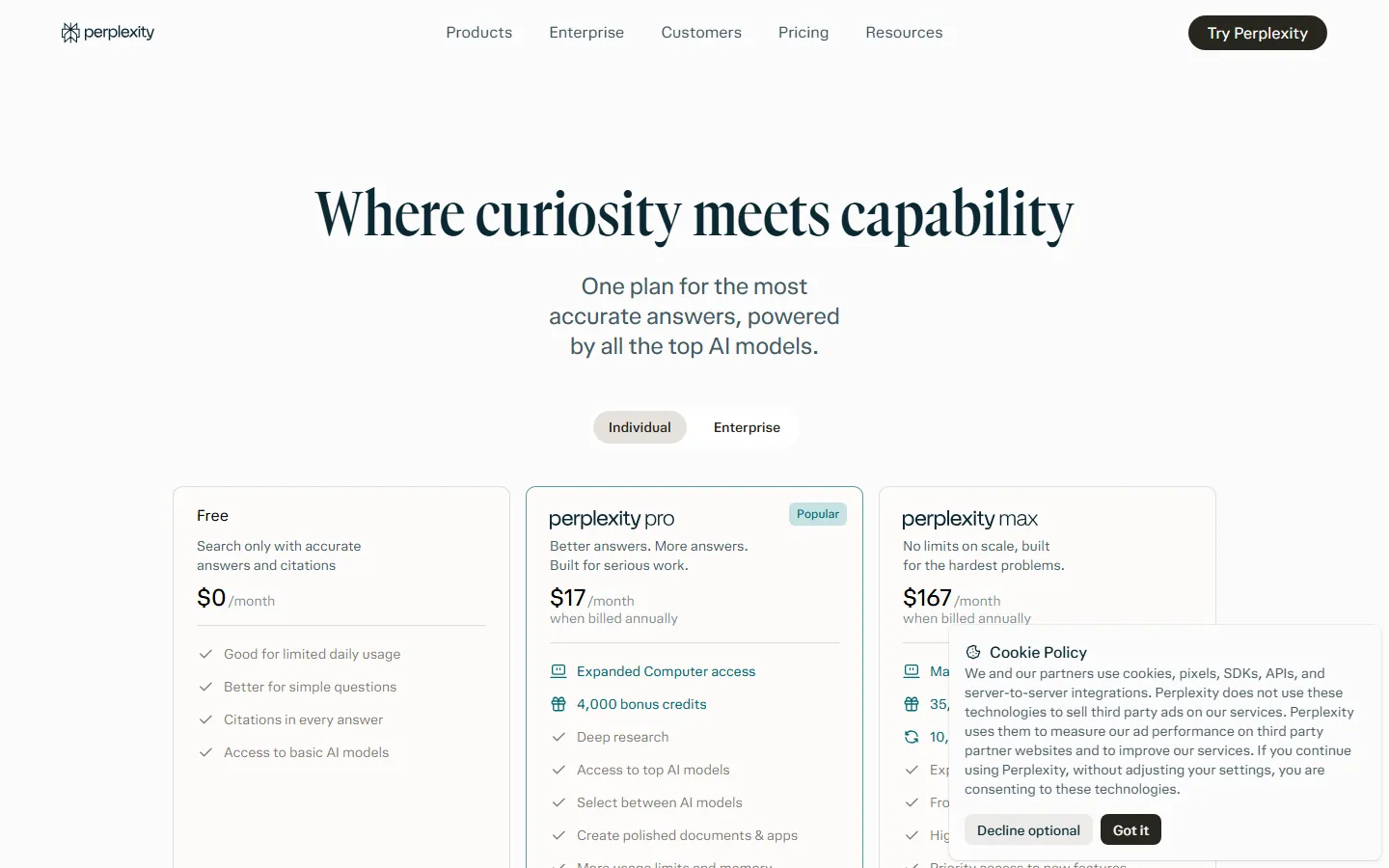
Perplexity's pricing, verified October 2026, is the baseline: a permanent free plan with roughly 3 to 5 Pro searches a day plus 1 Deep Research query a month, Pro at $20 a month or $200 a year, about $16.67 a month on annual billing, and Max at $167 a month billed annually, with the Pro tier replacing daily caps with weekly and monthly limits rather than removing them. The official site shows the current plan structure directly, and independent breakdowns like the one at Fello AI confirm the free-tier specifics and the end of the old WhatsApp and Airtel promotions in January 2026. The alternatives line up as follows: ChatGPT and Claude at $0 to $20 a month, NotebookLM free, Elicit from $10 a month annual, Consensus free to low-cost, Kagi with a 100-search free trial, and You.com at $15 a month annual. The only plan that is strictly more expensive than Perplexity Pro is Perplexity Max. For every other job there is a cheaper or free tool that does that job better, which is exactly why the recommendation is a portfolio, not a single switch.
What About ChatGPT Search and Gemini as Direct Substitutes?
ChatGPT Search and Gemini are the direct search-engine substitutes, and the comparison reviews are consistent about when each wins. ChatGPT Search turns the same cited-answer job into a conversation that can keep working after the answer, and comparison guides rank ChatGPT as the best overall Perplexity alternative when research needs to become drafts, files, or code, with the browsing mode built into the free and Plus tiers. Gemini makes more sense for users already living inside Google apps, because the answers plug into Docs, Sheets, and Gmail, and its deep research mode generates longer written briefs from the live web, which is the job Perplexity does not attempt. Claude rounds out the trio for long-document editorial work. The honest comparison is that none of the three is strictly better at pure cited search, which is Perplexity's home turf, but all three beat it at what happens after the answer, writing, organizing, and acting. For most switchers that is the whole point: the search result is rarely the final deliverable, and the tool that handles the next step wins the workflow.
Is Perplexity Still Worth Paying For in 2026?
Yes, but only for the search job. Perplexity remains the fastest way to get an accurate, cited answer from the current web, and its free tier is enough for a handful of genuine research questions a day. Pay for Pro if you run dozens of searches daily and want the higher weekly limits, model selection, and extra credits. What you should not do is pay for Pro expecting it to fix writing quality, because the model behind it produces the same dry, accurate output at every tier, and one reviewer's line, "incredibly accurate but may come across as dry", applies to the paid plan too. The value test is simple: if most of your sessions end with a citation list you paste into a document, keep Pro; if most end with a paragraph you have to rewrite, spend the $20 on a writing tool instead.
What Should You Choose Based on Your Use Case?
The decision table is short. You do research that becomes reports, proposals, or content, use Perplexity to gather facts with citations, then ChatGPT or Claude to write. You work from your own PDFs and notes, use NotebookLM and drop Perplexity for that job. You write literature reviews or defend evidence, use Elicit and Consensus. You hate ads and want primary sources, use Kagi. You want an agent that digs through hundreds of pages, use You.com. The one move to avoid is buying Perplexity Max expecting a writing upgrade, because the output voice does not change with the plan. Buy the tool that fixes the actual bottleneck, and for most readers in 2026 the bottleneck is tone and depth, not citations.
FAQ
Q: What is the best Perplexity alternative for writing?
A: ChatGPT for drafts and files at $0 to $20 a month, and Claude for long-document editing. Both produce natural voice, which is Perplexity's known weakness.
Q: Is there a free Perplexity alternative?
A: Yes. NotebookLM is free and source-grounded for your own documents, Consensus is free-leaning for academic evidence checks, and ChatGPT and Claude both have free tiers.
Q: How many free searches does Perplexity give per day?
A: About 3 to 5 Pro searches a day plus 1 Deep Research query a month on the permanent free plan, with basic model access and no file uploads, verified October 2026.
Q: Is Perplexity Pro unlimited?
A: No. Pro at $20 a month or $200 a year replaces daily caps with weekly Pro Search limits and monthly Deep Research limits, plus 4,000 bonus credits.
Q: Which Perplexity alternative is best for academic research?
A: Elicit for systematic, PRISMA-aligned reviews from $10 a month annual, and Consensus for free-leaning evidence checks of specific claims.
Q: Can NotebookLM replace Perplexity?
A: Only for your own documents. NotebookLM grounds answers in up to 50 of your sources and cannot search the live web the way Perplexity does, so the two complement each other.
Q: Is Perplexity Max worth it in 2026?
A: Only for heavy daily research use. At $167 a month billed annually it is the most expensive option here, and it does not change the dry writing style, so it is a poor buy for writers.
Conclusion
Perplexity is not a tool to abandon, it is a tool to narrow. It wins the job of fast, cited answers from the live web, and its free tier covers casual fact-checking completely. The alternatives win the jobs Perplexity does badly: ChatGPT and Claude for writing, NotebookLM for your own documents, Elicit and Consensus for defensible literature reviews, and Kagi or You.com for paid search with a different philosophy. The practical move in 2026 is to keep Perplexity for what it is good at and spend your money on the tool that fixes your actual bottleneck, which for most people is tone and depth, not citations.
CTA
Read our Perplexity review and Perplexity vs ChatGPT to see the original tool's limits in detail, then our best AI research assistants and ChatGPT vs Claude for the writing alternatives. If quality decline worries you, our is ChatGPT getting worse analysis covers what the $20 plans actually deliver in 2026.