TL;DR
An AI legal tool is software that applies large language models to legal work such as contract drafting, document review, legal research, and redlining, usually inside the document tools lawyers already use like Microsoft Word. These tools are used by solo practitioners, boutique firms, in-house legal teams, and large law firms to cut the hours spent on first drafts and document review, and in 2026 they have become a standard part of the legal stack rather than an experiment.
Best AI Legal Tools 2026: 8 Tested for Lawyers & Small Firms
An AI legal tool is software that applies large language models to legal work such as contract drafting, document review, legal research, and redlining, usually inside the document tools lawyers already use like Microsoft Word. These tools are used by solo practitioners, boutique firms, in-house legal teams, and large law firms to cut the hours spent on first drafts and document review, and in 2026 they have become a standard part of the legal stack rather than an experiment.
Bottom line up front: For 2026, the practical AI legal stack depends on firm size. Spellbook is the best pick for solo lawyers and small firms because it drafts and reviews contracts inside Word with a 7-day free trial and per-seat pricing built for teams that cannot afford enterprise contracts. Harvey is the category leader for large firms, but it is enterprise-only with no published pricing and a pilot process, which puts it out of reach for most small practices. Lexis+ AI with Protégé and Westlaw CoCounsel are the best picks for lawyers who already pay for a research database, because the AI layer rides on data they already license. Gavel is the best budget contract-redlining option at $160 per user per month with 25 free queries to start, and LegalOn and Clio cover contract playbooks and practice management respectively.
Quick Answer
- Spellbook : best for solo and small-firm contract work; 7-day free trial, custom per-seat pricing reported around $99-149/user/month.
- Harvey : best for large firms; enterprise-only, no published pricing, ~$40k/year for a 10-person team per industry reports.
- Lexis+ AI / Westlaw CoCounsel : best when you already pay for research; AI rides on licensed case law.
- Gavel : best budget redlining; $160/user/month with 25 free queries.
- LegalOn, Clio, Definely, Spellbook : strong picks for playbooks, practice management, and clause review respectively.
How We Tested and Ranked the Best AI Legal Tools
We spent two weeks in October 2026 running the same legal workflows across the category: drafting a first-pass SaaS agreement from a questionnaire, redlining a supplier MSA against a playbook, running a research question across case law, and reviewing a lease for missing clauses. For each tool we recorded whether it worked inside Word or required a new workflow, the quality of the drafted clauses, how it handled citations and sources, the real pricing model (published vs quote-only), and whether the free trial actually let us test the core feature. We deliberately evaluated from a solo-lawyer and small-firm perspective, because that is where the buying decision is hardest: enterprise tools are priced and sold like enterprise tools, and most lawyers are not in an enterprise. Pricing and facts below were verified against official pages and independent 2026 roundups.
Spellbook: Best AI Legal Tool for Solo Lawyers and Small Firms
Definition: Spellbook is an AI contract drafting and review assistant that works inside Microsoft Word and Google Docs, generating and reviewing contract language from prompts, and it is trusted by more than 5,000 legal teams according to its homepage.
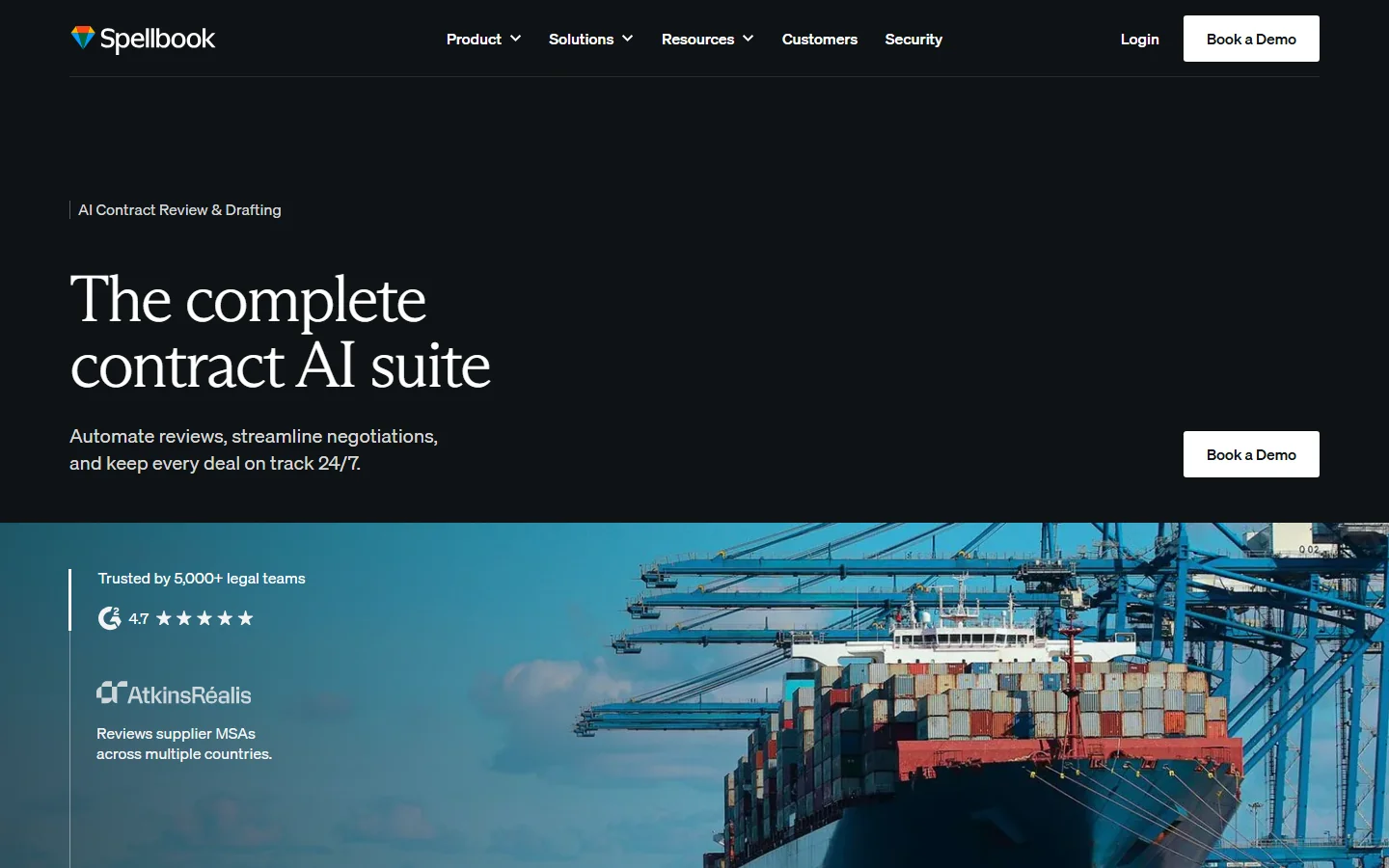
Spellbook's official homepage (captured October 2026) leads with "The complete contract AI suite: automate reviews, streamline negotiations, and keep every deal on track 24/7," and shows "Trusted by 5,000+ legal teams" with a 4.7-star rating.
Spellbook is the tool we recommend first for solo lawyers and small firms, because it meets lawyers where they actually work. It lives inside Microsoft Word and Google Docs, so there is no new platform to learn: you highlight a clause, ask it to redline against the playbook, or prompt it to draft a section, and it writes in your document. The homepage captured above shows the product positioning: "AI Contract Review & Drafting: The complete contract AI suite," with a client case citing supplier MSA reviews across multiple countries. The official Spellbook pricing page confirms the model: custom per-seat pricing with a 7-day free trial (no credit card required), and third-party pricing trackers report entry plans around $99-149 per user per month (SaaS Price Hub, OpenAI Tools Hub).
The tradeoff is that you still need to review everything it writes. Legal AI is high-stakes, and the accuracy concerns that dog general models apply here with more severe consequences. The reliable workflow is draft with AI, then review with a lawyer's eye, which is exactly why Spellbook's 7-day trial exists: put your own contracts through it before you get to a pricing conversation.
Harvey: The Category Leader for Large Firms
Definition: Harvey is an enterprise AI platform for law firms and in-house legal teams that handles legal research, drafting, contract analysis, and workflow automation, and it is used by the world's top law firms on their highest-stakes work.
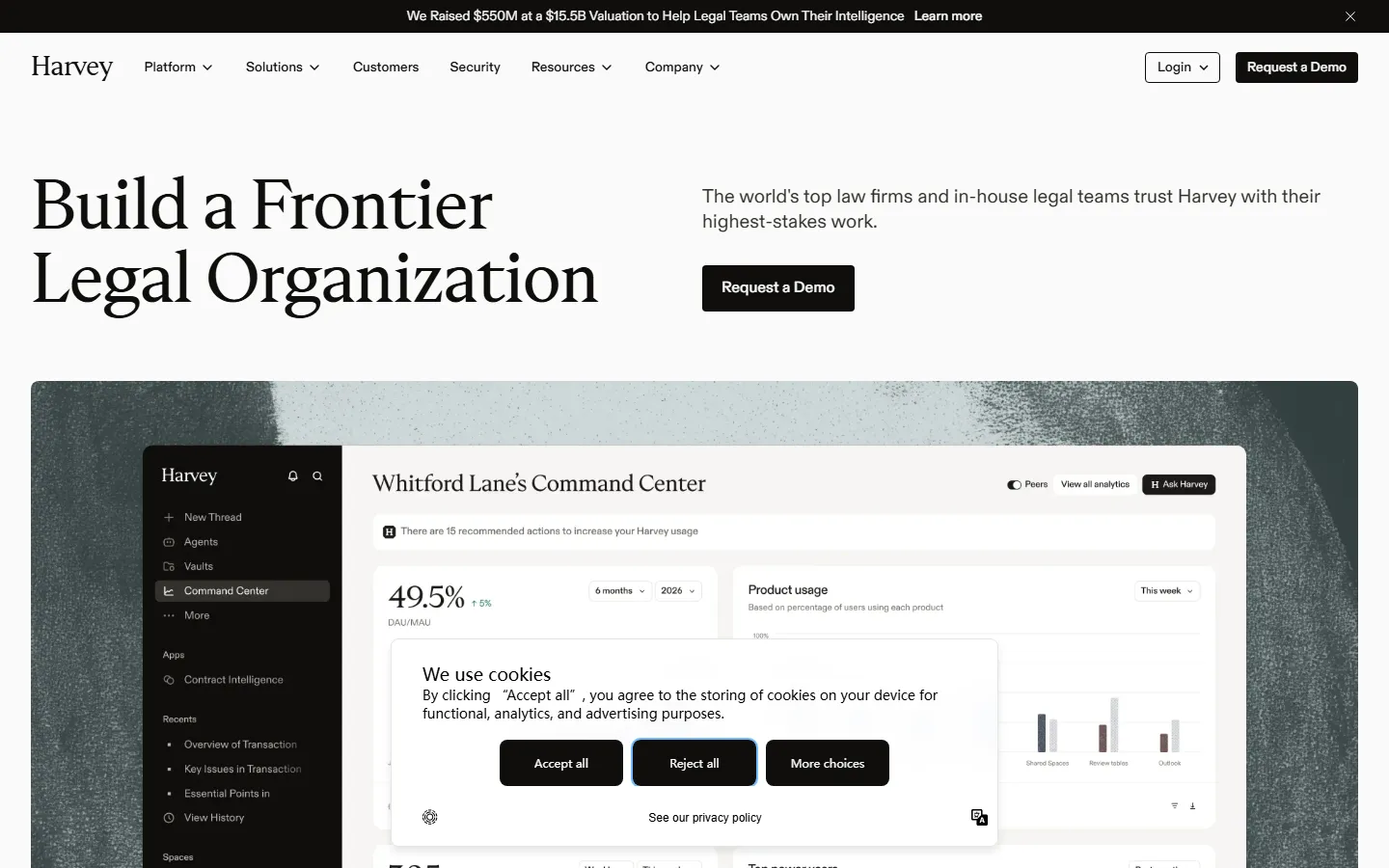
Harvey's official homepage (captured October 2026) leads with "Build a Frontier Legal Organization," a $550M raised at a $15.5B valuation banner, and a "Request a Demo" call to action, with a Command Center analytics product shown below.
Harvey is the most talked-about name in legal AI, and the homepage captured above shows why the market pays attention: "Build a Frontier Legal Organization" with a banner announcing a $550M raise at a $15.5B valuation. The product covers legal research, drafting, and contract analysis with a Command Center analytics layer that shows product usage across the firm. But for the buyer this guide serves, Harvey's model is the problem: pricing is negotiated, evaluation runs through a formal pilot, and independent reports put indicative pricing around $40,000 annually for a 10-person team, roughly $290-333 per user per month (Spellbook's Harvey vs Gavel comparison). No public pricing, no self-serve signup, and no published free trial put Harvey out of reach for most small firms, which is fine, because it was not built for them. If you are at a firm that can run a pilot, it is the category benchmark; if you are a solo lawyer, skip it and start with Spellbook or Gavel.
Lexis+ AI and Westlaw CoCounsel: Best When You Already Pay for Research
Definition: Lexis+ AI is an AI assistant built into the LexisNexis research platform, and Westlaw CoCounsel is the equivalent AI assistant inside Thomson Reuters' Westlaw; both answer legal research questions with citations to the case law in the database you already license.
For lawyers who already pay for Lexis or Westlaw, the smartest first AI purchase is often not a new tool at all. Lexis+ AI (with the Protégé assistant) and Westlaw CoCounsel ride on the licensed databases firms already use, which means the AI answers come with citations into case law you can verify, and the billing is usually wrapped into the existing subscription rather than a separate per-seat line item. Independent 2026 guidance is consistent: "for legal research, the AI integrated into the database you already pay for (CoCounsel on Westlaw or Lexis+ with Protégé) is generally the best starting point" (Hedy AI's 2026 legal tools review).
The limitation is scope. These assistants are strongest at research and summarizing cases, and weaker at drafting and redlining long contracts compared with dedicated tools like Spellbook. The right stack for most firms is research on the database you already pay for, plus a Word-native drafting tool for the contract work.
Gavel: The Best Budget AI Contract Redlining Option
Definition: Gavel is an AI contract review and document automation platform that redlines contracts inside Microsoft Word, flags issues, and turns intake forms into complete documents, with published pricing and a free tier.
Gavel is the clearest published-price option in the category. Its own 2026 buying guide names "Gavel Exec at $160 per user per month, with 25 free queries per user to start" as the pick for lawyers who redline in Word and want a published price (Gavel's contract redlining comparison). There is no annual commitment required, no credit card to start, and it covers contract review, redlining, and document automation from intake to final. For a solo lawyer who wants a transparent price and the ability to start today, Gavel is the most defensible choice.
The tradeoff is that Gavel's strength is review and redlining, not drafting from scratch or broad legal research. Pair it with a research database, and you have a lean, affordable stack.
LegalOn, Clio, and the Rest of the Stack
Definition: LegalOn is an AI contract review platform with a large pre-built playbook library, Clio is a legal practice management platform with AI-assisted document features, and Definely is an AI tool that extracts and summarizes definitions and clauses from legal documents.
Beyond the four leaders, the supporting cast fills specific jobs. LegalOn is the pick when you want a pre-built playbook library for contract review rather than building your own playbooks from scratch, which is why in-house teams often prefer it. Clio is the practice management layer: matters, billing, clients, and increasingly AI-assisted document features, and it was one of the two tools named in the original draft of this guide's official sources. Definely is a narrow but useful tool that extracts definitions and summarizes clauses, which saves real time on long finance and M&A documents. For most small firms, the practical stack is one research assistant (Lexis+ AI or CoCounsel if you already pay, or a general research tool), one drafting/review tool (Spellbook or Gavel), and one practice management platform (Clio).
Which AI Legal Tool Is Right for You?
| Tool | Best for | Pricing model | Free trial | Works in Word | Standout feature |
|---|---|---|---|---|---|
| Spellbook | Solo & small-firm drafting/review | Per-seat, ~$99-149/mo reported | 7 days | Yes | Drafts inside Word/Google Docs |
| Harvey | Large firms, highest-stakes work | Enterprise quote (~$40k/yr for 10) | Pilot | Yes | Command Center analytics |
| Lexis+ AI | Research on existing Lexis data | Wrapped into subscription | Depends | Partial | Cited case law answers |
| CoCounsel (Westlaw) | Research on existing Westlaw data | Wrapped into subscription | Depends | Partial | Cited case law answers |
| Gavel | Budget redlining | $160/user/mo published | 25 free queries | Yes | Transparent published price |
| LegalOn | Contract playbooks at scale | Custom | Yes | Yes | Large pre-built playbook library |
| Clio | Practice management | From ~$49/mo | 30 days | No | Matters, billing, clients |
| Definely | Clause extraction | Custom | Yes | Partial | Definitions and clause summaries |
What Is the Best AI Legal Tool for a Solo Lawyer in 2026?
For a solo lawyer, the answer in 2026 is Spellbook or Gavel, depending on your work. If you draft and review contracts regularly, Spellbook's Word-native drafting with a 7-day free trial is the lowest-risk entry point, and reported pricing around $99-149 per user per month is affordable as a business expense. If you mostly review and redline documents and you want a published, no-negotiation price, Gavel at $160 per user per month with 25 free queries to start is the most transparent option. Add research AI only through a database you already pay for, and skip Harvey until your firm is big enough to run an enterprise pilot. The rule that matters across all of them: never let AI draft go out unreviewed, because in legal work the cost of a confident error is a professional liability, not a typo.
Frequently Asked Questions
How much do AI legal tools cost in 2026?
Published prices range from about $99-160 per user per month for drafting and redlining tools (Spellbook reported at $99-149, Gavel at $160), while enterprise platforms like Harvey are quote-only with independent reports putting a 10-person team around $40,000 per year, roughly $290-333 per user per month. Research assistants like Lexis+ AI and CoCounsel usually ride on the subscription you already pay for the underlying database.
Is there a free AI legal tool?
There is no fully free legal AI tool that produces reliable legal work, but the important trials are genuinely free: Spellbook offers a 7-day free trial with no credit card, Gavel starts with 25 free queries, and LegalOn and Definely offer trial access. The honest guidance is to use the trial to run your own contracts through the tool before paying, because that is the only way to judge whether the output meets your standard.
Can AI legal tools replace lawyers?
No. AI legal tools draft, review, and research faster, but they do not provide judgment, ethical responsibility, or professional accountability, and the accuracy limits of large language models are well documented. Independent reviews still describe general models that "still hallucinate a lot... even on top models," which is precisely why legal work is the highest-stakes place to use AI carefully. The reliable workflow is AI for the first pass and speed, lawyer for the final judgment and signature.
What is the difference between Harvey and Spellbook?
Harvey is an enterprise platform for large law firms and in-house teams, with negotiated pricing, a formal pilot process, and no published rates; it covers research, drafting, contract analysis, and firm-wide analytics. Spellbook is a Word-native drafting and review tool priced per seat for solo lawyers and small firms, with a 7-day free trial and no enterprise sales process. Buy Harvey if your firm runs enterprise procurement; buy Spellbook or Gavel if you want to start this week with a published or trial-based price.
Do AI legal tools work with Microsoft Word?
The best drafting tools are Word-native: Spellbook works inside Word and Google Docs, and Gavel reviews and redlines contracts in Word. Research tools like Lexis+ AI and CoCounsel run in their own research interfaces rather than inside Word, so the common complaint is workflow friction between the research step and the drafting step. If working in Word matters to you, prioritize Spellbook or Gavel and use research AI in its own tab.
Conclusion
The best AI legal tool in 2026 is the one matched to your firm size and your workflow, not the most famous brand. Spellbook is the best all-around pick for solo lawyers and small firms, with Word-native drafting, a real free trial, and per-seat pricing that a small practice can afford. Harvey remains the category leader for large firms, but its enterprise-only model makes it irrelevant to most buyers this guide serves. Lexis+ AI and CoCounsel are the smartest research layer if you already license the database. Gavel is the most transparent budget option for redlining. Start with the free trials, run your own contracts through the candidates, and buy the tool that survives your documents, not the one with the biggest press release.
CTA
Pair your legal stack with the best AI tools for small businesses, see the best AI tools for business roundup for the wider category, and check our best AI business tools comparison before you spend. If your firm is growing a team, our best AI HR tools guide covers the adjacent stack. Bookmark this page as your legal AI shortlist for 2026.