An AI storyteller tool is a writing application that uses large language models to generate, continue, or collaboratively draft fiction, worlds, and characters, often with persistent story memory so the AI remembers what happened chapters ago. Authors and hobbyists use these tools to break writer's block, draft full novels, build consistent worlds, and finish stories faster than typing every sentence by hand.
Bottom line up front: NovelAI is the best AI storyteller in 2026 for interactive, memory-rich fiction, with plans from $10/month, because its story engine remembers your world and characters and writes with you rather than for you. Sudowrite is the best pick for drafting and editing full novels with guided tools, starting at $10 for 225,000 credits, and its fiction-tuned Muse model sets the standard for voice. Claude and ChatGPT are the best budget options if you want a capable general model without a fiction-specific subscription, at $20/month each, though they lack persistent story memory.
Quick Answer
The short version: NovelAI for AI-native interactive storytelling, Sudowrite for structured novel drafting and editing, Claude for the strongest general prose, and ChatGPT for the cheapest capable option. NovelAI runs on a fiction-focused model, keeps roughly 8,000 to 29,000 tokens of story memory depending on tier, and generates both text and anime art. Sudowrite bundles brainstorming, outlining, drafting, and rewriting tools around its Muse 1.5 fiction model, with testimonials from Vanity Fair and The New Yorker writers. Jasper and QuillBot are better for marketing copy and school writing than for fiction, so they sit lower on this list.
Every tool here has a real catch: NovelAI has no free tier beyond a short trial, Sudowrite credits run out fast if you draft long, and general chatbots such as ChatGPT and Claude lose story context once the conversation gets long, which is the single biggest source of frustration for AI-assisted novelists.
How We Tested the Best AI Storyteller Tools
We evaluated each tool on five criteria: fiction output quality, story memory and continuity, drafting and editing depth, pricing fairness, and how well it handles long sessions. We read official pricing pages and documentation, cross-checked independent reviews, and matched each product against the problems authors describe, such as repetitive drafts, generic voice, and hallucinations that break a story's internal logic.
We treated vendor claims with care. Sudowrite's homepage features praise from Vanity Fair, The New Yorker, The Atlantic, The Verge, and The Washington Post, and NovelAI advertises "Write worlds that remember everything," powered by GLM 4.6 for story generation. Those are positioning signals, not benchmarks, and we judged output quality on the models' documented capabilities and the recurring feedback in author reviews.
1. NovelAI: Best AI Storyteller for Memory-Rich Interactive Fiction
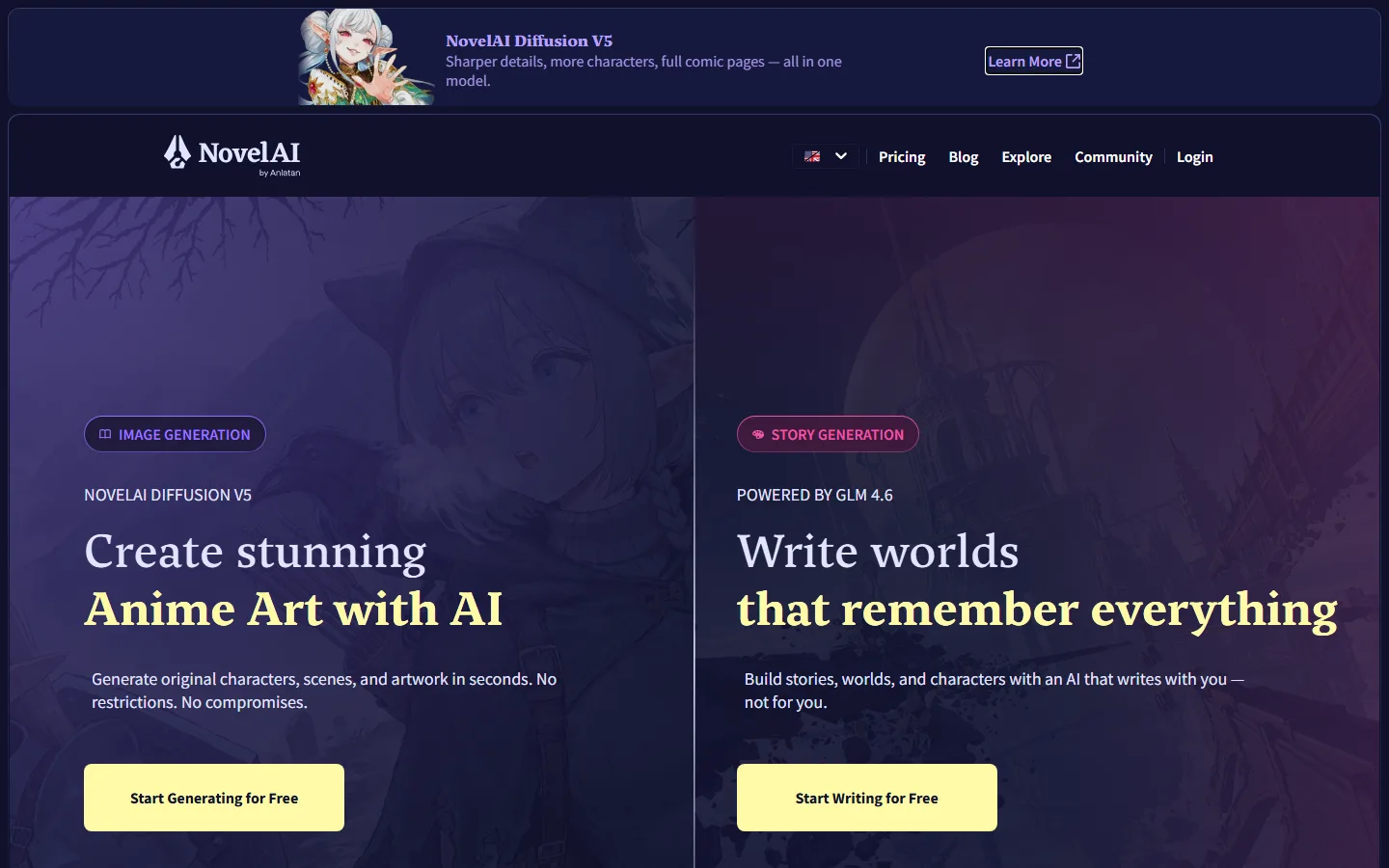
NovelAI is an AI writing and image generation platform built specifically for fiction, and its homepage splits the product into two halves: image generation with NovelAI Diffusion V5, and story generation powered by GLM 4.6, described as "Write worlds that remember everything." That memory claim is the core of what makes NovelAI different from a general chatbot.
NovelAI keeps a persistent story memory of your characters, settings, and plot so the model continues the story consistently across sessions, instead of forgetting chapter three by chapter ten. The platform supports deep customization of the story, including lorebooks that define characters and rules, and its text generation includes text-to-speech. The anime art generator is a genuine second product, useful for character portraits and scene illustrations.
Pricing: NovelAI has no free tier, only a short text trial. Tablet is $10/month, Scroll is $15/month, and Opus is $25/month, per the official NovelAI pricing page and verified by third-party trackers as of October 2026. Higher tiers increase story memory from about 8,000 tokens on Tablet to roughly 29,000 tokens on Opus, plus larger image credit allowances.
Best for: interactive fiction writers, roleplayers, and anyone who wants an AI that remembers the story across long sessions without paying per token.
2. Sudowrite: Best AI Storyteller for Drafting and Editing Novels
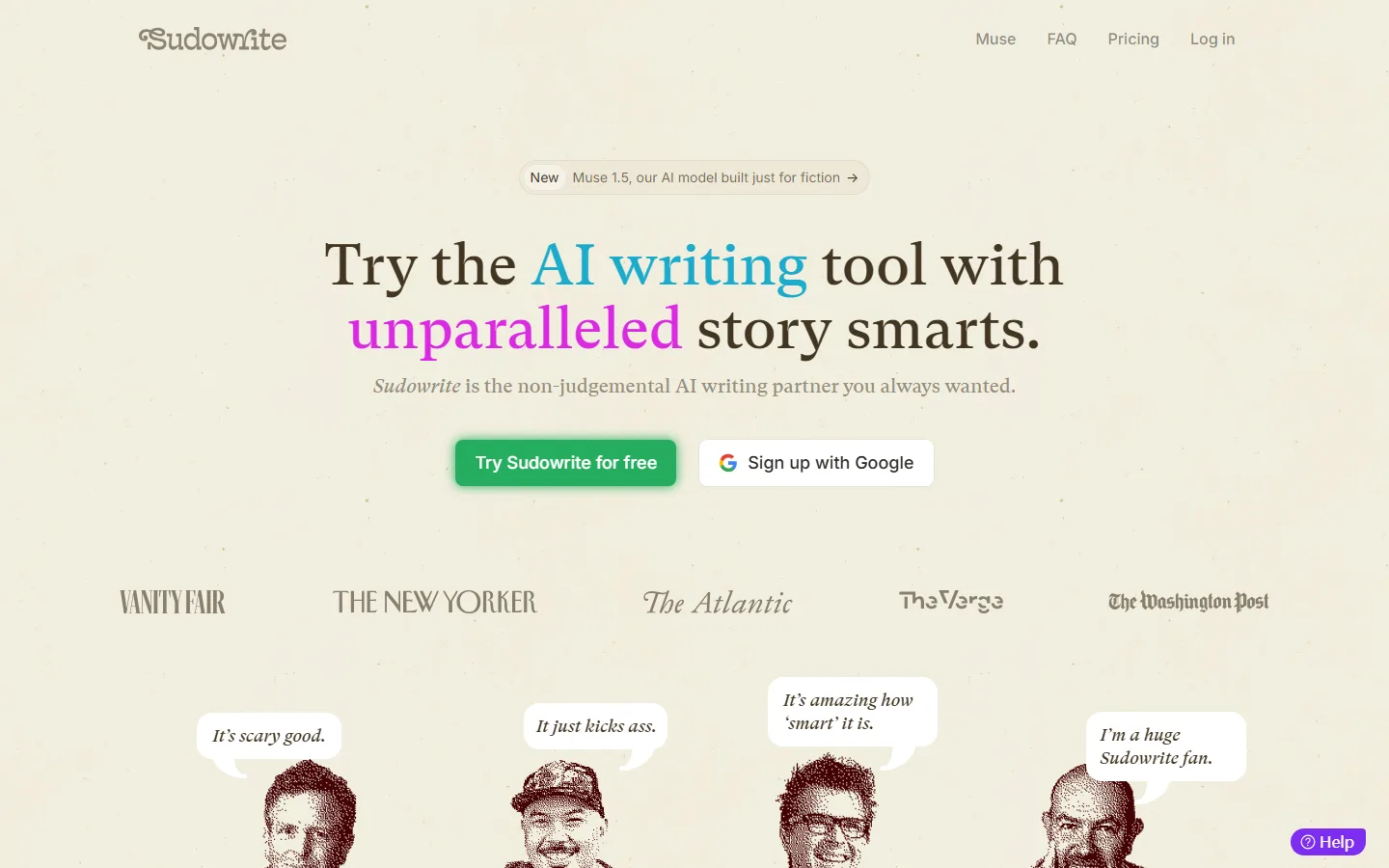
Sudowrite is an AI writing partner built for fiction, and its homepage leads with Muse 1.5, an AI model "built just for fiction," under the tagline "unparalleled story smarts." Where NovelAI is an interactive companion, Sudowrite is a structured drafting and editing suite: it generates outlines, drafts scenes, rewrites in your voice, and fixes pacing, all inside a tool designed for long-form novels.
Sudowrite's guided tools are the differentiator for novelists: describe your plot, and it produces chapters you can revise scene by scene; feed it a flat draft and it adds sensory detail, stakes, and dialogue that sound like you, not like generic AI copy. The testimonials from Vanity Fair, The New Yorker, and The Atlantic writers are real marketing signals, though the tool still needs an author who edits.
Pricing: Sudowrite's Hobby plan is $10 for 225,000 credits, per the official Sudowrite pricing page, with higher tiers for heavier drafting. Credits are the currency for model calls, and long drafts consume them quickly, so budget for the tier that matches your writing volume rather than the cheapest one.
Best for: novelists drafting and revising full manuscripts, and writers who want guided structure rather than open-ended chat.
3. Claude: Best General Model for Polished Prose
Claude is a general AI assistant whose prose quality makes it a strong storyteller even though it is not a fiction-specific tool. Anthropic's Claude models consistently produce the most natural, voice-aware long-form text among general assistants, which is why many authors use Claude for scenes, dialogue, and revision even when they subscribe to a fiction tool.
The catch is memory: Claude's context window is large, but a long novel will still outgrow it, and the model does not keep a persistent story memory file between sessions the way NovelAI does. You can work around this by keeping a chapter outline in the conversation, but it is manual.
Pricing: Claude Pro is $20/month, or $17/month billed annually, per the official Claude pricing page. That is a strong price for the prose quality, and Claude also handles research, coding, and general work, so it earns its cost beyond fiction.
Best for: authors who want the best general prose model and are willing to manage story continuity manually.
4. ChatGPT: Best Budget AI Storyteller With a Free Tier
ChatGPT is the most accessible AI storyteller because the free tier is enough to draft scenes and brainstorm plots, and the paid tier at $20/month adds advanced models and higher limits. For a casual writer, ChatGPT plus a notebook is a completely workable fiction stack.
What ChatGPT lacks is fiction-specific memory and structure: it will happily write a chapter, but it does not maintain a lorebook, and long conversations hit usage limits mid-flow. Reviews of AI assistants consistently mention "usage limits and token caps that break momentum mid-task," which is precisely the annoyance you will feel on a long writing session.
Pricing: Free tier available; ChatGPT Plus is $20/month per the official OpenAI pricing page.
Best for: beginners, budget writers, and short-form fiction where the conversation stays small enough to remain coherent.
5. Jasper: Best for Marketing Copy, Not Fiction
Jasper is an AI content platform aimed at marketing teams, and it can write brand-voice blog posts, ads, and social copy at scale. It appears on storyteller lists because it handles long-form writing well, but its templates and brand voice features are built for marketing, and its fiction output is generic compared with NovelAI or Sudowrite.
If your story is a brand story or a case study, Jasper is very strong; if your story is a novel, Jasper is a square peg. Its value is speed and consistency for commercial writing, not literary voice.
Pricing: Jasper Pro is $59/month billed annually or $69 month to month, per the official Jasper pricing page.
Best for: content teams and marketers, not fiction writers.
6. QuillBot: Best for Paraphrasing and Revision
QuillBot is a writing assistant best known for its paraphraser, which rewrites sentences to improve clarity and flow. In a storytelling workflow, it earns a supporting role: after you draft a scene in Sudowrite or NovelAI, QuillBot can clean up awkward phrasing and vary sentence patterns.
It is not a generative storyteller, and it cannot draft a plot or maintain characters, but it solves the one problem fiction writers report constantly, which is that AI drafts repeat the same sentence patterns across a run of pages. Running your draft through a paraphraser before final revision breaks those patterns.
Pricing: QuillBot Premium is $8.33/month billed annually, per the official pricing page, and the free tier covers a limited number of paraphrases per day.
Best for: revision and sentence-level polish in any writing workflow.
7. ProWritingAid: Best for Story-Level Editing
ProWritingAid is a grammar and style editor with fiction-specific reports for pacing, dialogue tags, and repeated words. It complements an AI storyteller by catching the mechanical problems the generator will not fix: repetitive sentence starts, weak verbs, and pacing dips across chapters.
Like QuillBot, it is an editor rather than a generator, but for novelists it is arguably the more useful companion because its fiction reports are built for manuscripts. The combination of an AI drafter and ProWritingAid's editing reports is a stronger workflow than any single tool.
Pricing: ProWritingAid offers a free tier and premium plans; annual premium pricing lands in the $80-$120 range depending on term, per the official site.
Best for: novelists who want manuscript-level editing reports on top of an AI drafter.
8. Sudowrite Muse vs. A General Chatbot for Fiction
If you are deciding between a fiction-tuned model such as Sudowrite Muse 1.5 or NovelAI's GLM 4.6 and a general model such as Claude or ChatGPT, the difference is voice and memory. Fiction models are trained and tuned on narrative, so their default output has stronger voice, fewer information-dump paragraphs, and better dialogue; general models are more flexible but tend to write in the same polished, neutral register.
That neutral register is exactly what authors complain about: "thin voice training reads generic, producing polished copy with no personality." If you want distinctive fiction, the fiction-tuned tools are worth the subscription; if you will rewrite heavily anyway, a general model plus strong editing is a legitimate budget path.
AI Storyteller Tools Pricing Comparison
| Tool | Best for | Starting price | Free tier | Story memory |
|---|---|---|---|---|
| NovelAI | Interactive memory-rich fiction | $10/mo (Tablet) | Short trial only | Yes (8k-29k tokens) |
| Sudowrite | Guided novel drafting | $10/225k credits | No | Session-based |
| Claude | Polished general prose | $20/mo | Limited | Context window only |
| ChatGPT | Budget storytelling | Free; Plus $20/mo | Yes | Context window only |
| Jasper | Marketing long-form | $59/mo annual | Trial | No |
| QuillBot | Paraphrasing and revision | $8.33/mo annual | Limited daily | No |
| ProWritingAid | Manuscript editing | ~$80-120/yr | Yes | No |
Which AI Storyteller Tool Should You Use?
Match the tool to your writing style:
Interactive and roleplay fiction: NovelAI. The persistent story memory and lorebooks make it the only tool that truly continues a long story consistently.
Novel drafting with structure: Sudowrite. The guided outline-to-draft workflow is the fastest path from plot idea to full manuscript, and Muse 1.5's voice is the strongest among fiction-tuned models.
Literary prose and heavy rewriting: Claude. The general model's prose quality beats most fiction tools, and you handle continuity with an outline.
Casual and budget writing: ChatGPT free tier plus QuillBot or ProWritingAid for revision. Total cost is zero.
Marketing and brand storytelling: Jasper. Use the right tool for the right kind of story.
Why Do AI Storytellers Write Repetitive, Generic Drafts?
The most common complaint in AI writing reviews is that long drafts get repetitive: one review describes "long drafts get repetitive, reusing sentence patterns across a run of posts," and another notes "thin voice training reads generic, producing polished copy with no personality." The cause is that general models optimize for average prose, so every scene ends up in the same neutral register.
Fiction-tuned tools solve part of the problem: NovelAI and Sudowrite Muse are trained on narrative and produce more varied sentence rhythm. The rest is workflow: draft in a fiction tool, then run the draft through a paraphraser such as QuillBot to break repeated patterns, then edit with ProWritingAid's fiction reports to catch pacing and repeated words. Generic output is a workflow problem as much as a model problem.
Can AI Storytellers Hallucinate Plot Details or Break Continuity?
Yes, and continuity errors are the most expensive failure for a novelist. "Occasional inaccuracies/hallucinations reduce confidence for critical work" applies to fiction too: an AI may invent a character trait, forget a setting detail, or contradict an earlier chapter, and in a 400-page manuscript those errors are hard to catch. NovelAI mitigates this with persistent story memory and lorebooks, which keep the model grounded in your defined facts. Sudowrite keeps continuity within a single session's outline. General chatbots offer no memory layer, so you must keep the canon in the prompt or a separate file.
The practical rule: maintain a canon file with character names, settings, and timeline, refresh it in the conversation as the story grows, and re-read each chapter against the canon before you call it done. AI is a drafting partner, not a memory.
How Do You Avoid Credits Running Out Mid-Novel?
Sudowrite and NovelAI both run on credits, and "credits cap your output on lower tiers and do not roll over" is a documented complaint pattern. A 225,000-credit Hobby plan on Sudowrite can disappear quickly if you generate long scenes with heavy settings. Before you subscribe, estimate your monthly writing volume, buy a tier with headroom, and check whether unused credits roll over. If they do not, time your drafts so a big writing week lands right after the monthly reset rather than just before it.
FAQ
What is the best AI storyteller tool for writing a novel?
Sudowrite is the best for guided novel drafting because its outline-to-draft workflow and fiction-tuned Muse 1.5 model are built for manuscripts, starting at $10 for 225,000 credits. NovelAI is the best for interactive, memory-rich fiction, and Claude is the best general-model alternative for polished prose at $20/month.
Is NovelAI good for story generation or just image generation?
NovelAI does both. Its story generation is powered by GLM 4.6 and is a first-class product with persistent story memory, lorebooks, and text-to-speech, while its Diffusion V5 image generator creates anime art for characters and scenes. The $10 Tablet tier includes text generation and a monthly image credit allowance.
How much does Sudowrite cost?
Sudowrite's Hobby plan is $10 for 225,000 credits, per the official pricing page, with higher tiers for heavier volume. Credits are consumed by model calls, and long drafting uses them quickly, so choose the tier based on your monthly writing volume.
Can ChatGPT write a novel?
ChatGPT can draft scenes and brainstorm plots, and its free tier is a workable starting point, but it has no persistent story memory and its neutral register produces generic prose over long runs. For a serious novel, a fiction-tuned tool such as Sudowrite or NovelAI, or Claude with a maintained outline, is a stronger base.
What is the difference between Sudowrite Muse and NovelAI?
Sudowrite Muse 1.5 is a fiction-tuned model embedded in a guided drafting and editing suite, best for authors who want outlines, drafts, and revisions in one structured workflow. NovelAI is an interactive story engine with persistent memory and lorebooks, best for continuous, memory-rich fiction and roleplay. Both cost about the same at entry level.
Are AI storyteller tools worth the subscription for hobby writers?
For casual writers, the free tiers of ChatGPT plus QuillBot are enough. For anyone writing regularly, the fiction-tuned tools pay for themselves quickly because they cut the drafting time from hours to minutes and produce a stronger first draft, which is worth $10-$25/month to most active writers.
Conclusion
The best AI storyteller tools in 2026 are NovelAI and Sudowrite at the top, because they are built for fiction: NovelAI remembers your story across sessions, and Sudowrite structures the path from outline to finished manuscript. Claude is the strongest general prose model and a legitimate budget pick, ChatGPT covers the free tier, and QuillBot and ProWritingAid fill the editing layer that fixes the repetitive, generic output authors complain about most. Draft with a fiction-tuned tool, maintain a canon file, and edit with dedicated fiction reports, and the AI becomes a genuine writing partner instead of a source of generic text.
Related Reading
- Best AI Text Generators 2026: 10 Tested by Output Quality - every AI writer benchmarked on output
- Best AI Writing Generators 2026 - general writing generators compared
- Best AI Essay Writing Tools 2026: QuillBot vs Sudowrite - Sudowrite against the essay-focused field
- Best AI Paraphrasing Tools 2026 - fix repetitive drafts with a paraphraser
- Best AI Writing Tools 2026: 12 Compared - the full writing stack, drafting through editing