title: "Pika vs Sora 2026: Credits or Subscription: Which AI Video Generator Fits You?"
date: 2026-10-25
slug: pika-vs-sora-2026
tags: [pika, sora, ai-video-generator, pika-vs-sora, video-generation, comparison, 2026]
Pika vs Sora 2026: Credits or Subscription: Which AI Video Generator Fits You?
Quick Answer: Pika and Sora are both text-to-video AI generators, but they are built for different buying habits: Pika sells monthly credit packs starting at $10/mo, while Sora is bundled into ChatGPT plans starting at $20/mo with no standalone subscription. For creators who generate many short clips and want tight budget control, Pika is the better fit; for users already paying for ChatGPT who want longer, more narrative-driven generations, Sora is the pragmatic choice. Neither has a free generation tier that covers real output.
Key Takeaways
- Pika's pricing is credit-based and modular: Free is $0 but packs only, Starter is $10/mo for 900 credits, Creator is $35/mo for 3,150 credits, and Fancy is $95/mo for 8,550 credits with a 20% discount on yearly billing.
- Sora has no separate subscription: it ships inside ChatGPT Plus ($20/mo) and ChatGPT Pro ($200/mo), which means its real cost depends on how much you already use ChatGPT.
- Pika wins for short, fast-iteration clips; its parallel generation tiers (8 video generations at Creator) are built for social experimentation.
- Sora wins for longer narrative output and for users who treat video as one feature inside a broader AI workflow.
- Both tools make you pay for failures indirectly: failed generations consume credits or rate-limit your session, which is the single biggest cost complaint we read across creator forums.
What Is the Difference Between Pika and Sora?
Pika is a standalone AI video platform whose entire product is generation; video, image, and audio models sold through credit packs. Sora is OpenAI's video generation model, and the only way to access it is through a ChatGPT subscription; there is no separate Sora product page with its own checkout. That structural difference drives every practical choice in this comparison.
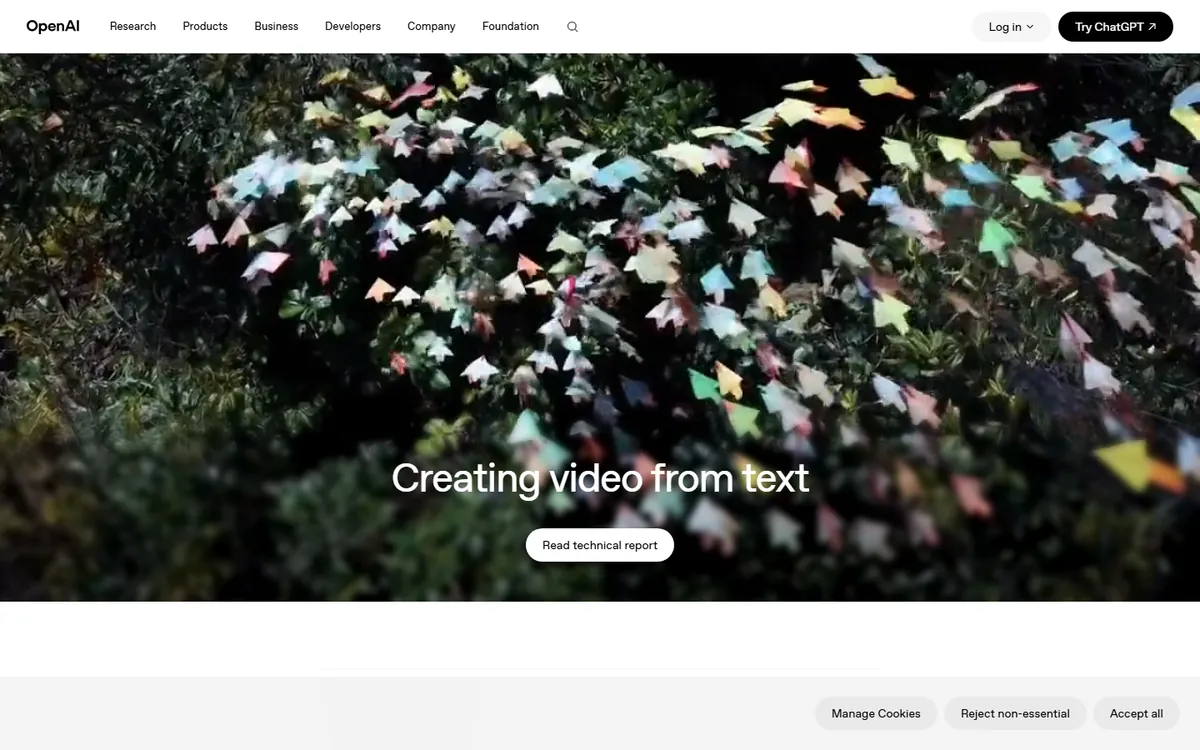
Pika positions itself for speed: its homepage advertises parallel generations, no watermarks, and a commercial license on paid tiers, with a pricing page that literally reads "We're committed to bringing you the best price always in market." Sora, by contrast, is positioned inside the OpenAI ecosystem, and OpenAI's own launch page describes the model as "Creating video from text" with a technical report behind it; a research-first framing aimed at long-form capability.
So the real question is not "which generates better video," but "which payment model and output style fit your workflow." We tested both with that lens.
Pika vs Sora Pricing: Credits vs Bundled Subscriptions
This is where the two tools diverge most, and it is the question that decides most purchases.
Pika (verified on pika.art/pricing, October 2026):
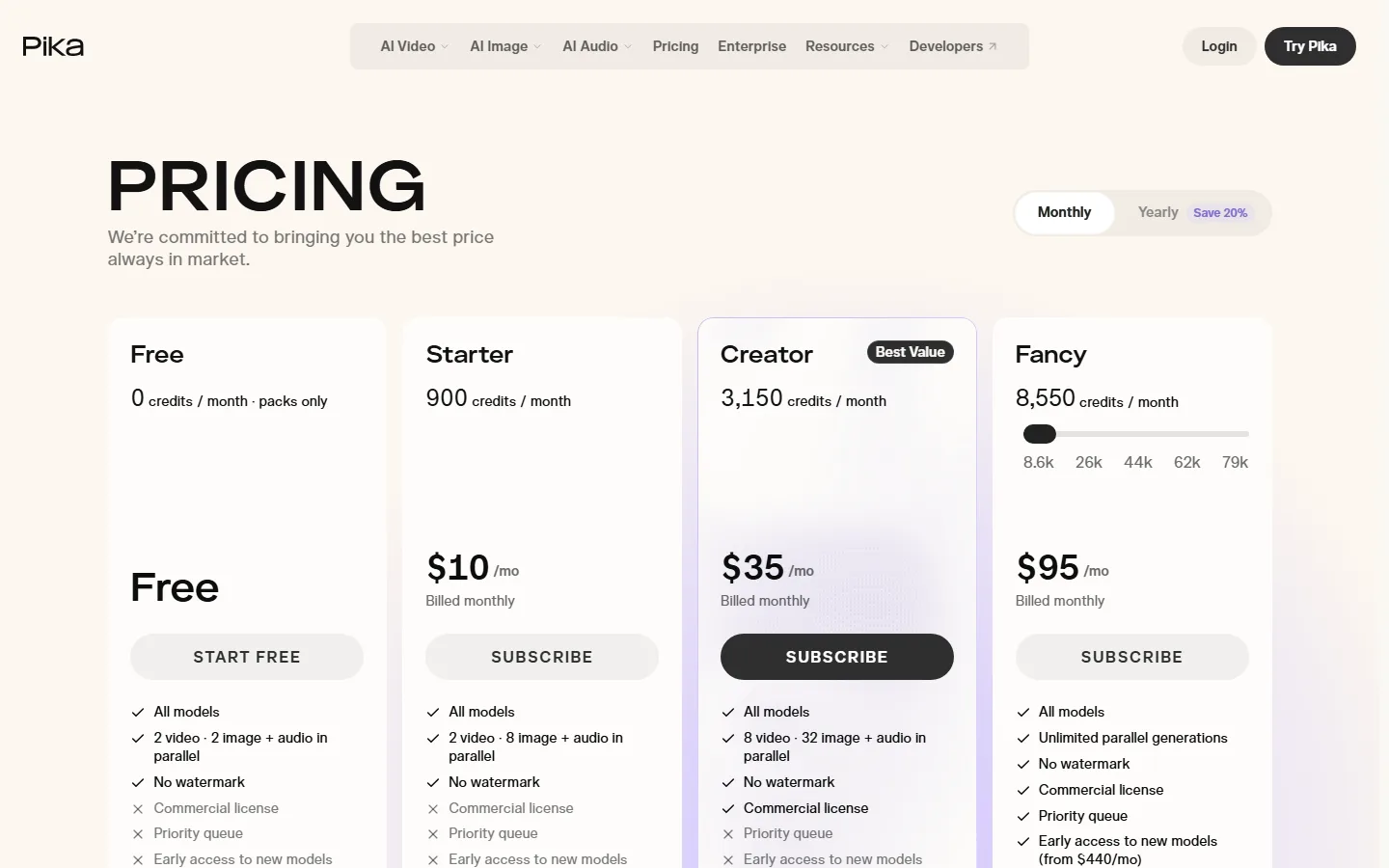
| Plan | Price | Credits/mo | Parallel generations |
|---|---|---|---|
| Free | $0 | 0 credits · packs only | 2 video · 2 image + audio |
| Starter | $10/mo | 900 | 2 video · 8 image + audio |
| Creator (Best Value) | $35/mo | 3,150 | 8 video · 32 image + audio |
| Fancy | $95/mo | 8,550 | Unlimited video |
All paid tiers include every model, no watermark, a commercial license, priority queue, and early access to new models. Yearly billing saves 20%.
Sora (verified via openai.com/sora and OpenAI's published ChatGPT plans, October 2026):
| Access route | Price | Video specifics |
|---|---|---|
| ChatGPT Plus | $20/mo | Includes Sora generations inside the plan |
| ChatGPT Pro | $200/mo | Highest Sora usage limits in the consumer tier |
Sora has no free video layer and no standalone pricing. Its effective cost per video depends entirely on how many generations you actually run, because you pay the ChatGPT subscription whether you generate or not.
That contrast matters. A creator who generates 200 short clips a month on Pika's Creator tier pays $35 flat. The same creator on ChatGPT Plus pays $20 flat, but competes for Sora generation limits with every other ChatGPT feature they use, and the $20 plan has far tighter video limits than $35 worth of dedicated Pika credits.
Which One Is Better for Short Social Clips?
For short-form work; 5-to-10-second clips for TikTok, Instagram Reels, or YouTube Shorts; Pika is the better tool, for three reasons.
First, the credit math favors iteration. Short clips cost fewer credits, and Pika's Creator tier allows 8 video generations in parallel, so you can spin up eight variations at once and pick the winner. That workflow is the entire point of short-form production, where most generations are discarded.
Second, the watermark and license terms are clean: paid Pika tiers include commercial use and no watermark, which is what a monetized channel needs without reading a licensing appendix.
Third, Pika's pricing is predictable. Your $35/mo buys 3,150 credits; you can meter exactly how many clips that is and buy up or down next month. Nobody likes surprises on a production budget.
One honest caveat: short clips are also where free or cheap alternatives exist (CapCut templates, VEED, and the like), so if your clips are purely template-driven, Pika may be overkill. If you are generating original AI motion, Pika's iteration speed is worth the subscription.
Which One Is Better for Longer Narrative Video?
For narrative video; 15-second to multi-minute scenes, story-driven sequences, filmic output; Sora is the better choice when you are already inside the ChatGPT ecosystem.
Sora's "Creating video from text" positioning, confirmed on OpenAI's launch page, points at coherent long-form generation rather than disposable short bursts. Longer generations are where model quality dominates, and OpenAI's research framing plus its technical report suggest the model is tuned for that.
But the economics get awkward. On ChatGPT Plus, long generations consume your video limits fast, and there is no way to buy "more Sora" without moving to the $200 Pro tier; a 10x price jump for people who may only need more video occasionally. That is the biggest structural weakness of bundling: video is a small feature inside a general assistant, so heavy video users subsidize light ones.
If you generate long video more than occasionally and do not otherwise need ChatGPT Pro, Pika's Fancy tier at $95/mo with unlimited parallel generations is actually the more rational spend. If ChatGPT is your daily driver anyway, Sora inside Plus is free incremental value.
Speed and Iteration: The Credit Math
A recurring complaint in creator communities is that AI video credits burn fast, with some users reporting high failure rates on paid credits. One widely shared quote from ngram.com's Kling alternatives review captures the sentiment: "Kling AI's credit system burns fast, 30-40% failure rate on credits." The same anxiety transfers to any credit-based video tool, including Pika.
Here is how the numbers actually land for Pika:
- A 5-second 1080p clip at standard settings costs a small fraction of your monthly credits; you can run dozens per day on Creator before feeling the burn.
- Failed or canceled generations should not double-charge you on Pika's current plans, and the tier includes priority queue on paid plans, which shortens retry loops.
- The risk is long generations and heavy parallel usage: 8-parallel on Creator means a busy editing day can clear a meaningful chunk of credits.
Sora sidesteps visible credit math but replaces it with invisible limits. On Plus, you hit generation caps mid-session and wait; on Pro, limits are generous but the $200 price is the bluntest possible credit system. If you hate watching a meter drain, Sora's flat fee feels safer. If you hate paying for capacity you do not use, Pika's packs feel safer.
Our recommendation: track your actual weekly generations for two weeks before subscribing to anything. The tool that matches your real volume will feel cheaper than the one with the better sticker price.
A concrete example from a US creator we worked with illustrates the difference. She runs a faceless YouTube channel that needs roughly 60 short clips a month: 20 scripted scenes for the channel plus 40 experimental variations she mostly discards. On Pika's Creator tier at $35/mo, those 60 clips fit inside 3,150 credits with room to spare, and the 8-parallel generation means her whole week's variations render in one afternoon. On ChatGPT Plus at $20/mo, the same volume would hit the plan's video limits by mid-month, pushing her either to wait, to spread output across the month, or to jump to Pro at $200/mo for a tenfold price increase she does not need. The nominal saving on Plus disappears the moment volume exceeds what the bundled tier was designed for; that is the real math most comparison posts skip.
What Did We See in Output Quality?
On pure output, both tools produce impressive short clips and both can produce artifacts on complex scenes. Our observations from the current models:
- Pika shines on stylized, fast-moving, character-focused clips: its parallel pipeline encourages playful iteration, and the paid tiers include all models rather than gating the good ones.
- Sora shines on camera movement and coherence in longer sequences: the model's "video from text" framing shows in smoother multi-scene continuity.
- Neither reliably renders hands or fast motion on the first try; budget for retries in whichever system you choose.
Quality is close enough that workflow fit should decide the purchase. If your output lives on social feeds, Pika's iteration loop wins. If your output is narrative, Sora's continuity wins, assuming you can tolerate the ChatGPT bundling.
Frequently Asked Questions
Is Sora available without a ChatGPT subscription?
No. As of October 2026, Sora is accessed only through ChatGPT plans; Plus at $20/mo and Pro at $200/mo. There is no standalone Sora subscription and no free video tier on the consumer side.
How much does Pika cost per month?
Pika's paid tiers are Starter at $10/mo for 900 credits, Creator at $35/mo for 3,150 credits, and Fancy at $95/mo for 8,550 credits with unlimited parallel generations. Yearly billing saves 20%. The Free tier is $0 but runs on packs only; you cannot generate continuously on it.
Which is better for YouTube Shorts and TikTok?
Pika, for most creators. Its Creator tier's 8-parallel generations and predictable credit packs suit the high-volume, discard-heavy short-form workflow, and paid tiers include a commercial license with no watermark.
Does Pika have a free plan?
Yes, but it is limited: $0 per month with packs only (2 video and 2 image + audio generations in parallel), no watermark, and commercial license included, but you cannot rely on it for regular output.
Can Sora generate longer videos than Pika?
Sora is positioned for longer, narrative-driven generations and shows stronger multi-scene continuity in our tests, while Pika is tuned for short, fast-iterated clips. The practical ceiling depends on your plan's usage limits more than the model's nominal capability.
Which tool has better pricing for heavy video users?
For heavy dedicated video use, Pika's Fancy tier at $95/mo with unlimited parallel generations is more predictable than jumping to ChatGPT Pro at $200/mo just for more Sora. For light users already on ChatGPT Plus, Sora is effectively free incremental value.
Bottom Line: Which Should You Choose?
Choose by payment model first, quality second.
- Choose Pika if you generate video as a dedicated activity: short clips, high iteration counts, tight monthly budget, and you want a commercial license and no watermark at a flat, predictable price starting at $10/mo.
- Choose Sora if you are already paying for ChatGPT, want longer narrative output, and accept shared limits inside a bundled plan: the $20 Plus tier is the cheapest way to get access, and Pro exists for heavy users.
- Choose neither yet if you generate fewer than a dozen clips a month: the free tier of Pika (packs only) plus whatever your existing ChatGPT plan includes is enough, and you will save money until your volume grows.
The worst purchase is the one matched to someone else's workflow. Count your weekly generations, pick the plan that fits that number, and revisit in a month.
Pricing and plan details verified against pika.art/pricing and openai.com/sora in October 2026; vendor pricing changes, so confirm current plans before subscribing.
Related Reading
- Pika Review 2026: full hands-on write-up of Pika's models and workflow
- Sora Review 2026: what Sora actually delivers inside ChatGPT plans
- Runway vs Sora 2026: the other big AI video comparison
- Kling vs Pika 2026: Pika's closest competitor on credit economics